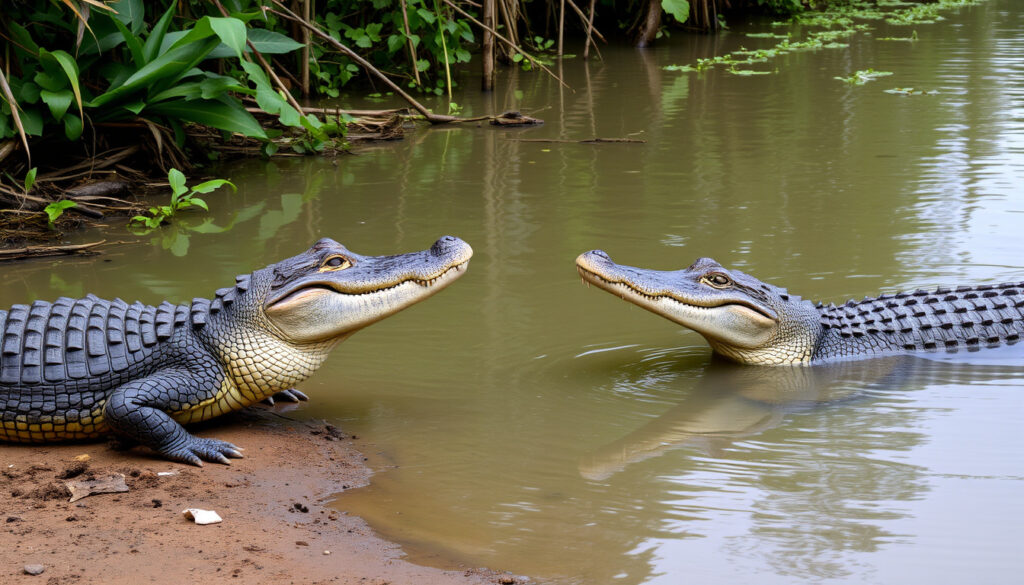
Alligator vs Crocodile: 5 Key Differences Explained
Picture this: you’re walking through a Florida wetland and spot a large reptile half-submerged in the water. Your first question is probably whether it’s an alligator or a crocodile — and the answer matters more than you might think.
Alligator species count: 2 ·
Crocodile species count: 14 ·
Alligator snout shape: U-shaped ·
Crocodile snout shape: V-shaped
Quick snapshot
- Alligators have broad, U-shaped snouts; crocodiles have narrow, V-shaped snouts (PBS Nature educational broadcaster)
- Alligators prefer freshwater; crocodiles favor coastal, brackish, and saltwater habitats (National Park Service federal land management agency)
- Which species is definitively stronger depends on size and species
- Exact hybrid viability has no verified cases, though the theory remains
- PBS updated its comparison explainer in August 2026 (PBS Nature educational broadcaster)
- Check local Florida signage and habitat guides before venturing near waterways
The table below outlines the key contrasts at a glance.
| Feature | Alligator | Crocodile |
|---|---|---|
| Snout shape | Broad U | Narrow V |
| Tooth visibility (mouth closed) | Only upper teeth | Upper and lower teeth |
| Coloration | Dark gray/black | Grayish-green |
| Preferred water | Freshwater | Salt/brackish water |
| Geographic range | SE USA, eastern China | Tropical regions worldwide |
What is the main difference between an alligator and a crocodile?
The most reliable way to tell these reptiles apart is to look at their heads. According to the Florida Fish and Wildlife Conservation Commission state wildlife authority, crocodiles have a narrow tapered snout, while alligators have a broad rounded one. This single feature is the strongest field mark for identification.
Snout shape: U vs. V
- Alligators: broad, rounded snout that forms a U shape (Britannica reference publisher)
- Crocodiles: narrow, pointed snout that forms a V shape (Britannica reference publisher)
Tooth visibility when mouth is closed
When an alligator shuts its mouth, only its upper teeth are visible. Crocodiles, by contrast, show both upper and lower teeth because the fourth tooth on the lower jaw sticks out visibly. The National Park Service federal land management agency notes this as a key distinguishing trait.
Coloration differences
Alligators appear dark gray or black, which helps them blend into murky freshwater. Crocodiles are typically lighter, with a grayish-green hue that suits their coastal environments. SeaWorld wildlife education organization confirms this color distinction.
The implication: if you spot a reptile with a dark, U-shaped snout in a freshwater pond, it’s almost certainly an alligator. A lighter, V-snouted animal near a coastline points to a crocodile.
Which is more dangerous, an alligator or a crocodile?
When comparing danger levels, the answer isn’t about the labels “alligator” and “crocodile” alone — it’s about the species and the circumstances. Saltwater crocodiles, for instance, are widely regarded as the most dangerous crocodile species to humans due to their size, aggression, and habitat overlap with populated coastal areas.
Aggression levels in the wild
- Crocodiles are generally more aggressive and territorial than alligators
- Alligators often flee unless provoked or defending their nest
- Saltwater crocodiles actively patrol their territory and may attack without warning
Fatalities and reported attacks
Alligators in the U.S. cause fewer fatalities than crocodiles globally, though both demand respect. The Florida Fish and Wildlife Conservation Commission state wildlife authority emphasizes that alligator encounters are more common simply because there are more alligators in Florida than crocodiles.
How to react in an encounter
- Back away slowly — never turn your back
- Maintain a safe distance of at least 30 feet
- If attacked, fight back aggressively, aiming for the eyes and snout
What this means: your risk depends less on whether you’re facing an “alligator” or a “crocodile” and more on the species’ size, the animal’s mood, and whether you’re near water. A large saltwater crocodile is a different threat than a smaller American alligator.
Does Florida have crocodiles or alligators?
Florida is the only place in the United States where both American alligators and American crocodiles coexist. The National Park Service federal land management agency confirms that both species live in South Florida, though they occupy different niches.
Alligator populations in Florida
- Alligators are common in freshwater habitats throughout the state, including swamps, lakes, and rivers
- They thrive in the Everglades’ freshwater marshes
American crocodile presence in Florida
American crocodiles are restricted to coastal, brackish, and saltwater areas of South Florida. According to the National Park Service, their range is limited, and they are less commonly seen than alligators.
Where to see each species
- Alligators: freshwater lakes, ponds, and slow-moving rivers
- Crocodiles: coastal areas, mangrove swamps, and canal systems
The pattern: habitat is your second clue. Freshwater points to alligators; saltwater and brackish environments point to crocodiles. If you’re in South Florida and near the coast, you might be looking at either — but inland freshwater almost guarantees an alligator.
Has a crocodile ever mated with an alligator?
Despite the occasional rumor, no verified cases of a crocodile-alligator hybrid exist. According to Britannica reference publisher, the genetic divergence between the two families is too great for successful crossbreeding.
Genetic compatibility
Alligators and crocodiles belong to different families within the order Crocodylia. Their chromosomes and reproductive biology are sufficiently different that viable offspring are not produced in the wild or in captivity.
Documented cases of hybrids
- No verified cases exist in scientific literature
- Reports of “crocodiles” and “alligators” mating are usually misidentifications
Why crossbreeding is unlikely
Even if mating occurred, the genetic distance alone would likely prevent the development of a viable embryo. The UCL Museums Blog academic institution explains that the two groups diverged millions of years ago, making hybridization a practical impossibility.
The takeaway: you won’t see an “alligator-crocodile” hybrid in any zoo or wild habitat. If someone claims otherwise, they’re likely referring to a misidentified animal or a hoax.
Can a human outrun a crocodile or alligator?
Short answer: yes on land, over a straight-line sprint. Both alligators and crocodiles can run at speeds up to 10–12 mph (16–19 km/h) over short distances — but that’s slower than an average adult human’s running speed.
Top speeds of each reptile
- Alligators: up to 10–12 mph (16–19 km/h) in short bursts
- Crocodiles: similar speeds, though the largest species are slower on land
Running on land vs. in water
In water, crocodiles are far faster and more agile than any human. The advantage shifts entirely to the reptile once you’re in the water. On land, you can outrun them in a straight line — but sudden direction changes or trying to climb over obstacles could buy them precious seconds.
Practical escape tips
- Run straight, away from the water
- Don’t try to climb a tree unless it’s a mature tree with sturdy branches
- If you fall, get up immediately and keep moving
Why this matters: if you’re near a waterway and see a crocodile or alligator, the safest move is to back away slowly and give it a wide berth. Sprinting away on land is effective, but the closer you are to the water, the less margin for error.
A Florida visitor who can identify a U-shaped snout and dark coloration is safer — because they know to give freshwater alligators space and to be especially cautious near brackish coastal waters where saltwater crocodiles may lurk.
The word “crocodile” covers 14 species, and “alligator” covers just 2 — so danger assessments based on the label alone are less reliable than those based on the specific species you’re facing.
Confirmed facts vs. what’s still unclear
Confirmed facts
- Snout shape difference: U vs. V, confirmed by PBS Nature educational broadcaster and Britannica reference publisher
- Alligator darker coloration than crocodile, per SeaWorld wildlife education organization
- Habitat preference: alligator freshwater, crocodile salt/brackish, per National Park Service federal land management agency
What’s unclear
- Which species is definitively stronger — depends on size and species
- Exact hybrid viability — no verified cases but theoretical possibility
Quotes from the experts
“Alligators have broad, rounded snouts shaped like a ‘U,’ while crocodiles have narrower, more pointed snouts shaped like a ‘V.'”
— PBS Nature educational broadcaster
“Alligators are dark colored with a broad, rounded snout and are usually found in fresh water. Crocodiles are grayish-green and prefer coastal, brackish and salt water.”
“The first is the shape of the snout. In alligators it’s broad and U-shaped, while in crocodiles it’s narrow and V-shaped. Next are the teeth.”
— Britannica reference publisher
Summary
Knowing the difference between a crocodile and an alligator isn’t just a trivia point — it’s a safety consideration in places like Florida, where both species share the landscape. The field marks are simple: check the snout and the teeth, then look at the water. For a visitor to South Florida, the implication is clear: respect every waterway, keep your distance from any large reptile, and remember that a crocodile near the coast is a different kind of encounter than an alligator in a freshwater pond — one that requires greater caution, or the consequences could be severe.
en.wikipedia.org, discoverwildlife.com, darwynhealth.com, a-z-animals.com, livescience.com, dictionary.com
For a more in-depth look at these reptiles, check out this detailed comparison of alligator and crocodile differences that breaks down six key facts.
Frequently asked questions
How many species of alligators exist?
There are two species: the American alligator and the Chinese alligator.
What is the largest crocodile species?
The saltwater crocodile is the largest living reptile, with males reaching lengths of over 20 feet.
Are alligators faster than crocodiles in water?
Crocodiles are typically faster and more agile in water, particularly saltwater crocodiles.
Do crocodiles live in the United States outside of Florida?
American crocodiles are rare in the U.S. and only found in South Florida; no other crocodile species live in the wild in the U.S.
What do alligators primarily eat?
Alligators are opportunistic carnivores, eating fish, turtles, birds, and mammals that come near the water.
Can alligators survive in saltwater?
Alligators can tolerate saltwater for short periods but prefer freshwater and are not adapted for long-term saltwater life.
Which crocodile species is most dangerous to humans?
The saltwater crocodile is responsible for the most human attacks and deaths worldwide.
Related reading
More related posts
 De Facto Relationship NZ: 3-Year Rule and Property Rights
 How to Clean a Keyboard: Best Methods, Tools, and Safety Tips
 Best Time to Post on Instagram in NZ: 2026 Data Guide
 Fun Facts About New Zealand: 50+ Interesting Facts for Kids
 Decorative Wall Panels NZ: Compare Prices, Types & Where to Buy
 Elon Musk Net Worth 2026: How Rich Is He? [Updated]
 Early Childhood Education NZ: Free ECE, Courses & Salary
 Royal Canin Cat Food: Vet Insights and Cost Analysis