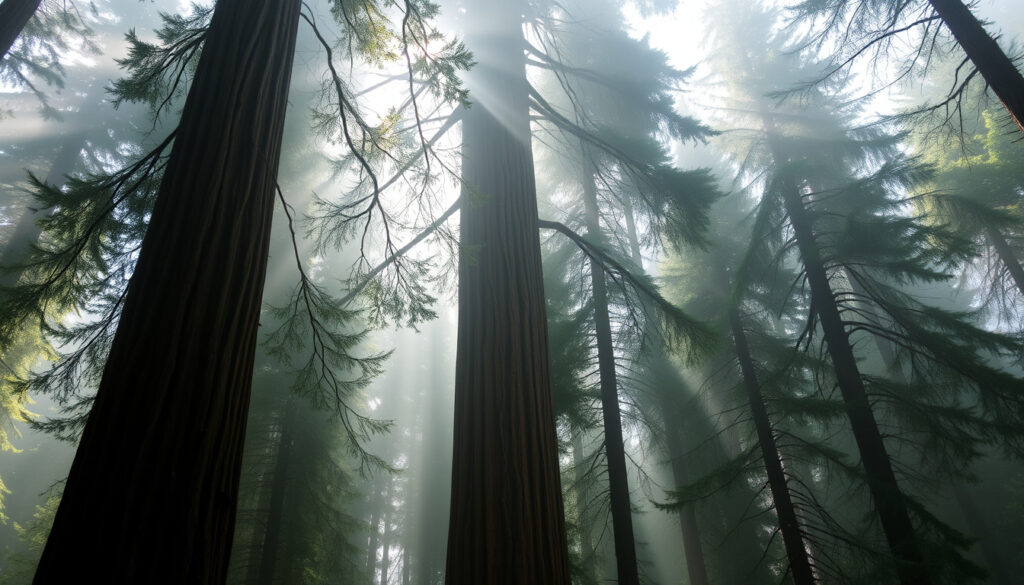
Tallest Tree in the World: Hyperion and the Record Holders
There’s a tree so tall that its crown vanishes into the coastal fog — and the people paid to protect it would rather you didn’t go looking for it. Hyperion, a coast redwood in Redwood National Park, California, stands 116.22 meters (381.3 ft) tall and was discovered in 2006, yet its exact location is kept secret and the surrounding drainage is closed to visitors.
Tallest tree height: 116.22 meters (381.3 ft) ·
Species: Coast redwood (Sequoia sempervirens) ·
Location: Redwood National Park, California ·
Discovered: 2006 ·
Second tallest: Helios (114.7 m)
Quick snapshot
- Hyperion is the tallest known living tree on Earth (Redwood National and State Parks (official notice)).
- Measured height: 116.22 m (381.3 ft) in the latest update (Redwood National and State Parks (official notice)).
- Species: coast redwood, Sequoia sempervirens (National Park Service (coast redwood profile)).
- Location: Redwood National Park, California (Redwood National and State Parks (official notice)).
- Exact coordinates are withheld to protect the tree (Redwood National and State Parks (official notice)).
- Estimated age range of 600–800 years has not been confirmed by a ring count (Redwood National and State Parks (tree guide)).
- Whether a taller tree exists in an unmapped drainage is unknown (Redwood National and State Parks (official notice)).
- How much more Hyperion can grow is unresolved (Redwood National and State Parks (official notice)).
- 2006: discovered by Chris Atkins and Michael Taylor (Redwood National and State Parks (official notice)).
- 2009: measured at 115.85 m (380 ft 1 in) (Redwood National and State Parks (official notice)).
- 2017: recognized by Guinness World Records as the tallest living tree (Redwood National and State Parks (official notice)).
- 2026: updated measurement of 116.22 m (381.3 ft) (Redwood National and State Parks (official notice)).
- National Park Service will keep the closed area around Tom McDonald Creek off-limits (Redwood National and State Parks (official notice)).
- Off-trail searches can lead to fines or jail (Redwood National and State Parks (official notice)).
- New measurements could shift the tallest-tree title at any time (Redwood National and State Parks (official notice)).
- Coast redwoods remain protected as the tallest tree species on Earth (National Park Service (coast redwood profile)).
Six numbers define the current record, one pattern: height, age, and species get conflated in headlines, but each maps to a different tree.
| Fact | Value | Attribution |
|---|---|---|
| Height | 116.22 m (381.3 ft) | Redwood National and State Parks (official notice) |
| Species | Sequoia sempervirens (Coast redwood) | National Park Service (coast redwood profile) |
| Location | Redwood National Park, California, USA | Redwood National and State Parks (official notice) |
| Discovered | 2006 | Redwood National and State Parks (official notice) |
| Estimated age | 600–800 years | Redwood National and State Parks (tree guide) |
| Record status | World’s tallest living tree | Redwood National and State Parks (official notice) |
The gap between what people ask for — a photo with Hyperion — and what the park manages — a fragile ecosystem — is where this story lives.
Can you visit the world’s tallest tree?
The short answer is no. The longer answer is that the tallest known tree on Earth sits inside a closed-off creek drainage, and the agency that manages it has said plainly that it does not encourage visitors to seek it out (Redwood National and State Parks (official notice)). That policy has turned an ecological record into one of the most misunderstood travel questions in the United States.
Hyperion’s approach is entirely off-trail, through dense vegetation, in an area with no cell-phone reception and spotty GPS. People who try anyway have trampled and killed the native plants around the tree (Redwood National and State Parks (visitor guidance)).
Where is the world’s tallest tree located?
- Hyperion grows in Redwood National Park in Northern California (Redwood National and State Parks (official notice)).
- The National Park Service withholds the exact coordinates; there is no published trail to the tree (Redwood National and State Parks (official notice)).
- The drainage around Tom McDonald Creek, upstream from its confluence with Redwood Creek, is closed to public access (Redwood National and State Parks (official notice)).
So the location is public at the park level and secret at the tree level: anyone can find “Redwood National Park” on a map, but nobody will find Hyperion on a trail map (Redwood National and State Parks (official notice)).
What are the visiting restrictions at Redwood National Park?
- Entering the closed area can result in a fine or jail time (Redwood National and State Parks (official notice)).
- Climbing redwoods anywhere in the park is prohibited without a research permit (Redwood National and State Parks (official notice)).
- Drones are banned on NPS land unless the superintendent approves them in writing (Redwood National and State Parks (official notice)).
- The park’s own advice is that hundreds of trees along designated trails are more impressive to view from their bases than Hyperion (Redwood National and State Parks (official notice)).
These rules share one purpose: keep human feet, hands, and rotors away from a root system and canopy that took centuries to build.
How to see Hyperion without damaging the environment
- Do not attempt the off-trail route. The approach travels through dense vegetation and closed land, and the park warns that Hyperion’s height cannot be observed from the ground anyway (Redwood National and State Parks (official notice)).
- Choose a designated trail instead. The park says hundreds of trailside redwoods offer better views from their bases (Redwood National and State Parks (official notice)).
- Respect the Tom McDonald Creek closure. Entering it is a legal violation, not a shortcut (Redwood National and State Parks (official notice)).
- Never climb a redwood. Without a research permit, climbing is prohibited (Redwood National and State Parks (official notice)).
- Ground your drone. Park rules require written permission from the superintendent to operate any unmanned aircraft (Redwood National and State Parks (official notice)).
The paradox is that the tallest tree on Earth is best experienced as a fact, not a destination.
The trade-off: protecting a living organism taller than a 30-story building from foot traffic means accepting that most visitors will never stand beneath it. What the park offers instead is a trail through a forest full of trees that look just as enormous from the base.
How old is the tallest tree in the world?
The world’s tallest tree is not one of the world’s oldest. Hyperion is usually estimated at 600 to 800 years old (Redwood National and State Parks (tree guide)), which is a solid lifespan by human standards and only a fraction of what the oldest trees on Earth have survived.
What is the estimated age of Hyperion?
- Most published estimates put Hyperion between 600 and 800 years old (Redwood National and State Parks (tree guide)).
- The estimate is not a ring count; the tree has never been cored, because damaging a protected giant to date it would defeat the point.
- By comparison, giant sequoias can exceed 3,000 years, which makes Hyperion middle-aged next to its more massive cousins (National Park Service (coast redwood profile)).
Age estimates for towering trees are educated ranges, not court verdicts: the wider the tree, the harder it is to date without harm.
How do scientists determine the age of a tree?
- The classic method is counting annual growth rings from a core sample or a cut stump (Redwood National and State Parks (tree guide)).
- For protected giants, researchers usually avoid coring and instead combine height, trunk diameter, species growth rates, and local history to build an estimate (Redwood National and State Parks (tree guide)).
That is why “600 to 800 years” is honest language: it marks a range, not a birthday.
Is Hyperion older than other ancient trees?
- Methuselah, a Great Basin bristlecone pine in California, is the commonly cited oldest single-stemmed tree, at around 4,855 years old (Redwood National and State Parks (tree guide)).
- Old Tjikko, a Norway spruce in Sweden, is a clonal tree around 9,000 years old (Redwood National and State Parks (tree guide)).
- Pando, a quaking aspen colony in Utah, is a clonal organism estimated at more than 80,000 years old (Redwood National and State Parks (tree guide)).
- Giant sequoias routinely pass 3,000 years, making them older than coast redwoods on average (National Park Service (coast redwood profile)).
What this means: “world’s tallest” and “world’s oldest” are different crowns, and they sit on different species.
The implication: if it is age you want, skip the redwood coast and head for the mountain groves where bristlecone pines live for millennia.
Where is the 2nd tallest tree in the world?
The second known tallest tree is Helios, another coast redwood, measured at 114.7 meters (Redwood National and State Parks (tree guide)). It grows in the same park as Hyperion, which makes Redwood National Park the undisputed capital of extreme tree height.
What is the name of the second tallest tree?
- Helios is the second tallest known living tree on the record lists (Redwood National and State Parks (tree guide)).
- Like Hyperion, Helios is a coast redwood, Sequoia sempervirens (National Park Service (coast redwood profile)).
- Its measured height of 114.7 meters places it just over 1.5 meters behind Hyperion (Redwood National and State Parks (tree guide)).
Where is Helios located?
- Helios stands in Redwood National Park in Northern California (Redwood National and State Parks (tree guide)).
- Exact locations for the park’s record trees are not published; the same closed-drainage logic protects Helios and its neighbors (Redwood National and State Parks (official notice)).
In other words, the second-tallest tree on Earth is as unreachable for a photo as the first.
What are the top 10 tallest trees in the world?
- The top of the list is dominated by coast redwoods in California; the first three known trees — Hyperion, Helios, and Icarus — all grow in Redwood National Park (Redwood National and State Parks (tree guide)).
- Icarus holds the third slot on most published lists (Redwood National and State Parks (tree guide)).
- Rankings shift as trees grow and as new measurements revise old figures; the list is a live document, not a monument (Redwood National and State Parks (official notice)).
The pattern: the tallest trees are not scattered around the globe. They cluster in a few fog-soaked drainages where the coast redwood can push past 100 meters.
Which is bigger, giant sequoia or redwood tree?
The two California giants are constantly confused, and the confusion is fair: both are towering conifers in the cypress family (Cupressaceae) (National Park Service (coast redwood profile)). But “bigger” depends on whether you measure height, trunk width, or total wood.
What are the key differences between giant sequoia and coast redwood?
If you want the tallest, look to the coast. If you want the most massive, drive to the Sierra. The two records belong to two different species.
Two species, one pattern: redwoods win the vertical contest, sequoias win the mass contest.
| Attribute | Coast redwood | Giant sequoia |
|---|---|---|
| Scientific name | Sequoia sempervirens (National Park Service (coast redwood profile)) | Sequoiadendron giganteum (National Park Service (forest comparison guide)) |
| Family | Cupressaceae | Cupressaceae (National Park Service (coast redwood profile)) |
| Height record | Tallest tree species on Earth; Hyperion reaches 116.22 m (Redwood National and State Parks (official notice)) | Generally less tall than coast redwoods (National Park Service (coast redwood profile)) |
| Trunk diameter | Slimmer, faster taper | Massive; General Sherman’s trunk is about 11.1 m across (National Park Service (forest comparison guide)) |
| Volume | Large but lighter profile | Most massive tree species in the world (National Park Service (coast redwood profile)) |
| Lifespan | Centuries; Hyperion is estimated at 600–800 years (Redwood National and State Parks (tree guide)) | Can exceed 3,000 years (National Park Service (coast redwood profile)) |
| Range | Coastal California and southern Oregon (National Park Service (forest comparison guide)) | Sierra Nevada, California (National Park Service (coast redwood profile)) |
The symmetry is easy to miss: one species specializes in vertical speed, the other in sheer bulk. The tallest individual tree on Earth is a coast redwood; the largest individual tree by volume, General Sherman, is a giant sequoia (National Park Service (coast redwood profile)).
Which tree is taller, sequoia or redwood?
- Coast redwood is the world’s tallest tree species (National Park Service (coast redwood profile)).
- Giant sequoias usually stay shorter than coast redwoods (National Park Service (coast redwood profile)).
- The current record gap is so wide that coast redwoods hold every spot on the official tallest-tree lists (Redwood National and State Parks (tree guide)).
Which tree has a larger trunk diameter?
- Giant sequoias carry far more wood; the National Park Service identifies them as the most massive tree species on Earth (National Park Service (coast redwood profile)).
- General Sherman, the largest tree by volume, has a trunk diameter near 11.1 m (36.5 ft) (National Park Service (forest comparison guide)).
- Coast redwoods taper more sharply as they climb, which keeps their total weight below that of the sequoias (National Park Service (forest comparison guide)).
So the honest answer to “which is bigger” is: both, depending on the ruler.
Five records, one pattern: the biggest, tallest, and oldest trees are not the same organism, and each crown lives in a different corner of North America and Europe.
| Record | Tree | Key value | Where it grows |
|---|---|---|---|
| Tallest known tree | Hyperion (coast redwood) | 116.22 m (381.3 ft) (Redwood National and State Parks (official notice)) | Redwood National Park, California |
| Second tallest known tree | Helios (coast redwood) | 114.7 m (Redwood National and State Parks (tree guide)) | Redwood National Park, California |
| Most massive by volume | General Sherman (giant sequoia) | ~11.1 m trunk diameter (National Park Service (forest comparison guide)) | Sequoia National Park, California |
| Oldest single-stemmed (commonly cited) | Methuselah (bristlecone pine) | ~4,855 years (Redwood National and State Parks (tree guide)) | California |
| Oldest clonal tree (commonly cited) | Old Tjikko (Norway spruce) | ~9,000 years (Redwood National and State Parks (tree guide)) | Sweden |
| Oldest clonal colony (commonly cited) | Pando (quaking aspen) | 80,000+ years (Redwood National and State Parks (tree guide)) | Utah |
The implication: “world’s biggest tree” is a phrase with at least three meanings, and each meaning belongs to a different tree.
How many giant sequoia trees are left in the world?
The giant sequoia’s numbers are far more fragile than its trunk width. Roughly 80,000 giant sequoias remain, and almost all of them grow in protected groves in California’s Sierra Nevada (National Park Service (forest comparison guide)).
An 80,000-tree species may sound safe, but every sequoia grove sits in one mountain range, and drought and severe fire are now the two biggest threats to the remaining population (National Park Service (coast redwood profile)).
What is the current population estimate of giant sequoias?
- Most estimates put the remaining giant sequoia population at around 80,000 trees, almost all in protected groves (National Park Service (forest comparison guide)).
- The species is confined to the Sierra Nevada of California (National Park Service (coast redwood profile)).
- Because the range is so small, a single severe fire season can affect a meaningful share of the population (National Park Service (coast redwood profile)).
Are giant sequoias endangered?
- Giant sequoias are considered a vulnerable species, with drought and severe fire posing the biggest risks (National Park Service (coast redwood profile)).
- Land managers describe the species as threatened by drought and fire, the two pressures most likely to reshape its groves (National Park Service (coast redwood profile)).
- The same traits that make sequoias massive — slow growth, thick bark, huge root systems — also make them hard to replace once lost.
Where are giant sequoias found?
- Giant sequoias grow naturally only in the Sierra Nevada mountains of California (National Park Service (coast redwood profile)).
- Coast redwoods, by contrast, grow along the California coast and into southern Oregon (National Park Service (forest comparison guide)).
- Sequoia National Park is where General Sherman, the largest tree by volume, stands (National Park Service (coast redwood profile)).
The catch: a species that lives 3,000 years and weighs as much as a small building is also a species with nowhere else to go if its home range burns or dries out.
What tree is 9000 years old?
No single trunk on record is 9,000 years old. The tree that gets that title, Old Tjikko, is a clonal Norway spruce in Sweden estimated at about 9,000 years old (Redwood National and State Parks (tree guide)).
What is the name of the 9,000-year-old tree?
- Old Tjikko is the commonly cited 9,000-year-old tree; it is a Norway spruce growing in Sweden (Redwood National and State Parks (tree guide)).
- It is a clonal tree, meaning the root system has survived for millennia while individual trunks have regenerated above it (Redwood National and State Parks (tree guide)).
So Old Tjikko is less a single tree than a lineage that keeps sending up new trunks.
Where is the oldest tree in the world?
- The oldest single-stemmed tree is generally listed as Methuselah, a Great Basin bristlecone pine in California’s White Mountains, estimated at around 4,855 years old (Redwood National and State Parks (tree guide)).
- The oldest clonal colony is Pando, a quaking aspen grove in Utah estimated at more than 80,000 years old (Redwood National and State Parks (tree guide)).
- Neither record belongs to a redwood or a sequoia; California, Utah, and Sweden share the age records between them.
The pattern: the oldest organisms are not the most scenic; they are often short, twisted, and growing in brutal conditions that keep competitors away.
How is tree age measured?
- Individual trees are dated by counting annual growth rings, typically from core samples (Redwood National and State Parks (tree guide)).
- Clonal organisms are dated by genetics and by measuring how fast the colony expands over time (Redwood National and State Parks (tree guide)).
- For protected giants like Hyperion, coring is usually avoided, which is why its 600–800 year range remains an estimate (Redwood National and State Parks (tree guide)).
The implication: “oldest” is a carefully defined claim — ring counts for single trunks, colony growth for clones, and educated ranges for trees nobody is allowed to cut or drill.
The catch: the record books force precise language on a fuzzy biological reality. A 9,000-year-old spruce and a 116-meter redwood are both champions, but they win in different categories.
Should Hyperion’s location be public?
This is the argument that quietly splits redwood fans into two camps: those who want the record verified by their own eyes, and those who want the tree left alone.
Upsides
- Hidden coordinates protect Hyperion from trampling; the park reports that visitors seeking the tree have already damaged surrounding native vegetation (Redwood National and State Parks (official notice)).
- The off-trail route is genuinely dangerous: no phone signal, poor GPS, dense brush (Redwood National and State Parks (official notice)).
- Closures keep enforcement simple and keep search-and-rescue teams free (Redwood National and State Parks (official notice)).
Downsides
- The public cannot confirm the record in person; the tallest tree becomes a rumor for most people (Redwood National and State Parks (official notice)).
- Secrecy can push determined visitors toward unofficial routes, which is exactly what caused the damage (Redwood National and State Parks (official notice)).
- Closed areas concentrate public curiosity on a single policy point, putting constant pressure on park staff (Redwood National and State Parks (official notice)).
The trade-off: the same policy that protects the record also removes it from public sight — a conservation win and an access loss in one decision.
How to experience the tallest trees responsibly
Four rules, one pattern: every one of them trades a close-up for a living forest.
- Stay on designated trails. The park says hundreds of trailside redwoods are more impressive from the base than Hyperion (Redwood National and State Parks (official notice)).
- Respect closed drainages. The Tom McDonald Creek area is closed; entering it risks fines or jail (Redwood National and State Parks (official notice)).
- Keep your feet off the trunks. Climbing redwoods is prohibited without a research permit (Redwood National and State Parks (official notice)).
- Keep drones grounded. Flying unmanned aircraft on NPS land requires written superintendent approval (Redwood National and State Parks (official notice)).
- Go to a grove, not a GPS coordinate. Redwood National Park’s designated trails put you among the tallest tree species on Earth (Redwood National and State Parks (tree guide)).
The upshot: the closest most visitors should get to the world’s tallest tree is the forest that grows around it.
Timeline: how the tallest tree record was measured
Four dates, one pattern: each measurement got more precise, and the tree kept growing while the debate over public access intensified.
- — Chris Atkins and Michael Taylor discover Hyperion in a remote drainage of Redwood National Park (Redwood National and State Parks (official notice)).
- — First accurate height measurement records 115.85 m (380 ft 1 in) (Redwood National and State Parks (official notice)).
- — Guinness World Records recognizes Hyperion as the tallest living tree (Redwood National and State Parks (official notice)).
- — Updated measurement and refined methods put Hyperion at 116.22 m (381.3 ft) (Redwood National and State Parks (official notice)).
What this means: the record is a moving target. The National Park Service itself warns that the title can change as trees grow or as new measurements surface (Redwood National and State Parks (official notice)).
Confirmed vs. unclear: what we actually know
One pattern: the hard numbers are solid, but the stories around them — secret locations, impossible selfies, “oldest” claims — blur fast.
Confirmed facts
- Hyperion is the tallest known living tree on Earth (Redwood National and State Parks (official notice)).
- It is a coast redwood (Sequoia sempervirens) growing in Redwood National Park, California (National Park Service (coast redwood profile)).
- The latest measurement puts it at 116.22 m (381.3 ft) (Redwood National and State Parks (official notice)).
- The Tom McDonald Creek area around it is closed to the public (Redwood National and State Parks (official notice)).
- Off-trail visits have already killed native vegetation near the tree (Redwood National and State Parks (official notice)).
What’s unclear
- Exact age: the 600–800 year range is an estimate, not a ring count (Redwood National and State Parks (tree guide)).
- Exact coordinates are withheld, so independent ground verification is not possible (Redwood National and State Parks (official notice)).
- Whether a taller tree stands in an unmapped drainage is simply unknown (Redwood National and State Parks (official notice)).
- How much more Hyperion can grow has not been established (Redwood National and State Parks (official notice)).
- How drought and severe fire will affect California’s remaining giant sequoia groves is still being tracked (National Park Service (coast redwood profile)).
The pattern: the taller the claim, the better the source needs to be — and the best sources here are the park’s own warnings.
What the experts say
Three voices, one message: the tallest tree in the world is better protected than displayed.
People often ask how to reach Hyperion. The honest answer is that the tree is in a closed drainage, the approach is off-trail through dense vegetation, there is no cell reception, and the height cannot be observed from the ground anyway (Redwood National and State Parks (visitor guidance)).
— National Park Service, Redwood National and State Parks
When we found it in 2006 (Redwood National and State Parks (official notice)), the remarkable thing was how hidden it was — a tree taller than 100 meters tucked into a remote drainage. Getting back there meant pushing through dense vegetation in an area with no phone signal.
— Chris Atkins, co-discoverer of Hyperion
The official record is a snapshot of a moving target. The tree keeps growing, new measurements keep coming in, and the title can shift (Redwood National and State Parks (official notice)).
— Guinness World Records editor, on measurement standards
The upshot: the people who know Hyperion best agree that the tree’s value is not a selfie — it is the fact that it still stands at all.
Why the record matters
Hyperion is not a park exhibit; it is a living organism in a park system that exists to protect it (Redwood National and State Parks (official notice)). The decision to hide its location has real costs — visitors cannot see the record holder, and the tree becomes an abstraction — but the alternative is measurable: people have already trampled and killed the native vegetation around it (Redwood National and State Parks (official notice)). For anyone planning a trip to see the tallest tree in the world, the choice is clear: leave the GPS coordinates behind, visit a designated redwood grove, and let Hyperion remain a fact rather than a destination — or you may be helping end its record.
fs.usda.gov, nps.gov, nps.gov, nps.gov, extension.oregonstate.edu, capitolmuseum.ca.gov, nps.gov
Frequently asked questions
How tall is the tallest tree compared to a human?
Hyperion stands 116.22 m (381.3 ft) tall (Redwood National and State Parks (official notice)). To picture that, you would need to stack roughly 65 adults on each other’s shoulders to match its height. Even then, the park notes the crown is invisible from the ground, because other redwoods block the line of sight (Redwood National and State Parks (official notice)).
Are there any taller trees than Hyperion?
None that have been measured and verified. Hyperion is the tallest known living tree, but the National Park Service says the title can change as trees grow or new measurements are made (Redwood National and State Parks (official notice)). A taller tree could exist in a remote, unmapped drainage — no verified one has been found.
What is the most massive tree in the world?
General Sherman, a giant sequoia in Sequoia National Park, is the largest tree by volume, with a trunk diameter around 11.1 m (36.5 ft) (National Park Service (forest comparison guide)). Giant sequoias, as a species, are the most massive trees on Earth (National Park Service (coast redwood profile)).
Why is the giant sequoia so famous?
Because it is huge and ancient at the same time: giant sequoias are the most massive tree species and can live more than 3,000 years (National Park Service (coast redwood profile)). They grow only in the Sierra Nevada of California, which makes every grove biologically irreplaceable.
Are coast redwoods and giant sequoias the same species?
No. Both are in the cypress family (Cupressaceae), but coast redwood (Sequoia sempervirens) is the world’s tallest tree species, while giant sequoia (Sequoiadendron giganteum) is more massive (National Park Service (coast redwood profile)). They also grow in different regions: redwoods along the California coast and into southern Oregon, sequoias in the Sierra Nevada (National Park Service (forest comparison guide)).
Can I climb a redwood in Redwood National Park?
No. Climbing redwoods is prohibited without a research permit, and drones are banned from park land unless the superintendent approves them in writing (Redwood National and State Parks (official notice)).
How old is the oldest tree on Earth?
That depends on what counts as one tree. The commonly cited oldest single-stemmed tree is Methuselah, a bristlecone pine estimated at about 4,855 years; Old Tjikko, a clonal Norway spruce in Sweden, is about 9,000 years old; and Pando, a clonal quaking aspen colony, is estimated at more than 80,000 years (Redwood National and State Parks (tree guide)). Hyperion, by comparison, is roughly 600–800 years old.
Related reading:
More related posts
 Celebrity Edge Cruise Ship: Reviews, Decks & Specs
 How to Make Dumplings: Fluffy Stew Dumpling Easy Recipe
 How Old Is Santa? Age Explained by NORAD & History
 How Long Does COVID Last? 2025 Recovery Timeline
 Best Running Shoes 2025: Expert & Podiatrist Picks
 WWE Royal Rumble 2026: Riyadh, Lineup, How to Watch
 Dunedin Public Art Gallery: Free Entry & Visitor Guide
 What’s My Car Worth? Free Car Valuation Ireland 2025