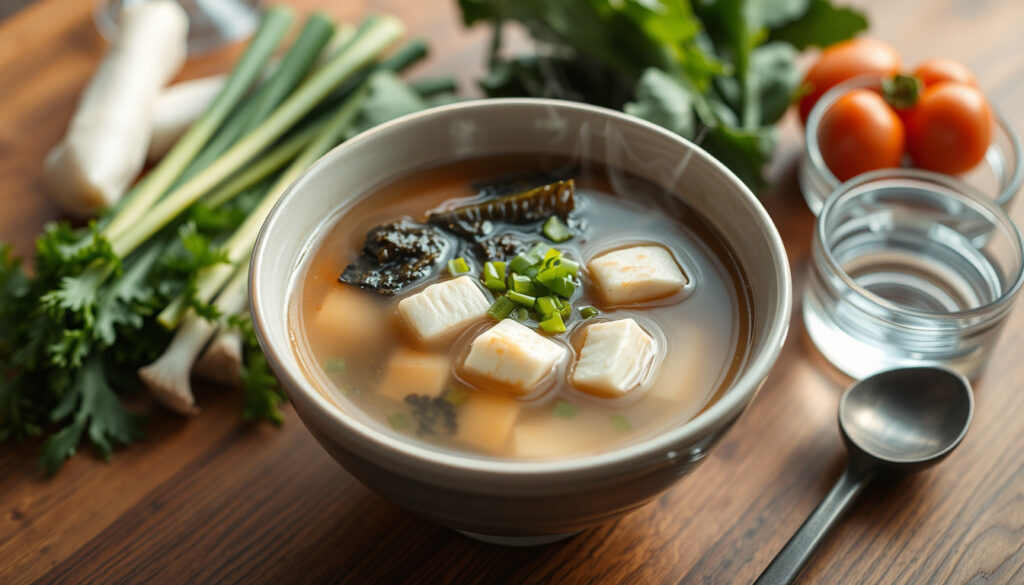
Is Miso Soup Good for You? Benefits, Risks, and Nutrition
There’s a reason miso soup shows up in Japanese kitchens more often than coffee does in Western ones — it’s cheap, warm, and quietly satisfying. Yet a single cup can carry anywhere from about 600 to more than 1,100 mg of sodium, because nutrition varies substantially with the miso type and ingredients, notes Health (nutrition and wellness outlet).
Calories per serving (1 cup): 40–50 kcal for a light bowl · Sodium per serving: 600–800 mg light, up to 1,140 mg with tofu and onion · Fermentation time: a few days to 3 years · Probiotic strains: Lactobacillus, Bifidobacterium (live strains vary by product)
Quick snapshot
- Miso is a fermented soybean paste traditionally made with koji and salt (Food Science & Nutrition (peer-reviewed food science journal)).
- Some studies associate habitual miso consumption with lower cardiovascular risk, but the evidence does not prove that miso soup independently prevents heart disease (Environmental Health and Preventive Medicine (peer-reviewed public health journal)).
- Fermentation ranges from a few days to 3 years, and salt is essential to the process (Food Science & Nutrition, cited above).
- A review in the National Library of Medicine reports associations between miso soup intake and reduced hypertension risk and improved glycemic control — promising, but not yet proof of cause and effect (National Library of Medicine / PMC (biomedical research archive)).
The numbers move with the recipe — six reference points, one pattern: the sodium is the number to budget for.
| Label | Value |
|---|---|
| Serving size | 1 cup (240 ml) |
| Calories and protein | About 60 kcal and 5 g protein in a bowl with miso, tofu, broth, and onions; lighter bowls land lower (WebMD (clinical health reference)) |
| Sodium | 600–1,140 mg depending on recipe; a full bowl can approach half of the 2,300 mg U.S. daily sodium limit (WebMD, cited above) |
| Fermentation time | A few days to 3 years, depending on the variety (Food Science & Nutrition, cited above) |
| Probiotic content | Varies by miso type, product, and preparation; a fermented label does not equal a clinically proven probiotic (NIH Office of Dietary Supplements (federal supplement authority)) |
| Common additions | Tofu, seaweed, green onion, and dashi — which also change the nutrition profile |
Is it okay to drink miso soup every day?
How much sodium is in a typical serving?
- The nutrition table above sets the baseline: a full bowl with miso, tofu, broth, and onions lands at roughly 60 calories, 5 g protein, and about 1,140 mg sodium — close to half of the 2,300 mg U.S. daily sodium limit.
- A serving of miso soup typically contains 1–2 g of salt, because salt is essential to miso’s fermentation and preservation (Environmental Health and Preventive Medicine, cited above).
For most healthy adults, that math is workable as long as the rest of the day doesn’t add a second bowl, a salty snack, and a processed dinner. The problem is that sodium accumulates faster than people expect.
For people with high blood pressure or a sodium-restricted diet, the daily-bowl habit is the riskiest version of the dish: high sodium intake is a known driver of higher blood pressure and cardiovascular risk (WebMD, cited above).
Who should not eat miso paste?
- People with hypertension or a sodium-restricted diet should treat miso as a counted serving, not an unlimited side.
- Anyone with a soy allergy should avoid miso, since it is a soybean product.
- People with celiac disease or gluten sensitivity need to check the label: barley miso contains gluten.
- Those managing thyroid conditions should discuss soy isoflavones with a clinician, since isoflavones are biologically active phytoestrogens.
The thyroid point deserves context: isoflavones are not a reason to panic. They are a reason to be consistent about portion sizes and to flag miso during a medication review if you have a hormone-sensitive condition.
What are the risks of eating miso daily?
- Cumulative sodium is the main risk: multiple servings plus a typical Western diet can push daily intake well past the 2,300 mg benchmark.
- Not every fermented food is a clinically proven probiotic: live strains, identity, and viability vary by product and preparation (NIH Office of Dietary Supplements, cited above).
- Heating soup can reduce live cultures, so assuming every hot bowl is a probiotic shot overstates the science.
For someone with hypertension, finishing a full miso bowl has already consumed a large share of the 2,300 mg daily sodium allowance — before the rest of the day’s meals add a single gram.
What are the pros and cons of miso soup?
Health benefits of miso soup
- Miso contains isoflavones, biologically active phytoestrogens that have been studied for their effects on hormones and chronic disease (National Library of Medicine / PMC, cited above).
- Fermented soy intake has been associated with improved insulin sensitivity and a lower prevalence of some metabolic conditions — an association that does not by itself prove causation (National Library of Medicine / PMC, cited above).
- Tofu and miso together contribute plant protein; the nutrition table above shows 2–5 g per bowl.
- Fermentation changes soy compounds and can make them gentler, which is why miso has traditionally been paired with rice and vegetables.
The last point is where the science gets cautious: fermentation can alter compounds and digestibility, but human evidence for specific digestive benefits from miso soup is still limited.
Potential drawbacks
- Sodium is the main drawback: a bowl can carry 1–2 g of salt, which can dominate the meal for a sodium-sensitive person.
- Fermented labels are not probiotic guarantees: live cultures vary by product, and hot soup can reduce viability.
- Barley miso contains gluten; people with gluten sensitivity need a rice-based or soybean-based miso.
- Soy isoflavones are biologically active, so people with hormone-sensitive conditions should keep portions reasonable and discuss miso with their clinician.
Nutritional profile
- Calories: roughly 40–60 per bowl, depending on ingredients.
- Protein: 2–5 g, mostly from tofu and miso.
- Sodium: 600–1,140 mg, depending on the recipe and the amount of miso paste.
- Fermentation: a few days to 3 years, which changes flavor, saltiness, and live-culture content.
The pattern is consistent: miso’s nutritional value is real but modest, while its sodium is the most measurable part of the profile.
Upsides
- Low-calorie and satisfying — a warm way to add flavor without much energy.
- Plant protein from tofu and miso, plus B vitamins and vitamin K in a typical bowl.
- Fermented food with biologically active isoflavones and fermentation-derived compounds.
- Fast and inexpensive to prepare at home.
Downsides
- Sodium-heavy: 600–1,140 mg per bowl depending on the recipe.
- Not a clinically proven probiotic food in most products, as the NIH fact sheet above notes.
- Barley miso is not gluten-free.
- Instant packets and heavy toppings can inflate both calories and salt.
The implication: the choice to eat miso daily depends on your health profile and how the rest of your diet balances the sodium load.
Is miso soup good for weight loss?
Calorie content
- A full bowl with tofu and onion is about 60 calories; a lighter broth-only version lands closer to 40–50 calories.
- Most of the calories come from tofu and miso paste, not the broth.
By calorie standard, miso soup is an unusually cheap food: it sits in the same range as a cup of tea with milk, but with protein and salt.
How miso soup aids weight loss
- The protein and fiber in a bowl come mostly from tofu, seaweed, and vegetables — the same foods that create satiety.
- Starting a meal with a warm bowl can slow down eating and make a smaller main course feel complete.
- There is no evidence that miso soup alone produces meaningful weight loss.
That last line is the one to remember. Miso soup is a useful weight-loss support food because it replaces higher-calorie starters and snacks, not because it burns fat.
For someone counting calories, a 40–60 kcal bowl adds flavor, liquid, and protein for almost no energy — but it can’t rescue a day that’s already over budget on sodium.
Incorporating miso soup into a weight loss diet
- Use one teaspoon to one tablespoon of miso paste per cup, depending on the brand and your salt tolerance.
- Bulk the bowl with cabbage, mushrooms, or spinach instead of extra paste.
- Skip instant packets with added sugar, MSG, and fried toppings.
This is the part that matters in the kitchen: miso soup is as healthy as the ingredients you add. Tofu is a common addition, and if you’ve ever wondered what tofu is actually made from, our explainer on what tofu is made out of walks through the process.
Why do Japanese eat so much miso soup?
Historical context
- Miso is a fermented soybean paste traditionally made with koji and salt — a technique passed down through generations in Japan.
- Miso soup grew from a preservation method into a daily comfort food rather than a special occasion dish.
In Japan, miso soup is not an exotic side dish; it is the breakfast default, served alongside rice and pickled vegetables.
Nutritional reasons
- A typical Japanese breakfast bowl provides hydration, plant protein, and fermented compounds in a single warm course.
- Fermented soy products such as miso can provide peptides, enzymes, minerals, and other fermentation-derived compounds.
- Reviews archived at the National Library of Medicine report associations between miso soup intake and lower hypertension risk and improved glycemic control, as the snapshot above notes.
The nutritional signal is about the whole meal pattern, not just the paste: rice, fish, vegetables, and a fermented starter create a balanced plate that Western breakfasts often lack.
Cultural habits
- Miso soup is eaten daily by many Japanese families, often at breakfast, because it is fast, affordable, and warming.
- The bowl is typically drunk directly from the rim; chopsticks are used for the solid ingredients.
- The habit pairs a fermented food with rice, fish, and vegetables — a pattern nutrition researchers often describe as balanced.
That cultural context is why “is miso soup good for you?” is the wrong question in Japan. The better question is whether a fermented, salty starter fits into the meals you already eat.
The pattern: miso soup works in Japan because it appears inside a meal that is mostly whole foods and modest portions. Transplanted to a diet of processed meals, the same bowl becomes a side note rather than a solution.
Which miso is better for you, red or white?
Differences between red and white miso
- White (shiro) miso is fermented for a shorter time, so it is milder and slightly sweet.
- Red (aka) miso is fermented longer, producing a deeper, more pungent flavor.
- Longer fermentation generally means more salt per serving, because salt drives the aging process.
Nutritional comparison
- Nutrition varies substantially with miso type, quantity used, broth, and additional ingredients — the same recipe can change character completely with a different paste.
- Both white and red miso are fermented soybean pastes, so both carry isoflavones and fermentation byproducts.
Two miso pastes, one pattern: the longer-fermented red variety is generally the saltier one, and the exact numbers depend on the type and the amount you use (Health, cited above).
| Attribute | White (shiro) miso | Red (aka) miso |
|---|---|---|
| Fermentation | Shorter — a few days to weeks | Longer — months to a few years |
| Flavor | Milder, slightly sweet | Robust, pungent, saltier |
| Sodium | Generally lower per serving | Generally higher per serving |
| Best for | Light soups, dressings, quick sauces | Hearty stocks and braises |
Which is healthier?
For most people, the healthier miso is the one they can measure consistently — white miso’s lower sodium is an advantage if it means a reasonable portion. For flavor-driven cooking, red miso brings more depth for less paste, which can balance its higher salt content. For sodium-sensitive eaters, white miso in a small amount is the safer default.
There is no absolute winner. There is only a sodium trade-off, and the right answer depends on your blood pressure, your portion control, and what else is on the plate. The catch: miso often gets marketed as a health food, but the real variable is salt per spoonful. Choose a variety you enjoy, then measure it — the label and your blood pressure will both be honest with you.
Two lists summarize how much of the miso story is settled and how much is still open.
Confirmed facts
- Miso is a fermented soybean paste made with koji and salt (Food Science & Nutrition, cited above).
- Miso contains sodium because salt is essential to its fermentation and preservation (Environmental Health and Preventive Medicine, cited above).
- Miso contains isoflavones, which are biologically active phytoestrogens (National Library of Medicine / PMC, cited above).
What’s unclear
- Whether miso’s association with lower cardiovascular risk is a causal effect remains unresolved.
- Whether the isoflavones in miso meaningfully change cancer risk is still debated.
- What daily amount of miso can deliver benefits without pushing sodium past safe limits is not established.
- Whether miso soup by itself produces meaningful weight loss is not proven.
- Whether live cultures in commercial miso survive storage, heating, and your digestive tract is highly variable.
Two authoritative sources frame the debate from different angles.
Foods labeled fermented do not automatically qualify as products with clinically demonstrated probiotic effects.
— NIH Office of Dietary Supplements (federal supplement authority)
Some research reports that miso intake does not raise blood pressure as much as an equivalent amount of salt in experimental or selected human contexts — but this is not a license to treat a high-sodium miso bowl as risk-free.
— Environmental Health and Preventive Medicine (peer-reviewed public health journal)
None of this makes miso soup good or bad in the abstract — it makes it conditional. For healthy adults who watch salt elsewhere, a daily bowl is a reasonable, tasty habit with real nutritional upside. The same evidence-first test applies to other wellness staples, from aloe vera gel benefits to any food with a health halo. For someone with hypertension or a sodium-restricted diet, the choice is clear: pick a lower-sodium miso, measure your scoop, and add vegetables — or keep miso for occasional meals and let the rest of the plate do the work.
ods.od.nih.gov, bccdc.ca, onlinelibrary.wiley.com, link.springer.com, lifestylemedicine.stanford.edu
Frequently asked questions
Is miso soup good for your stomach?
For most people, miso is easy to digest, and fermentation changes soy compounds in ways that can make them gentler. Human evidence for specific digestive benefits is still limited, so treat it as a comfort food rather than a digestive remedy. If you’re evaluating other wellness staples the same way, our look at aloe vera gel benefits applies the same evidence-first test.
Why am I craving miso soup?
There is no solid data linking miso cravings to a nutrient deficiency. The more likely triggers are umami taste, warmth, and habit — the same reasons people crave broth-based soups in general. If the craving fits your sodium budget, a serving is a reasonable way to answer it.
What is the proper way to eat miso soup?
The Japanese way is to sip the broth directly from the bowl and use chopsticks for the solid pieces like tofu and seaweed. It is a breakfast staple in Japan, served hot and meant to be finished quickly alongside rice and pickles.
Can miso soup help with bowel movements?
Miso provides some fiber from soy and whatever vegetables or seaweed are in the bowl, and warm liquid can support regular digestion. But a specific laxative effect from miso soup is not established in the evidence. Hydration and whole plant foods do more for regularity than any single fermented food.
Is miso soup safe during pregnancy?
The main pregnancy concern is sodium, not fermentation. A full bowl can carry about 1,140 mg sodium — close to half of the 2,300 mg daily U.S. limit — so it counts toward your daily budget. As with any soy food, if you have thyroid or hormone-related conditions, check with your clinician.
Is miso soup good to eat before bed?
A small, light bowl before bed is a reasonable low-calorie snack and won’t spike blood sugar the way dessert will. The catch is sodium and fluid: a salty bowl can make you thirsty overnight and disrupt sleep. Keep the portion small and choose a lower-sodium miso if it becomes a nightly habit.
More related posts
 What Is an Enzyme? Definition, Function, Examples & More
 Red Cross First Aid – Certification Training Guide
 Queenstown to Te Anau Drive: Guide, Stops & Milford Sound Tips
 John Tamihere Daughter Accident: Facts and Family Truth
 Chappell Roan Grammy Outfit: Prosthetic Nipples & Mugler
 New Build Cleaning Services: Pricing & Checklist
 Things to Do in Osaka: Top Attractions, Food & Itineraries
 ANZ Home Loan Calculator NZ – Repayments and Borrowing Guide