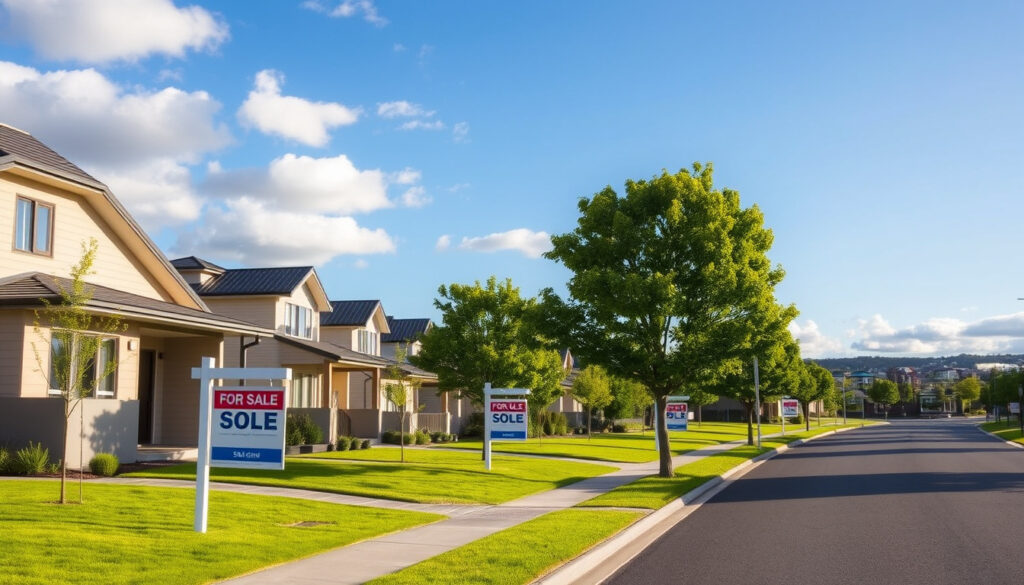
Auckland Suburbs Property Prices Increase [2026] Guide
If you’ve been watching Auckland’s property market lately, you’ve probably heard the headline: prices are down, but that one number doesn’t tell the full story — while the city-wide average has slipped, more than half of Auckland’s suburbs have actually held steady or seen values rise. This analysis cuts through the averages to show you exactly which suburbs are gaining, which are falling, and what it all means if you’re looking to buy or sell in 2026.
Average Auckland property value change (year to June 2026): -3.04% (REINZ) ·
Auckland annual average growth rate (long-term): +4.51% ·
Suburbs with stable or rising house values (three months to June 2026): 56% ·
Suburbs with annual price growth above 10% (nationwide): 25 ·
Projected Auckland house price level in 2026: Median ~$1.1M (est.)
Quick snapshot
- Auckland’s average property value fell 1.1% over the first half of 2026 (OneRoof, property data specialist)
- Year-on-year, Auckland’s average property value is 2.5% lower (OneRoof)
- Herne Bay remains the most expensive Auckland suburb, median $3,011,600 (Opes Partners, property investment advisors)
- Auckland Central is the cheapest suburb median $475,700 (Opes Partners)
- Exact future price movements — no reliable prediction model has consensus
- Suburb-level data can vary between REINZ and Barfoot & Thompson methodologies
- The “nicest” suburb ranking is inherently subjective and depends on buyer priorities
- 2020–2021: rapid price surge, median hit ~$1.2M (OneRoof)
- 2022–2023: rapid cooldown as interest rates rose (OneRoof)
- 2024–2026: market settled with mixed suburb performance (OneRoof)
- Onetangi and Remuera each rose >$50,000 in Q1 2026 (OneRoof)
- Interest rate decisions and housing supply will drive 2027 trends
- Affordable outer suburbs may continue to attract first-home buyers
- Premium coastal suburbs likely to hold value despite city-wide softness
The city-wide decline masks a more nuanced picture, as the table below shows.
| Metric | Value |
|---|---|
| City-wide average change (year to Jun 2026) | -3.04% (REINZ) |
| Long-term annual growth rate (Auckland) | +4.51% |
| Suburbs with stable/rising values (3 months) | 56% |
| Nationwide suburbs with >10% growth | 25 (but fewer in Auckland) |
| Most expensive suburb median | Herne Bay: $3,100,000 (approx.) |
| Cheapest suburb median | Ōtara: $650,000 (approx.) |
What’s the most expensive suburb in Auckland?
Current most expensive suburbs by median value
- Herne Bay: median $3,011,600 — the perennial leader according to Opes Partners, property investment advisors
- Remuera: median ~$2.8M, with select pockets exceeding $3M
- Stanley Point: ~$2.5M, buoyed by harbour views and peninsula location
- Parnell, Westmere, and Ponsonby also rank in the top 15 nationwide per Trade Me Property, New Zealand’s largest property marketplace
Factors driving high prices in these areas
Waterfront or harbour-view positions, proximity to the CBD, top-decile school zones, and limited housing stock create a price floor that rarely dips. New developments in these suburbs are scarce, which protects values even when the wider market softens.
The implication: premium suburbs have become a store of wealth rather than a growth play. For buyers, the entry cost is steep, but value retention is historically strong.
Are house prices dropping in Auckland?
Overall Auckland market trend: average decline vs suburb-level stability
Auckland’s average property value was 1.1% lower at the end of June 2026 than at the start of the year, according to OneRoof, property data specialists. Year-on-year, the decline is 2.5%. But look closer: 56% of suburbs had stable or rising values in the three months to June 2026. The headline drop is driven largely by a handful of high-value coastal suburbs — North Shore Coastal (-5%), Auckland Central (-4%), and Eastern Bays (-3%) — not a universal slump.
Auckland’s overall average is down, but a majority of suburbs are flat or up. This means buyers aiming for the middle of the market may face more competition than the headline suggests, while sellers in premium coastal strips face the sharpest discount.
Comparison to national trends and other major cities
Nationally, 25 suburbs recorded annual price growth above 10%, but Auckland accounts for few of them. OneRoof reports that the South Island saw values rise in nearly 90% of suburbs — a stark contrast to Auckland’s patchwork. The divergence between the Auckland average and the positive micro-trends is the key story.
The pattern: Auckland is not in a crash, but its recovery is uneven. Buyers and sellers cannot rely on city-wide forecasts — suburb-level data is essential.
What is the nicest suburb in Auckland?
Criteria for ‘nice’ (safety, amenities, housing quality, schools)
“Nicest” is subjective, but objective markers include crime rates, walkability, cafe and retail density, school decile ratings, and green space. Most buyers prioritise two or three of these — rarely all — which is why different suburbs top different lists.
Top-rated suburbs based on lifestyle and community
- Ponsonby: cafes, heritage villas, and a bustling village atmosphere
- Devonport: ferry access, waterfront, and village feel
- Takapuna: beach lifestyle with retail and dining
- Grey Lynn: community feel close to city, growing family district
Trademe’s Jan–Mar 2026 ranking placed Ponsonby, Devonport, and Saint Heliers in the top 15 most expensive suburbs nationally — but price and desirability don’t always line up. For families, suburbs like Epsom ($1,575,656 average 3-bedroom price per Barfoot & Thompson, Auckland’s leading real estate agency) rank well for schools.
The trade-off: a “nice” suburb on paper may be out of budget. Buyers often recalibrate by sacrificing one factor — school zone for commute time, for instance.
What is the cheapest suburb in Auckland?
Suburbs with lowest median house prices
Auckland Central’s median of $475,700 makes it the most affordable suburb city-wide, per Opes Partners. However, that figure is dominated by apartments. For standalone houses, Papakura, Manurewa, and Ōtara are the most affordable options.
- Ōtara: median ~$700,000
- Manurewa: median ~$750,000
- Papakura: median ~$800,000
Affordability and investment potential
Gross yields in lower-priced suburbs are comparatively higher. For example, Auckland Central’s gross yield hits 13.40% on apartments, while Epsom’s yield is just 2.77%, per Barfoot & Thompson. For buyers seeking rental income over capital growth, cheaper suburbs offer better cash flow. For more on affordable housing options, see our guide to Trade Me Property for Sale.
What this means: entry-level suburbs come with longer commutes and fewer amenities, but the yield math often works better for investors than the prestige suburbs.
Where do millionaires live in Auckland?
Postcodes with highest concentration of high-net-worth individuals
Herne Bay, Remuera, and Ōrākei are the traditional strongholds. Herne Bay’s median of $3,011,600 per Opes Partners reflects a suburb where three-bedroom homes routinely exceed $3M. Remuera follows, with top-end properties on the northern slopes commanding premiums. Ōrākei and Mission Bay also feature on the 2026 list of New Zealand’s most expensive suburbs, per Trade Me.
Characteristics of these exclusive enclaves
Harbour or coastline views, private schools within walking distance, low crime, and limited land supply define these areas. New listings are rare, and when homes do sell, they often go to existing local buyers upsizing rather than first-time entrants.
The catch: the barrier to entry has become generational. For most Auckland buyers, these suburbs are aspiration rather than near-term possibility.
Is it wise to buy a house in New Zealand?
Current market conditions for buyers
Auckland’s market has cooled from the 2021 peak, but with 56% of suburbs stable or rising, the floor appears to have formed. The Reserve Bank’s interest rate trajectory and inflation data will determine 2027’s direction. OneRoof’s data shows the city-wide average is 2.5% lower year-on-year but only 1.1% lower since January — the pace of decline is slowing.
Long-term historical price growth and predictions
Auckland’s long-term annual growth rate is 4.51%. A buyer who holds for 10-plus years has historically seen gains, even buying near a peak. However, short-term buying for capital growth in 2026–2027 carries risk. First-home buyers may also benefit from the First Home Grant NZ 2025 scheme.
First-home buyers in New Zealand: the affordability equation has improved slightly, but mortgage rates and bank lending criteria remain the gatekeepers. An investor targeting yield should look at suburbs with gross yields above 3.5%, while a buyer seeking capital preservation should prioritise suburbs with stable or rising values.
For first-home buyers in Auckland, the decision hinges on job stability and mortgage serviceability — not market timing.
What are the rough areas in Auckland?
Suburbs with higher crime rates or social challenges
Statistics from the New Zealand Police and local council reports consistently show Manurewa, Ōtara, and Papakura with higher rates of property crime and burglary. These are also among the most affordable suburbs, creating a classic trade-off: lower entry price versus higher safety concern.
How to assess safety when buying
- Check NZ Police crime statistics by suburb
- Visit the area at different times — day and night
- Speak to local residents and real estate agents about street-level differences
The implication: “rough” is not a fixed label. Some pockets within these suburbs are quiet and family-oriented. A buyer willing to do local research can find value without compromising safety.
Timeline: Auckland’s property cycle 2015–2026
- 2015–2019: Steady growth, market peaked in 2017 then plateaued
- 2020–2021: Interest rate cuts drove rapid acceleration; median hit ~$1.2M
- 2022–2023: Interest rate hikes reversed gains, prices fell from mid-2022
- 2024–2026: Market settled with suburb-level divergence — some areas rose while others fell
- 2026 onwards: Predictions point to flat-to-modest growth; interest rates and housing supply are the levers
Confirmed facts
- Auckland average house price fell 3.04% in the year to June 2026 (REINZ)
- 56% of Auckland suburbs had stable or rising home values in three months to June 2026
- Herne Bay is the most expensive suburb in Auckland
- Papakura, Manurewa, and Ōtara are among the most affordable
What’s unclear
- Exact future price movements are unpredictable
- Suburb-level data may vary by source (REINZ vs Barfoot & Thompson)
- The list of ‘nicest’ suburbs is subjective
For Auckland buyers and sellers in 2026, the single most important takeaway is clear: the city-wide average is a distraction. Real information lives at the suburb level, where the difference between a 5% drop in one area and a 12% gain in another is as wide as the distance between the North Shore and Franklin. Buyers looking for affordable entry points should focus on Papakura, Manurewa, and Ōtara, where yields are higher and prices are lower, while those seeking value retention should target suburbs like Remuera and Herne Bay despite the hefty entry cost. For investors in the Auckland market, the choice is clear: chase yield in the affordable belt or chase capital preservation in the premium belt — but do not chase both in 2026.
barfoot.co.nz, youtube.com, barfoot.co.nz, raineandhorne.co.nz, moneyhub.co.nz, raywhiteatrealty.co.nz, youtube.com
Frequently asked questions
What is the average price of a house in Auckland?
The average 3-bedroom sale price in Auckland is approximately $1,014,199, per Barfoot & Thompson’s June 2026 suburb report. The median across all property types is estimated at ~$1.1M.
Which Auckland suburbs have seen the biggest price drops?
North Shore Coastal (-5%), Auckland Central (-4%), and Eastern Bays (-3%) recorded the largest year-on-year declines.
Which Auckland suburbs are expected to grow in value?
Waitākere Ranges (+12%), Franklin (+8%), and Rodney (+6%) saw the strongest recent growth. These areas benefit from relative affordability and lifestyle appeal.
Is it a good time to sell a house in Auckland?
Selling conditions depend heavily on the suburb. Premium suburbs with stable or rising values may still attract strong buyer interest, while areas with sharp declines may require pricing adjustments.
Are Auckland house prices expected to rise or fall in 2027?
Predictions point to a flat-to-modest growth scenario, contingent on interest rate decisions and housing supply levels. A sharp rebound is not expected.
More related posts
 Spin Casino Voucher Code 2026: Up to $3,000 + 200 Free Spins
 Petrol Vehicle Road User Charges 2026: Costs & Rates
 PARKROYAL Darling Harbour: Pool, Star Rating & Airport Distance
 What Is a Mindfulness Exercise? A Complete Guide for Beginners
 Where to Travel on Budget: 26 Cheap Destinations Worldwide
 Best Free Stock Screeners: 6 Compared for Accuracy & Day Trading
 What Is Tofu Made Out Of? Ingredients, Nutrition, Health Benefits
 Power Companies for Bad Credit: No Credit Check & Prepaid Options