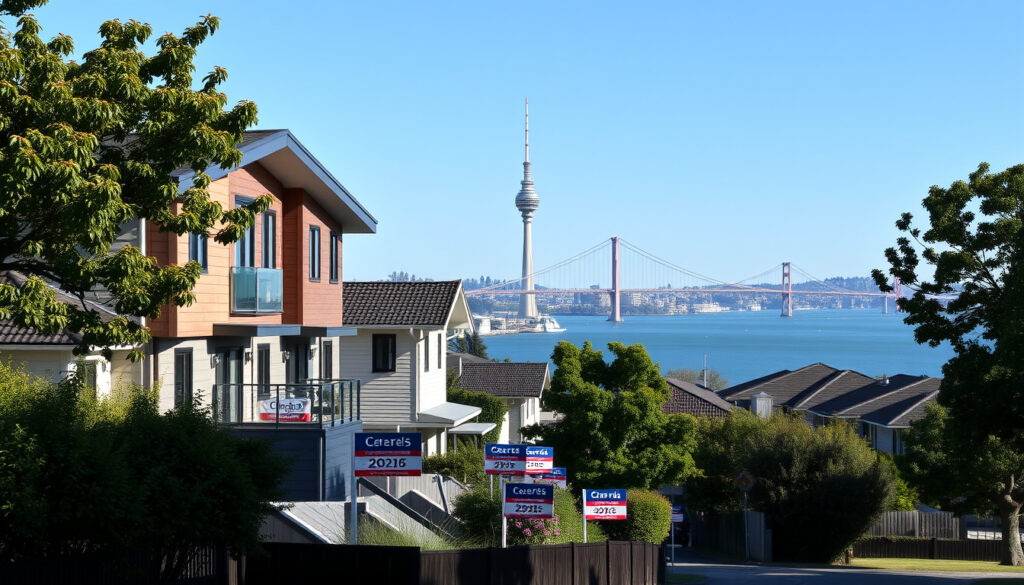
Houses in New Zealand for Sale in Auckland – 2026 Prices and Trends
Auckland remains New Zealand’s most active and expensive property market, though recent months have brought notable shifts in both pricing and buyer behavior. The city’s median house price stood at $1,014,000 as of February 2026, according to REINZ data, representing a 1.09% decline year-over-year. This follows a more pronounced correction in mid-2025 when the median reached $990,000, marking a -3.4% annual drop that contrasted sharply with a flat national median of $770,000. The market has since shown signs of stabilization, with prices settling approximately 9.43% below their long-term average, a condition that analysts at Opes Partners interpret as potential undervaluation rather than sustained weakness. Against this backdrop of modest cooling, Auckland continues to outperform the broader New Zealand market on long-term growth metrics, with historical averages of 4.85% annually over two decades and 6.5% over three decades. The city also absorbed new listings at the highest rate since mid-2021 during 2025, suggesting that demand remains present even as buyer sentiment stays cautious.
For those searching for houses in New Zealand for sale in Auckland, the current environment presents a mixed landscape. First-home buyers have gained ground as properties under $1 million now comprise the majority of sales, a shift from three years prior when such transactions represented less than half the market. Supply has increased through new listings, but demand has followed suit with greater selectivity, particularly for properties priced realistically relative to comparable sales. Major agencies like Barfoot & Thompson reported strong volumes through 2025, with sales totaling 11,024 over the twelve months to August, up from 9,773 the prior year. Whether seeking a luxury waterfront property, a modest apartment in Auckland Central, or a growing suburb like Matakana, understanding local price patterns and market dynamics proves essential for informed purchasing decisions.
What Are Current Auckland House Prices and Market Conditions?
Understanding the numbers requires stepping back to examine the broader picture. Auckland’s median sale price reached $1,014,000 in February 2026, climbing from approximately $770,000 a decade earlier for annual growth of 2.79%. This long-term trajectory masks shorter-term volatility, including a period of sharper declines in 2025 followed by the current stabilization. The market’s relationship to its historical average reveals important context: prices sit nearly 10% below where they typically trend, creating potential opportunities for buyers who act during this correction phase.
Key Market Insights for Auckland Buyers
- Properties under $1 million now represent 56% of all sales, up from 41% three years ago, expanding entry options for first-home buyers
- Supply has tightened through reduced new home completions, declining approximately 463 homes per month from the 2024 peak
- Buyer sentiment remains cautious but selective, with strong interest in realistically priced homes across all price brackets
- Sales volumes rebounded significantly, with Barfoot reporting the highest annual total in nine years outside the 2020-2021 boom
- Auckland consistently outpaces national growth, with property values reaching 8.5 times their 1992 level compared to 7 times for New Zealand overall
- Regional areas are experiencing price and rent declines due to oversupply and migration patterns, diverging from Auckland’s resilience
| Metric | Auckland Average | New Zealand National |
|---|---|---|
| Median Sale Price | NZD 1,014,000 | NZD 770,000 |
| Active Listings Trend | Rising (+2.8% YoY) | Mixed across regions |
| YoY Price Movement | -1.09% (to Feb 2026) | +0.3% (HPI vs 2024) |
| Annual Sales Volume | 11,024 (12-mo to Aug 2025) | 113,200 new listings nationally |
| Growth Since 1992 | 8.5x increase | 7x increase |
Where Are the Best Locations to Find Auckland Property for Sale?
Geographic diversity defines Auckland’s property landscape, with significant price variation across neighborhoods that reflect distinct lifestyle offerings, transportation access, and development patterns. Realestate.co.nz and other platforms aggregate listings spanning apartments, townhouses, and standalone homes across urban and semi-rural settings. The key for buyers is identifying which suburb aligns with budget constraints, family needs, and long-term investment objectives, recognizing that Auckland’s premium locations can command multiples of the citywide median.
Understanding Auckland’s Suburb Price Spectrum
Auckland Central offers the most accessible entry point for buyers seeking urban living at a lower price threshold. The suburb’s median of approximately $480,800 represents just 47% of the Auckland median, positioning it as the cheapest major market within the city. This discount reflects the prevalence of apartments and smaller dwellings rather than standalone family homes, but it also creates genuine opportunities for first-home buyers and investors seeking rental income in a central location.
At the opposite end, Herne Bay exemplifies Auckland’s luxury segment with a median of $3,136,900—roughly 309% of the citywide median. This waterfront-adjacent suburb consistently ranks among New Zealand’s most expensive neighborhoods, attracting buyers seeking prestige, historical character homes, and proximity to the CBD. Properties in this price range represented a five-month low of just 42 sales in August 2025, suggesting that even wealthy buyers have become more price-conscious amid rising interest rates.
Emerging Growth Suburbs and Undervalued Markets
Between these extremes lies a range of suburbs with varying growth profiles. Matakana emerged as the fastest-growing suburb over 24 months to March 2026, with annual appreciation reaching 6%. This semi-rural area northeast of Auckland has attracted buyers seeking lifestyle properties with land, driving demand that outpaced the broader market. Conversely, Karaka recorded the steepest decline at -9%, suggesting that not all peripheral suburbs share the same trajectory.
For those prioritizing value, Auckland Central stands out not only as the cheapest suburb but as one where apartments and townhouses have gained share as the market has shifted. The broader pattern reveals that buyers willing to consider central apartments, newer townhouse developments, or suburbs beyond the prestige locations find more options within reach of the $1 million threshold. Investors may also explore resources like TradeMe Property and OneRoof to compare listings across price points and property types.
When evaluating Auckland suburbs, consider both current median prices and growth trajectories. Matakana’s 6% annual growth may appeal to long-term investors, while Auckland Central’s lower entry point suits first-home buyers or those prioritizing location over property size. Herne Bay remains the domain of luxury buyers with longer holding periods and higher capital requirements.
What Factors Are Driving Auckland’s Property Market Right Now?
Multiple forces shape Auckland’s real estate dynamics, from fundamental population growth to more immediate factors like interest rate movements and buyer sentiment shifts. Understanding these drivers helps prospective purchasers contextualize current price levels and anticipate future movements. Tremains Real Estate and industry analysts track these indicators to inform market commentary and buyer recommendations.
Population Growth and Economic Fundamentals
Auckland’s population has grown approximately 0.6% faster annually than the rest of New Zealand, creating persistent demand pressure that underpins long-term appreciation. This differential compounds over decades: property values have reached 8.5 times their 1992 level compared to 7 times for the nation overall. Economic opportunities in Auckland’s diverse sectors—from finance and technology to education and tourism—continue attracting migrants from both domestic regions and overseas, maintaining a baseline demand floor that buffers against sharper corrections.
Supply Dynamics and Construction Trends
New home construction has moderated after peaking in 2024, with completions declining approximately 463 homes per month from that high point. Interest.co.nz reports this slowdown alongside ongoing intensification policies that encourage higher-density development in select zones. Meanwhile, new listings rose 2.8% to 113,200 nationally over the year to December 2025, reaching their highest level since mid-2021. This increased supply has partially offset demand, creating a more balanced market where buyers exercise greater selectivity.
The interplay between population growth driving demand and construction activity affecting supply creates Auckland’s distinctive price dynamics. Current conditions show supply expanding through new listings while demand remains selective rather than exuberant, a combination that has produced the ongoing stabilization after earlier price declines.
Buyer Profiles and Sentiment Shifts
Investor activity has cooled following regulatory changes in some regions, opening opportunities for first-home buyers who now access a larger share of available inventory. Properties under $1 million comprised 56% of sales in August 2025, up from 41% three years prior, reflecting both price adjustments and changed buyer demographics. Cautious sentiment persists across market segments, with buyers scrutinizing valuations against recent sales and factoring in higher borrowing costs.
For those navigating this environment, whether searching for family homes, investment properties, or entry-level apartments, aligning financing capacity with realistic timelines remains essential. ANZ Home Loan Calculator NZ – Repayments and Borrowing Guide offers tools for assessing mortgage obligations under various rate scenarios. Understanding local market conditions through resources like Infometrics and direct engagement with licensed agents helps buyers make informed decisions amid ongoing price discovery.
Auckland Housing Market Timeline: 2021 to 2026
Auckland’s property market has traversed significant terrain over the past five years, with cycles of rapid appreciation, sharp corrections, and gradual stabilization. Understanding this trajectory contextualizes current conditions and illuminates the forces that have shaped buyer and seller expectations.
- 2021: Market peaked amid historically low interest rates, with strong demand from owner-occupiers and investors competing for limited inventory. This period established price benchmarks that subsequent corrections would test.
- 2022: Sharp correction following Reserve Bank of New Zealand interest rate increases. Borrowing costs rose significantly, reducing purchasing power and triggering price declines that reversed multi-year appreciation trends.
- 2023: Gradual stabilization as the market absorbed rate impacts and adjusted to changing regulatory conditions, including modifications to bright-line test rules affecting investment property taxation.
- 2024: Modest recovery attempts coincided with national elections, creating policy uncertainty that delayed some purchasing decisions. New home construction reached peak completion levels during this period.
- 2025: The market entered an early stabilization phase, according to Global Property Guide analysis. Prices corrected further, with Auckland’s June 2025 median at $990,000 representing a -3.4% annual decline, while national data showed broader market settling.
- 2026 (to date): Continued stabilization with February 2026 median of $1,014,000, down 1.09% year-over-year but showing reduced rate of decline. New listings reached post-2021 highs, suggesting improved market balance.
Market Certainties and Remaining Uncertainties
Buyers benefit from distinguishing between established facts and unresolved questions that could affect future market direction. This clearer picture supports better-informed decision-making aligned with individual circumstances and risk tolerance. For those looking to protect their new device, you can find the best iPhone 15 cases NZ at best iPhone 15 cases NZ.
| Established Information | Remaining Uncertainties |
|---|---|
| Auckland median price of $1,014,000 (February 2026), approximately 9.43% below long-term average | Precise timing and magnitude of any recovery; whether current undervaluation translates to near-term gains |
| National median of $770,000, with Auckland continuing to command a premium | Impact of potential foreign buyer restrictions on Auckland’s premium segment and international demand |
| Historical growth averaging 4.85% annually over 20 years and 6.5% over 30+ years | How interest rate paths from the Reserve Bank of New Zealand will influence borrowing costs and buyer capacity |
| New listings reaching highest level since mid-2021, with 56% of sales under $1 million | Effect of regional oversupply on Auckland relative performance; whether migration patterns favor urban centers |
| Market stabilization after earlier corrections, with reduced rate of price decline | Government policy impacts from potential electoral shifts affecting property taxation or first-home buyer support |
Understanding Auckland’s Position in New Zealand’s Property Landscape
Auckland occupies a distinctive position within New Zealand’s property ecosystem, functioning as both the economic engine of the country and its most expensive housing market. The city’s median house price of $1,014,000 substantially exceeds the national median of $770,000, reflecting concentrated economic activity, population growth, and geographic constraints on supply expansion. This premium has persisted through multiple market cycles, demonstrating underlying demand fundamentals that attract both owner-occupiers and investors despite elevated entry costs.
The broader context matters for prospective buyers evaluating Auckland against alternatives. While regional areas have experienced price and rent declines attributed to oversupply and migration shifts, Auckland has maintained relative stability through its combination of domestic and international migration inflows, diverse employment opportunities, and limited land availability in established neighborhoods. This resilience does not guarantee continued appreciation but suggests structural support for property values that less-populated regions may lack.
Auckland’s market dynamics differ substantially from regional New Zealand, where oversupply has driven price and rent declines. Buyers considering non-Auckland investments should apply different evaluation criteria than those appropriate for Auckland property, recognizing that forces driving Auckland’s premium may not operate elsewhere.
What Experts Say About Auckland Real Estate
Industry participants and research organizations provide ongoing commentary that shapes market expectations. These perspectives, grounded in transaction data and economic analysis, offer buyers additional context for decision-making.
Auckland remains New Zealand’s premium property market, with structural supply constraints and population growth continuing to support long-term value despite short-term price fluctuations.
— Industry analysis from Opes Partners, Auckland Property Market
The market has entered an early stabilization phase after significant adjustments. Auckland’s pricing now reflects a more sustainable balance between buyer capacity and seller expectations.
— Global Property Guide New Zealand Analysis
Key sources informing this analysis include Barfoot & Thompson for transaction volumes and pricing trends, the Real Estate Institute of New Zealand for median data, OneRoof for suburb-level analysis, and Infometrics for economic and listing indicators. Banking sector forecasts from ANZ, ASB, and BNZ provide additional perspective on anticipated national growth trajectories.
What Auckland Buyers Should Know Before Making a Decision
The Auckland property market presents a nuanced opportunity in early 2026. Prices have corrected from peak levels and currently sit below their long-term average, suggesting potential value for buyers with appropriate time horizons. The expansion of properties under $1 million has opened pathways for first-home buyers who previously faced more limited options, while selective demand from all buyer categories maintains market activity at healthy levels. Long-term fundamentals including population growth and economic prominence continue supporting Auckland’s premium position within New Zealand.
Prospective purchasers benefit from clarifying financing capacity before engaging with the market, understanding that interest costs remain elevated compared to the ultralow-rate environment of 2021. Resources like ANZ Home Loan Calculator NZ – Repayments and Borrowing Guide can assist with scenario planning under various rate assumptions. KiwiSaver withdrawals and first-home incentives may assist eligible buyers, though specific eligibility requirements apply and should be verified independently. Engaging a licensed real estate agent provides localized knowledge of suburb trends, recent comparable sales, and negotiation dynamics that complement broader market analysis.
Frequently Asked Questions
What is the median house price in Auckland right now?
Auckland’s median sale price stood at $1,014,000 as of February 2026, down 1.09% from the prior year according to REINZ data.
Which Auckland suburbs have the cheapest houses?
Auckland Central features the most affordable median prices at approximately $480,800, roughly 47% of the Auckland median, making it attractive for buyers seeking lower entry points.
Which suburb has shown the strongest recent growth?
Matakana recorded the fastest growth over 24 months to March 2026 at approximately 6% annually, while Karaka experienced the steepest decline at -9%.
Is Auckland property a good investment in 2026?
Historical data shows Auckland averaging 4.85% annual growth over 20 years and 6.5% over 30+ years, with analysts projecting 6% long-term annual growth. Prices currently sit below their long-term average, suggesting potential opportunity.
What percentage of Auckland homes sell for under $1 million?
In August 2025, 56% of all sales fell under the $1 million mark, up from 41% three years earlier, indicating more accessible entry points amid selective buyer sentiment.
How many homes sell in Auckland each year?
Barfoot reported 11,024 sales over the 12 months to August 2025, a significant increase from 9,773 the prior year, with the agency moving more properties than any prior nine years outside the 2020-2021 boom period.
Can first-home buyers afford property in Auckland?
Under-$1M sales now represent the majority of transactions, with townhouses and apartments offering more affordable pathways. KiwiSaver withdrawals and first-home incentives may assist eligible buyers, though conditions apply.
More related posts
 Liverpool F.C. vs Qarabag FK Lineups: Predicted XI & Match History
 Lucinda Riley Books in Order: Complete Reading Guide (2025)
 FireFly Metals Share Price: Analysis, Targets & Outlook
 Monterey Jack Cheese NZ: Where to Buy & Substitutes
 Auckland Coast to Coast Walk: Route Map, Distance & Guide
 How Much Can I Borrow Against My House Calculator – Ireland Guide
 NZ Shoe Size to US – Charts for Men, Women and Kids
 £ to NZ Dollar: Current Exchange Rate & Forecast (2024)