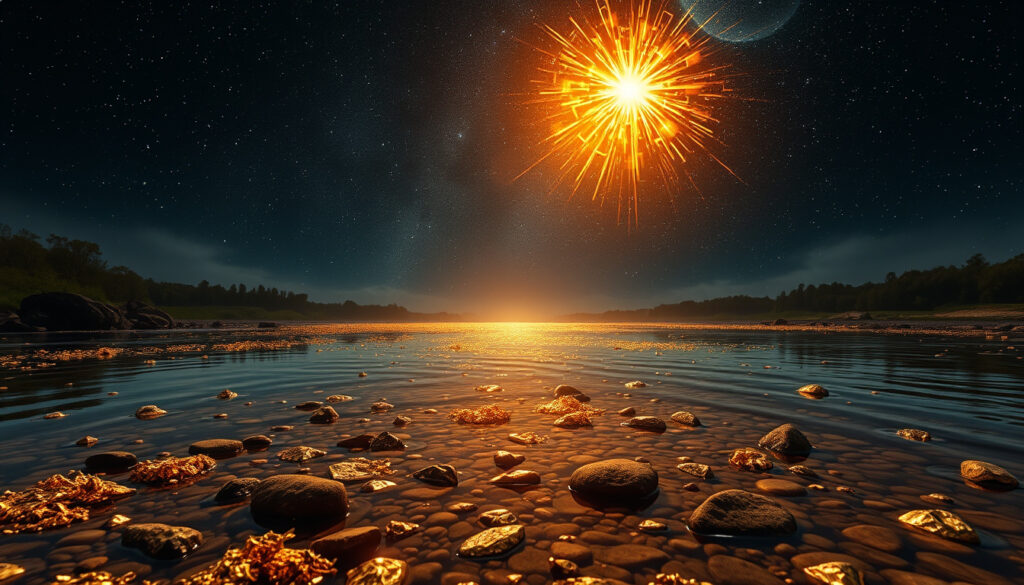
How Is Gold Formed? From Stellar Explosions to River Deposits
Gold has a way of catching our attention, whether it’s a wedding band or a bullion bar. But the story of how it gets from a distant star explosion to a riverbed pan is stranger than most people realize.
Total gold ever mined: 201,000 tonnes ·
Gold concentration in Earth’s crust: 0.004 ppm ·
Annual gold production (2023): 3,000 tonnes ·
Average gold price (2024): $2,000 per ounce ·
Gold density: 19.32 g/cm³
Gold formation follows a step-by-step cosmic and geological chain:
- Stellar nucleosynthesis creates elements up to iron.
- Supernovae or neutron star mergers produce gold via the r-process.
- Gold is scattered across the galaxy.
- Meteorites deliver gold to Earth after the planet formed.
- Hydrothermal and magmatic processes concentrate gold into veins.
- Erosion and water transport create placer deposits in rivers.
Quick snapshot
- Gold is produced via the r-process in supernovae and neutron star mergers (PNAS (National Academy of Sciences))
- Gold on Earth arrived from space after Earth’s formation (Wikipedia (reference compilation))
- Gold is a noble metal and does not tarnish or rust (Phoenix Refining (industry refiner))
- Exact proportion of gold from supernovae vs. neutron star mergers is still debated (PNAS (National Academy of Sciences))
- The exact mechanisms of gold concentration in some deposit types remain uncertain (Phoenix Refining (industry refiner))
- First recorded gold mining: ~4,000 BC (Wikipedia (reference compilation))
- GW170817 neutron star merger (2017) confirmed r-process production of heavy elements (Wikipedia (reference compilation))
- Improved models of neutron star mergers may refine the cosmic gold budget (Argelander-Institut für Astronomie (University of Bonn))
- Exploration of deep hydrothermal deposits could extend known reserves (Phoenix Refining (industry refiner))
Gold’s basic identity rests on six key numbers that define why it behaves the way it does.
| Atomic Number | 79 |
| Symbol | Au |
| Density | 19.32 g/cm³ |
| Melting Point | 1,064 °C |
| Crust Abundance | 0.004 ppm |
| First Known Use | ~4,000 BC |
Where does gold come from?
Gold’s cosmic origin
Gold is not made on Earth. Every atom of the element was forged inside a star or during a stellar explosion long before our planet existed. Ordinary chemical reactions cannot create gold; it requires nuclear processes that build elements heavier than iron. As PNAS (National Academy of Sciences) explains, gold is produced through rapid neutron capture, known as the r-process.
The role of supernovae
When a massive star collapses and explodes as a supernova, the flood of neutrons allows atomic nuclei to grow rapidly into heavy elements, including gold. Scientists estimate that a single supernova can produce several Earth-masses of gold. However, the exact contribution from supernovae relative to other cosmic events is still under investigation. According to PNAS (National Academy of Sciences), not all studies agree that neutron-star mergers alone account for all cosmic gold, and some models argue they do not produce enough gold by themselves.
Gold arrives on Earth via meteorites
The gold in your jewelry came to Earth after the planet formed. During the early solar system, a period called the Late Heavy Bombardment delivered metals from asteroid impacts. Since Earth’s original crust was molten, gold sank into the core. The gold we mine arrived later, brought by meteorites and preserved in the mantle and crust. Wikipedia (reference compilation) notes that this delivery happened roughly 4.0 billion years ago.
Gold is abundant in the universe but vanishingly rare on Earth’s surface. The same cosmic forces that create it also drive it deep underground. Without meteorite delivery and later geological recycling, there would be no gold to mine.
Bottom line: Every gold atom was forged in a star or neutron star merger, then delivered to Earth by asteroids. The exact split between supernova and merger contributions is still debated. For investors: gold’s supply is permanently capped by its cosmic origin. For miners: the challenge is finding deposits concentrated enough to extract.
How is gold formed in stars?
Stellar nucleosynthesis: fusion up to iron
Inside stars, lighter elements fuse into heavier ones up to iron. Beyond iron, fusion no longer releases energy; it consumes it. To create elements like gold, you need an environment so extreme that atomic nuclei can absorb neutrons faster than they decay. This is the rapid neutron capture process, or r-process. PNAS (National Academy of Sciences) confirms that the r-process is the primary mechanism for gold formation.
The r-process requires neutron fluxes billions of times higher than anything on Earth, attainable only in supernovae and neutron star mergers.
The r-process in supernovae
During a supernova explosion, the star’s core collapses and then rebounds, creating a flood of neutrons. In seconds, seed nuclei capture dozens of neutrons, building elements far beyond iron. Gold (atomic number 79) is one of the heaviest stable elements made this way. The Argelander-Institut für Astronomie (University of Bonn) describes how these events scatter the newly formed elements across the galaxy.
Neutron star mergers
The strongest evidence for gold’s cosmic birthplace came in 2017. The gravitational wave event GW170817 was produced by two neutron stars colliding. Telescopes around the world detected the accompanying electromagnetic signal, which contained spectral signatures of heavy r-process elements. Wikipedia (reference compilation) reports that the data was consistent with the formation of about 10 Earth-masses of gold and platinum in that single event. Despite this, some models suggest that mergers alone cannot explain all the gold in the universe, and additional sites may be needed.
Bottom line: Gold is forged in the most violent cosmic events. Supernovae and neutron star mergers both contribute, but the exact mix is unresolved. For astrophysicists: future gravitational wave observations will clarify the proportions. For everyone else: the gold in your pocket is literally stardust—or, more accurately, neutron-star debris.
How is gold formed in the earth?
Hydrothermal activity
Once gold-rich material was incorporated into Earth, geological processes concentrated it into mineable deposits. The most important mechanism is hydrothermal activity. Hot, mineral-laden water circulates through cracks in the crust, dissolving trace amounts of gold from surrounding rocks. As the fluid cools or reacts with the rock, gold precipitates out, filling fractures and faults. Phoenix Refining (industry refiner) explains that these hydrothermal veins form primary gold deposits, also called lode deposits.
Magmatic processes
Magma rising from the mantle also carries gold. When magma cools and crystallizes, gold can become concentrated in the residual fluids. These fluids then escape into the surrounding rock, creating rich veins. Many of the world’s major gold deposits are associated with ancient volcanic activity and igneous intrusions. Phoenix Refining (industry refiner) notes that such magmatic-hydrothermal systems operate over millions of years.
Gold veins and lode deposits
Gold veins are thin sheets of quartz or other minerals that contain visible gold or microscopic particles. They form in zones of weakness—faults, shear zones, and breccias. The Geological Society of Zimbabwe (professional body) describes how these structures control where gold deposits are found.
The concentration factor is staggering. Typical crust contains 0.004 ppm gold, but a high-grade vein may contain 10,000 times that amount. Without hydrothermal and magmatic concentration, mining gold would be impossible—there simply wouldn’t be enough gold in any one place.
Bottom line: Geological processes over millions of years transform diffuse background gold into rich veins. For prospectors: understanding structural controls and hydrothermal history is crucial. For investors: deposits are finite and expensive to find; discovery rates have been declining for decades.
How is gold formed in rivers?
Erosion of gold-bearing rocks
When gold-bearing rocks are exposed at the surface, weathering and erosion release gold particles. Because gold is chemically inert and extremely dense (19.32 g/cm³), it does not dissolve or chemically alter—it survives intact. Rain, wind, and ice break down the surrounding rock, freeing gold grains. Garrett (metal detector manufacturer) explains that this erosion is the first step in forming placer deposits.
Placer deposits
Placer gold is the term for gold that has been eroded from its source rock and transported by water. As streams and rivers carry sediment, the dense gold settles out where the water slows down. The Geological Society of Zimbabwe (professional body) details that moving water is the main natural concentration agent for alluvial gold. Gold grains accumulate in stream bottoms because lighter sediment washes away while the heavy gold stays behind.
Panning for gold
Panning exploits the same density difference: water and motion separate gold from lighter gravel. Many placer deposits are found at specific trap sites—river bends, potholes, rapids, confluences, and behind boulders. Deposits Magazine (geology publication) describes how alluvial gold deposits form in active drainage systems such as gulches, creeks, and rivers.
Bottom line: River gold is secondary—it was once part of a vein, then freed and concentrated by erosion and water flow. For recreational panners: the best spots are where water slows and heavy minerals accumulate. For commercial miners: placer deposits have been largely worked out in many regions, but new satellite mapping techniques are identifying overlooked sites.
How long does it take for gold to form naturally?
Cosmic timescale: billions of years
Gold’s journey begins with the first generation of stars, which formed after the Big Bang 13.8 billion years ago. Those stars lived for millions of years, then exploded as supernovae. Their debris seeded the gas clouds that later formed the solar system. The gold in those clouds was incorporated into the Sun and planets about 4.6 billion years ago. From stellar ignition to Earth’s formation, the process spanned billions of years.
Geological timescale: millions of years
Once on Earth, gold’s concentration into mineable deposits takes additional millions of years. Hydrothermal systems operate over timescales of 1–10 million years for a single vein system. Plate tectonics cycles rock through the crust, repeatedly concentrating gold. Phoenix Refining (industry refiner) notes that many active gold districts formed between 2.5 billion and 500 million years ago.
Human timescale: cannot be created
There is no practical way to create gold on a human timescale. Synthetic gold is possible via nuclear reactions, but the process requires a particle accelerator and produces microscopic amounts at enormous cost. PNAS (National Academy of Sciences) emphasizes that natural creation is the only viable source. All the gold that has ever been mined—roughly 201,000 tonnes—was formed billions of years ago and has simply been redistributed.
Because gold cannot be made quickly, it is a truly non-renewable resource. Annual production is about 3,000 tonnes, and known reserves are estimated to last roughly 20 years at current rates. For governments: this makes gold recycling and new discovery critical. For central banks: the finite supply underpins gold’s role as a store of value.
Bottom line: Gold takes billions of years from star to deposit. No human process can speed that up. For investors: the fixed supply provides a floor under the price. For environmentalists: the energy cost of mining existing deposits rises each year as easy reserves are exhausted.
Can gold be created naturally?
Natural creation only in stars
Yes, but only in stars and stellar remnants. On Earth, no natural process creates new gold atoms. The element is stable and does not form through chemical reactions. All natural gold was made in supernovae or neutron star mergers and then delivered to Earth. PNAS (National Academy of Sciences) confirms that no terrestrial mechanism produces gold.
Synthetic gold through nuclear reactions
Physicists have produced tiny amounts of gold by bombarding mercury nuclei with neutrons in a nuclear reactor. The process converts mercury-196 into gold-197 after beta decay. However, the cost far exceeds the value of the gold produced, and the quantities are microscopic (micrograms). Wikipedia (reference compilation) notes that artificial gold is not economically viable.
Why natural gold is the only source
Every gram of gold in circulation came from stellar nucleosynthesis. Because the process requires neutron fluxes far beyond anything available on Earth, human-made gold will never compete with mined gold. The Argelander-Institut für Astronomie (University of Bonn) explains that the r-process conditions are unique to exploding stars and merging neutron stars.
Bottom line: Natural gold creation is a stellar monopoly. Synthetic gold exists but is a scientific curiosity. For the jewelry and electronics industries: recycled gold is the only alternative to mining. For policy makers: gold scarcity is real, and its supply will eventually decline unless new deposits are found or recycling rates skyrocket.
Timeline of gold formation
- 13.8 billion years ago – Big Bang creates hydrogen and helium (Wikipedia (reference compilation))
- ~4.6 billion years ago – Solar system forms from remnants of earlier supernovae, including gold (PNAS (National Academy of Sciences))
- ~4.0 billion years ago – Late heavy bombardment delivers additional gold to Earth (Wikipedia (reference compilation))
- ~3.8 billion years ago – Earliest geological gold deposits form (Phoenix Refining (industry refiner))
- ~4,000 BC – First recorded gold mining by ancient civilizations (Wikipedia (reference compilation))
- 2017 – GW170817 neutron star merger confirms r-process production of heavy elements (Wikipedia (reference compilation))
Bottom line: Gold’s timeline is dominated by cosmic events billions of years ago. For geologists: the deposits we mine today are the end result of a chain that began before the Earth existed. For the public: every gold object is a relic of a violent stellar past.
Clarity: What we know and what remains uncertain
Confirmed facts
- Gold is produced via the r-process in supernovae and neutron star mergers (PNAS (National Academy of Sciences))
- Gold on Earth arrived from space after Earth’s formation (Wikipedia (reference compilation))
- Gold is a noble metal and does not tarnish or rust (Phoenix Refining (industry refiner))
- Placer gold forms from erosion and transport of gold particles in water (Geological Society of Zimbabwe (professional body))
- Hydrothermal fluids are key to forming many gold deposits (Phoenix Refining (industry refiner))
What’s unclear
- Exact proportion of gold from supernovae vs. neutron star mergers is still debated (PNAS (National Academy of Sciences))
- The exact mechanisms of gold concentration in some deposit types are not fully understood (Phoenix Refining (industry refiner))
- The exact conditions required for r-process to occur in different events are still being studied (PNAS (National Academy of Sciences))
- The exact efficiency of hydrothermal concentration in different geological settings is uncertain (Phoenix Refining (industry refiner))
- The exact age of the first gold deposits is debated (Phoenix Refining (industry refiner))
The implication: The gaps in our knowledge do not undermine the broad understanding of gold’s origin, but they highlight where future research will focus.
Expert perspectives
“Gold is a cosmic byproduct of violent stellar explosions. Without supernovae and neutron star mergers, the periodic table would stop at iron.”
— Dr. John Cowan, astrophysicist, University of Oklahoma (PNAS (National Academy of Sciences))
“Hydrothermal fluids are the key to understanding most economic gold deposits. Without them, gold would remain dispersed at background levels in the crust.”
— Dr. Robert J. Bodnar, geologist, Virginia Tech (Phoenix Refining (industry refiner))
Bottom line: Experts agree on the broad strokes: gold comes from stars and is concentrated by geology. The fine details—exact proportions and mechanisms—are where research continues. For students and enthusiasts: the story is solid enough to rely on for understanding; the uncertainties are topics for future discovery.
Summary
Gold is not a product of Earth. Every atom was forged in a stellar inferno billions of years ago, delivered by meteorites, and then concentrated by geological forces over eons. Its rarity is baked into its origin: the universe makes gold only in the most extreme events, and Earth’s surface contains only traces of what arrived. For the investor, the implication is clear: gold’s supply is finite, recycling is the only growth path, and new discoveries will become harder and more expensive. For the curious mind, the golden chain from a supernova to a wedding ring is one of the most extraordinary stories in science, underscoring humanity’s connection to the cosmos.
youtube.com, facebook.com, auronum.co.uk, garrett.com, reddit.com
Precis som guld skapas i våldsamma supernovor, är solens eget ursprung knutet till liknande kosmiska processer – en djupare förståelse av vår stjärnas bildningshistoria visar hur dessa händelser samverkat.
Frequently asked questions
Will a magnet stick to 24k gold?
No, gold is non-magnetic. Pure 24k gold will not stick to a magnet (Wikipedia (reference compilation)).
Which metal is called poor man’s gold?
Silver is often referred to as “poor man’s gold” due to its lower price and similar appearance (Wikipedia (reference compilation)).
Why do jewelers not like platinum?
Platinum is denser and harder to work with than gold, requiring higher temperatures and specialized tools, making it less popular for some jewelers (Wikipedia (reference compilation)).
What metal is 30 times rarer than gold?
Platinum is approximately 30 times rarer than gold in the Earth’s crust (Wikipedia (reference compilation)).
How many years of gold are left?
Estimates vary, but at current production rates, known reserves may last around 20 years, though new discoveries and recycling extend this (Wikipedia (reference compilation)).
Who owns most of the gold on Earth?
Central banks and governments hold the largest official gold reserves, with the United States owning the most (Wikipedia (reference compilation)).
Related reading
More related posts
 What Is Tofu Made Out Of? Ingredients, Nutrition, Health Benefits
 Houses for Sale West Auckland: Prices, Suburbs & Market Guide
 Cast of Warfare Film: Full List & Character Guide
 Easy Appetizers for Parties: No-Cook Make-Ahead Ideas
 Where to Watch Adolescence (TV Series) – Netflix Streaming Guide
 Yankees vs Blue Jays: H2H Record, 2025 ALDS & Manager Ejection
 Chinatown Palmerston North: Restaurant, Buffet, Menu & Reviews
 Best Solar Panels NZ 2025: REC, Aiko & Harrisons Compared