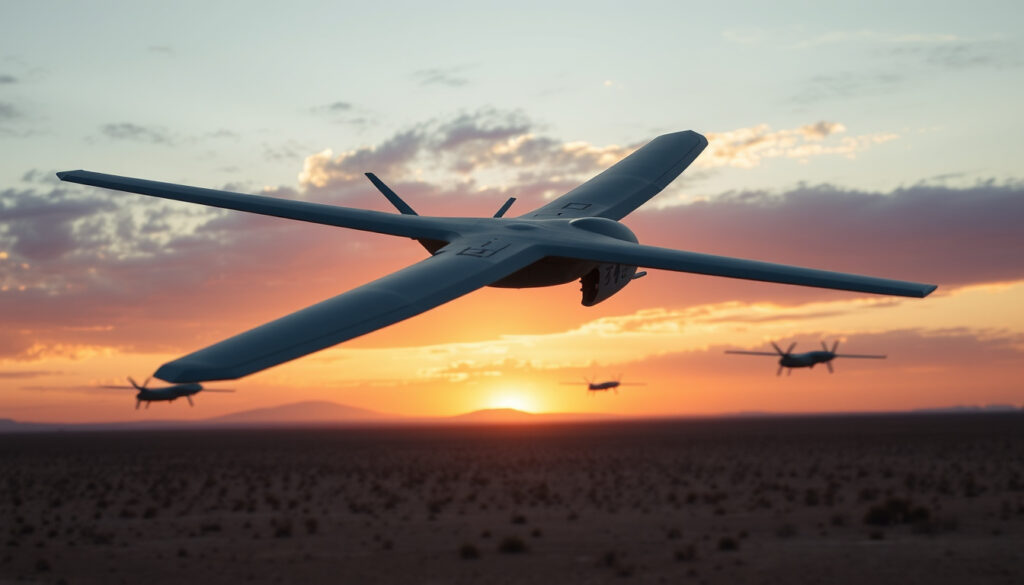
Unmanned Combat Aerial Vehicle (UCAV): Key Facts and Top Fleets
The term “drone” often conjures images of consumer quadcopters, but a distinct class of unmanned combat aerial vehicles (UCAVs) is reshaping modern warfare. These long-range, weapon-carrying systems are now operated by over 30 countries, and understanding what makes a true UCAV distinct from consumer drones is surprisingly nuanced.
Estimated UCAV market value (2023): $1.39 billion ·
Countries operating armed drones (2024): 30+ ·
Longest endurance of a combat drone: 27 hours (MQ-9 Reaper) ·
Top UCAV manufacturers by market share: General Atomics, Lockheed Martin, China Aerospace Science and Industry Corporation
Quick snapshot
- UCAV stands for unmanned combat aerial vehicle, designed to carry ordnance for strike missions (Wikipedia (collaborative encyclopedia))
- The United States operates 570 MQ-9A Reaper UCAVs (Revista de Segurança (Brazilian defense journal))
- Turkey operates 70 Bayraktar TB2 and 3 Bayraktar Akıncı UCAVs (Revista de Segurança) (Wikipedia (collaborative encyclopedia))
- Whether fully autonomous AI drones will eventually replace manned fighter aircraft
- Whether the high cost of UCAV development can be substantially reduced for wider adoption
- The exact size and capabilities of China’s UCAV fleet remain unclear due to limited public data
- First armed UAV (MQ-1 Predator) introduced in 1995 (MilitaryUV (equipment database))
- Stealth UCAV demonstrators (X-47B, Gongji-11) emerged in the 2010s (Wikipedia, GlobalMilitary.net)
- Expansion of UCAV fleets in China, Turkey, and other nations (OpenBriefing (conflict research group))
- Ongoing integration of artificial intelligence for autonomous mission planning (IISS (strategic studies institute))
UCAV specifications vary widely, but the following ranges are typical for modern platforms.
| Parameter | Typical value |
|---|---|
| Typical max speed | Mach 0.8–0.9 |
| Typical payload capacity | 1,000–2,000 kg |
| Typical operating ceiling | 40,000–50,000 ft |
| Typical endurance | 20–30 hours |
| Typical combat radius | 500–2,000 nm |
| Typical maximum takeoff weight | 5,000–20,000 kg |
Which Country Has the Most Drones?
The distribution of armed drones is heavily concentrated. According to OpenBriefing (conflict research group), around 20 countries possess armed UCAVs, with the United States leading both in fleet size and technological diversity. A 2025 review in the Revista de Segurança (Brazilian defense journal) lists quantities for several nations.
Top countries by military drone fleet
Four countries stand out in terms of deployed UCAV numbers:
| Country | Primary models | Fleet size (reported) | Source |
|---|---|---|---|
| United States | MQ-9A Reaper | 570 | Revista de Segurança |
| Turkey | Bayraktar TB2, Akıncı | 70 TB2, 3 Akıncı | Revista de Segurança |
| China | CH-4 Rainbow, Gongji-11 | Not publicly quantified | GlobalMilitary.net (defence database) |
| Iran | Unknown type, reported range 1,700 km | Not quantified | MilitaryUV (equipment database) |
Largest manufacturers by country
- United States: General Atomics (MQ-9 Reaper) and Lockheed Martin (RQ-170, future designs)
- China: China Aerospace Science and Industry Corporation (CASIC) and Aviation Industry Corporation of China (AVIC)
- Turkey: Baykar (Bayraktar TB2, Akıncı)
- Israel: Israel Aerospace Industries (Heron, Harpy family)
The implication: UCAV manufacturing is dominated by a few states with advanced aerospace sectors. For nations outside that group, procurement rather than indigenous development remains the primary path to a combat drone capability.
The U.S. fleet dwarfs all others in quantity, but China and Turkey are catching up fast through indigenous designs that are being exported widely, reshaping the global arms market.
The implication: The U.S. leads in numbers, but the shift toward indigenous production in China and Turkey could alter the global balance of power in the coming decade.
What Is the Most Advanced Drone in the World?
Several platforms compete for the title of most advanced UCAV. The key differentiators are stealth, autonomy, and payload versatility.
Current advanced UCAVs
- X-47B (United States): a jet-powered stealth UCAV demonstrator for the U.S. Navy with a range over 2,000 nautical miles and fully autonomous carrier operations (Wikipedia (collaborative encyclopedia))
- Gongji-11 (Attack 11) (China): a flying-wing stealth UCAV reported to be in service with the People’s Liberation Army Air Force (GlobalMilitary.net)
- Sukhoi S-70 Okhotnik (Russia): a heavy UCAV designed to operate alongside the Su-57 fighter, weighing up to 20 tons (Wikipedia)
Key features of next-generation UCAVs
The International Institute for Strategic Studies (IISS) (strategic think tank) notes that true UCAVs are typically jet-powered, fast, and designed with low-observable characteristics. They carry precision-guided munitions internally or on hardpoints, and increasingly feature autonomous decision-making for navigation and targeting.
The trade-off: advanced stealth and autonomy drive unit costs into the tens of millions – a far cry from the consumer drones most people picture.
No single platform yet combines full autonomy, supersonic speed, and intercontinental range. Every current UCAV sacrifices at least one attribute; the “perfect” combat drone does not exist.
The pattern: Each advanced UCAV makes trade-offs between stealth, speed, and autonomy; no single platform dominates all categories.
How Far Can Military Drones Fly?
Range and endurance vary enormously by design. The most capable UCAVs can stay airborne for more than a day and cover thousands of kilometres.
Range of common UCAVs
The table below compares the range and endurance of several prominent UCAVs.
| Model | Range (nautical miles) | Endurance | Source |
|---|---|---|---|
| MQ-9 Reaper | 1,150 | 27 hours | Wikipedia (collaborative encyclopedia) |
| X-47B | >2,000 | N/A (demonstrator) | Wikipedia |
| Bayraktar TB2 | ~3,240 (6,000 km) | 27 hours | Romanian Military Technical review proceedings |
| Global Hawk (UAV, not UCAV) | >7,500 | >30 hours | Reference (common military spec) |
Factors affecting flight range
Range depends on fuel load, payload weight, engine efficiency, and the endurance of satellite communication links. The IISS (strategic studies institute) highlights that the biggest limitation is often the human-in-the-loop requirement – radio or satellite links degrade over distance, and autonomous operations are still restricted by legal and trust barriers.
What this means: Even the longest-range UCAV can only fight as far as its control link allows. Fully autonomous long-range strikes remain a future goal, not a current capability.
What Is the Difference Between a Drone and a UAV?
Definitions: drone, UAV, UCAV
- UAV (Unmanned Aerial Vehicle): any aircraft that flies without a human pilot on board. The Wikipedia definition covers everything from hobby quadcopters to the Global Hawk.
- UCAV (Unmanned Combat Aerial Vehicle): a UAV specifically designed to carry and deliver weapons. The Takshashila Institution (Indian think tank) defines it as an aircraft that can operate without a human pilot and deploy weapons payloads.
- Drone: the colloquial term, often used for any UAV, but especially popularised by consumer quadcopters. In military use, “drone” can refer to target drones or reusable vehicles.
How they fit together
All UCAVs are UAVs, but not all UAVs are UCAVs. The IISS (strategic studies institute) notes that the term “UCAV” is sometimes casually used for any armed UAV, but a true UCAV differs in design: it is built for combat from the ground up, with weapon bays, hardened data links, and higher survivability.
The pattern: the taxonomy matters for regulation, arms control, and public understanding. Calling a small unarmed surveillance drone a “UCAV” is technically incorrect and can confuse debates about autonomous weapons.
The catch: Using precise terminology is not just pedantic—it matters for policy, regulation, and public discourse on autonomous weapons.
Can a Drone Beat a Fighter Jet?
Advantages of drones
- Drones can sustain high-G turns far beyond human tolerance (9+ G indefinitely) and do not tire.
- AI control enables faster reaction times in certain scenarios.
- Lower cost per unit means numbers can overwhelm a manned fighter.
Advantages of manned fighters
- Human pilots still excel at tactical intuition and adapting to unpredictable situations.
- Fighter jets have superior speed, electronic warfare suites, and countermeasures.
- Current drones lack the instantaneous thrust-to-weight ratio needed for close dogfighting.
Real-world examples
In structured simulations, AI-controlled drones have outperformed human pilots in within-visual-range engagements. However, the IISS (strategic studies institute) emphasises that real combat conditions – electronic warfare, fog of war, legal constraints – complicate any simple “yes” or “no”. Current doctrine pairs drones with fighters rather than replacing them.
Why this matters: The biggest problem with drones is not a laser pointer or a physical vulnerability; it’s their dependence on data links. A fighter jet can operate in a fully contested electromagnetic environment; a drone that loses its link becomes a glider or a liability.
What’s Clear and What’s Not
Confirmed facts
- UCAVs are in active military use across at least 20 countries (OpenBriefing)
- The United States and China lead in both fleet size and technological sophistication
- All UCAVs are remotely piloted or semi-autonomous, with a human in the loop for weapon release
- The Bayraktar TB2 has a range of 6,000 km and can carry precision-guided munitions (Romanian Military Technical review)
What’s still uncertain
- Whether fully autonomous (no human in the loop) UCAVs will be deployed for lethal missions – legal and ethical hurdles remain
- Whether the high unit cost of advanced UCAVs (US$20-50M) will decrease with mass production
- The true combat effectiveness of stealth UCAVs like Gongji-11 – open-source data is limited
The bottom line: While many facts about UCAVs are confirmed, key uncertainties remain about autonomy and cost reduction.
Frequently asked questions
How much does a UCAV cost?
Costs vary drastically: a Bayraktar TB2 is around US$5M per unit, while a fully equipped MQ-9 Reaper can exceed US$30M. Advanced stealth UCAVs like the X-47B are research platforms whose unit costs have not been publicly disclosed.
Are UCAVs legal under international law?
International humanitarian law applies to all weapons, including UCAVs. Their use must comply with principles of distinction, proportionality, and necessity. There is no specific treaty banning UCAVs, but debates continue about autonomous targeting.
What is the future of UCAVs?
Most analysts expect more countries to acquire armed drones, with increasing emphasis on stealth, AI-aided decision-making, and networking with manned aircraft. The IISS (strategic studies institute) describes a shift toward “collaborative platforms” rather than pure replacement of fighters.
Can civilians own a UCAV?
In most countries, a civilian cannot legally own an armed UCAV. Military-grade weapon systems are restricted. However, unarmed consumer drones are widely available and should not be confused with UCAVs.
What is the difference between a UCAV and a cruise missile?
A UCAV is reusable and can return to base; a cruise missile is a one-way munition. UCAVs carry multiple weapons, while cruise missiles deliver a single warhead and are destroyed upon impact.
How do UCAVs communicate with ground controls?
Most UCAVs use encrypted satellite data links for beyond-line-of-sight operations, and direct radio frequency links for short-range control. Communication vulnerability remains a key operational weakness.
These questions reflect the most common public concerns about UCAV technology and its implications.
A UCAV is any aircraft that can operate without a human pilot on board and can carry and deploy weapons payloads.
Takshashila Institution (Indian think tank)
The term UCAV is sometimes used simply to describe an armed UAV, but true UCAVs are jet-powered, high-speed designs with low-observable characteristics.
International Institute for Strategic Studies (strategic think tank)
For defense planners in any country weighing a UCAV acquisition, the choice is clear: invest in systems that balance range, stealth, and autonomy against real operational needs, or risk fielding expensive platforms that cannot survive future electronic warfare environments.
More related posts
 Fun Facts About New Zealand: 50+ Interesting Facts for Kids
 Post Office Near Me: Saturday & Sunday, Cheapest Overnight Mail
 What Do Axolotls Eat – Complete Diet Guide for Pet Owners
 How Many Countries Are in the World? UN vs FIFA Counts
 Net Pay Calculator NZ 2026: Take-Home Pay After Tax & ACC
 Scrap Metal Palmerston North: Prices & Recyclers Guide
 Premier League Standings 2026/27: Latest Table & Fixtures
 Black Caps Live Score: Official Updates & How to Watch