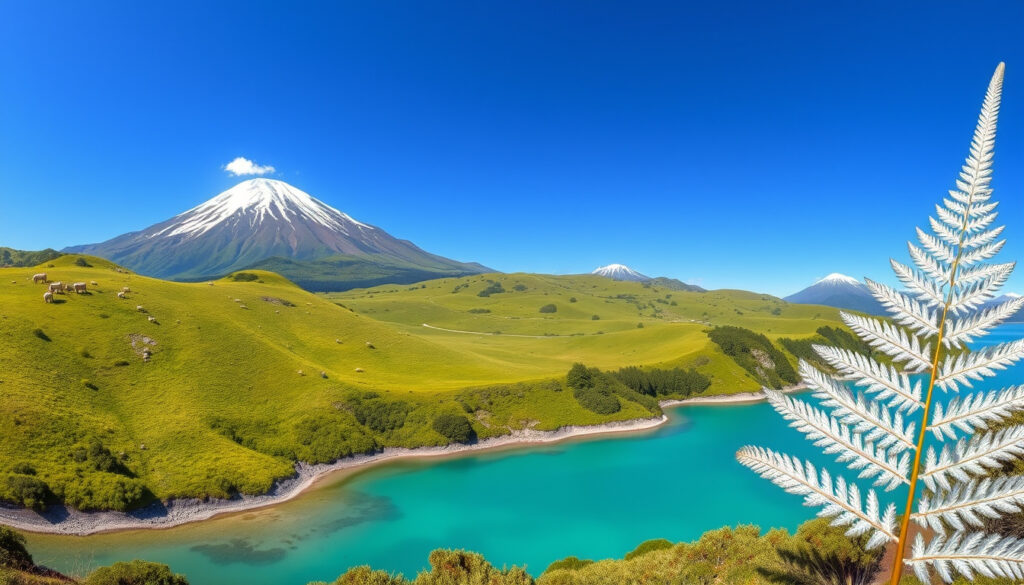
Fun Facts About New Zealand: 50+ Interesting Facts for Kids
There’s a reason New Zealand consistently tops lists of places people want to visit—it’s a country that packs an extraordinary amount of diversity into a relatively small landmass. From its flightless kiwi bird to its world-famous landscapes and rich Māori heritage, the country offers a seemingly endless supply of fascinating facts.
Population (2024 estimate): 5.2 million ·
Sheep per person ratio: 5 sheep to 1 person ·
% of national park land: 30% ·
World’s steepest residential street: Baldwin Street, Dunedin ·
Largest milk exporter globally: Yes ·
Official languages: English, Māori, NZ Sign Language
Quick snapshot
- Two main islands: North and South (Ministry for the Environment)
- Active volcanoes, fiords and glaciers (Te Ara Encyclopedia of New Zealand)
- 30% national park land (Ministry for the Environment)
- Kiwi bird (flightless, endemic) (University of Auckland)
- No native land mammals except bats (University of Auckland)
- Kea parrot and yellow-eyed penguin (Te Ara Encyclopedia of New Zealand)
- Māori heritage and haka dance (NZ History)
- Pavlova dessert (claimed by NZ and Australia) (NZ History)
- Bungee jumping invented here (Te Ara Encyclopedia of New Zealand)
- World’s largest milk exporter (Statistics New Zealand)
- Strong wine industry (Sauvignon Blanc) (New Zealand Wine)
- Film production hub (The Lord of the Rings) (New Zealand Film Commission)
These four pillars give a quick sense of what makes New Zealand tick. But the real depth lies in the details—and the numbers.
| Label | Value |
|---|---|
| Official name | New Zealand / Aotearoa |
| Capital city | Wellington |
| Largest city | Auckland |
| Population (estimate) | 5.2 million |
| Official languages | English, Māori, NZ Sign Language |
| Government | Parliamentary democracy |
| Currency | New Zealand dollar (NZD) |
| Time zone | NZST (UTC+12) |
What are 5 facts about New Zealand?
Key geographic fact about New Zealand
New Zealand consists of two large islands, the North Island and the South Island, plus several smaller islands including Stewart Island and the Chatham Islands (Ministry for the Environment). The North and South Islands are separated by Cook Strait (National Geographic Kids). The North Island is mainly hill country, with Lake Taupō at its center, while the South Island is dominated by the Southern Alps mountain range (Te Ara Encyclopedia of New Zealand).
Key wildlife fact about New Zealand
The kiwi bird is a national symbol and flightless, and it is endemic to New Zealand, meaning it is found nowhere else (Te Ara Encyclopedia of New Zealand). New Zealand’s native wildlife is unusually distinctive because the country was isolated from other lands for millions of years (Te Ara Encyclopedia of New Zealand). Birds are the most noticeable form of native wildlife, and most are unique to the country.
Key cultural fact about New Zealand
Māori culture is an integral part of New Zealand’s identity. The haka, a traditional Māori war dance, is performed at important ceremonies and sporting events, most notably by the All Blacks rugby team before matches (NZ History). New Zealand was the first country to grant women the vote in 1893 (NZ History).
The implication: this interconnectedness is the key to understanding the country’s character.
What is New Zealand famous for?
Famous natural landscapes
New Zealand’s landscape includes volcanoes, glaciers, beaches, forests, open plains, fiords, and long shorelines (Te Ara Encyclopedia of New Zealand). The country is famous for its “Lord of the Rings” filming locations, particularly the dramatic scenery around Queenstown and Tongariro National Park (New Zealand Film Commission).
Famous cultural exports
New Zealand is famous for the haka, a Māori war dance that has become a global symbol of the country (NZ History). The country’s wine industry, especially Sauvignon Blanc from the Marlborough region, is world-renowned (New Zealand Wine). Pavlova, a meringue-based dessert, is claimed by both New Zealand and Australia as their own (NZ History).
Famous inventions
New Zealand is famous for inventing bungee jumping (Te Ara Encyclopedia of New Zealand). Jet boats were also invented by New Zealander Bill Hamilton in the 1950s (HamiltonJet). The country also led the way in women’s suffrage, becoming the first self-governing nation to grant women the right to vote in 1893.
New Zealand’s fame is no accident. The combination of dramatic natural scenery, indigenous cultural traditions, and a knack for inventive thinking has made it a disproportionately influential player on the global stage.
What are 10 unique facts about New Zealand?
Unique wildlife facts
- New Zealand has no native land mammals except two species of small forest-dwelling bats (University of Auckland).
- Over 80% of New Zealand’s 2,500 native conifer, flowering-plant, and fern species are found nowhere else (Te Ara Encyclopedia of New Zealand).
- Before human arrival, 71% of the 245 bird species breeding in New Zealand were endemic (Te Ara Encyclopedia of New Zealand).
Unique geographical facts
- The longest place name in New Zealand is Taumatawhakatangihangakoauauotamateaturipukakapikimaungahoronukupokaiwhenuakitanatahu (Te Ara Encyclopedia of New Zealand).
- Baldwin Street in Dunedin holds the Guinness World Record for steepest residential street (Guinness World Records).
- New Zealand’s coastline is long and varied, with beaches, estuaries, peninsulas, and fiords (Te Ara Encyclopedia of New Zealand).
Unique historical facts
- New Zealand was the first country to give women the vote (1893) (NZ History).
- Around 44% of New Zealand’s land area is covered by native vegetation, mostly in hill country and alpine areas (Ministry for the Environment).
- About half of New Zealand’s land has been converted to farmland (Te Ara Encyclopedia of New Zealand).
The pattern: isolation drives both natural and human innovation.
What are fun facts about New Zealand for kids?
Fun animal facts for kids
The kea is a mountain parrot known for being very clever and curious, often seen playing with objects left by hikers (Te Ara Encyclopedia of New Zealand). New Zealand has over 40 species of lizard, including geckos and skinks, and the ancient tuatara, which is a reptile that predates the dinosaurs (University of Auckland).
Fun geography facts for kids
More than 30% of New Zealand is protected national parks, meaning there are huge areas of wilderness to explore (Ministry for the Environment). New Zealand’s flag has four red stars representing the Southern Cross constellation (NZ History).
Fun nature facts for kids
New Zealand has a carnivorous land snail called Powelliphanta, which can grow to the size of a fist and eats earthworms (Te Ara Encyclopedia of New Zealand). The yellow-eyed penguin is one of the rarest penguin species in the world and lives along the southeast coast of the South Island.
For kids, New Zealand is a real-life science lab. The wildlife and geography offer hands-on lessons in evolution, conservation, and the power of natural protection.
What are fun facts about New Zealand culture?
Māori culture traditions
The haka is performed at important ceremonies and sporting events, and it is a powerful expression of Māori identity and history (NZ History). Māori are the indigenous people of New Zealand, and their language, te reo Māori, is an official language of the country.
Modern New Zealand culture
New Zealand’s culture is a blend of Māori, European, Pacific Island, and Asian influences. The country is known for its friendly, laid-back attitude, often called the “Kiwi” spirit. The All Blacks rugby team is a national icon, and their pre-match haka is one of the most recognizable sporting traditions in the world.
Cuisine of New Zealand
New Zealand’s wine industry, especially Sauvignon Blanc, is world-famous (New Zealand Wine). Pavlova is a popular dessert claimed by both New Zealand and Australia (NZ History). The country also produces high-quality dairy products, lamb, and seafood.
The implication: cultural blending is a strength, not a dilution.
What are 10 creepy facts about New Zealand that are true?
Creepy wildlife fact
New Zealand has a carnivorous land snail called Powelliphanta that hunts earthworms and can grow to the size of a fist (Te Ara Encyclopedia of New Zealand). The giant wētā, a type of insect, can weigh more than a sparrow and is one of the heaviest insects in the world.
Creepy historical event
The 1931 Hawke’s Bay earthquake killed 256 people and was one of New Zealand’s deadliest natural disasters (NZ History). The earthquake caused widespread destruction in Napier and Hastings.
Creepy natural phenomenon
Waitomo Caves are home to glowworms that lure insects with bioluminescence, creating a starry effect on the cave ceilings (Waitomo Caves). The glowworms produce sticky threads to trap their prey, making them effective predators despite their small size.
New Zealand’s “creepy” side is really just nature being efficient. The glowworms, carnivorous snails, and giant insects are all evolutionary adaptations that work perfectly in an isolated ecosystem.
What are 10 interesting facts about New Zealand for students?
Facts about New Zealand’s government
New Zealand’s parliament is called the House of Representatives, and the country operates as a parliamentary democracy under a constitutional monarchy (New Zealand Parliament). The head of state is the British monarch, represented by the Governor-General.
Facts about New Zealand’s economy
Dairy products are New Zealand’s largest export, and the country is the world’s largest milk exporter by volume (Statistics New Zealand). The economy also relies heavily on tourism, agriculture, and film production.
Facts about New Zealand’s education
New Zealand has a world-leading education system and offers free primary and secondary education for all citizens. The country also has eight universities, all of which are publicly funded.
The pattern: scale does not limit institutional quality.
Clarity check
Confirmed facts
- Baldwin Street in Dunedin holds the Guinness World Record for steepest residential street (Guinness World Records).
- New Zealand is the world’s largest milk exporter (by volume) (Statistics New Zealand).
- The kiwi bird is flightless and endemic to New Zealand (Te Ara Encyclopedia of New Zealand).
- New Zealand was the first country to grant women the vote (1893) (NZ History).
What’s unclear
- The exact number of sheep in New Zealand fluctuates; the famous “10 sheep per person” ratio is outdated (Statistics New Zealand).
- Whether the glowworms in Waitomo Caves are technically “creepy” is subjective.
- The best estimate for the number of land-based native plants and animals in New Zealand is around 70,000 species, but this is a medium-confidence estimate.
- The figure that 71% of bird species were endemic before human arrival is based on pre-human estimates and may be imprecise (Te Ara Encyclopedia of New Zealand).
Perspectives from the experts
“New Zealand’s longest place name, Taumatawhakatangihangakoauauotamateaturipukakapikimaungahoronukupokaiwhenuakitanatahu, is a hill in the Hawke’s Bay region. It translates to ‘the summit where Tamatea, the man with the big knees, the slider, climber of mountains, the land-swallower who travelled about, played his flute to his loved one.’”
— Te Ara Encyclopedia of New Zealand (government reference)
“Dairy exports account for a significant portion of New Zealand’s total export revenue, and the country remains the largest exporter of whole milk powder globally.”
— Statistics New Zealand (national statistics office)
These perspectives underscore the blend of quirky trivia and serious economic data that defines New Zealand.
superprof.co.nz, tepapa.govt.nz, backpackerboard.co.nz, doc.govt.nz, collections.tepapa.govt.nz, gotonewzealand.co.nz
Frequently asked questions
Is it safe to travel to New Zealand?
Yes, New Zealand is considered one of the safest countries in the world for travelers. Crime rates are low, and the country is politically stable. However, natural hazards like earthquakes and strong currents exist, so always follow local advice.
What is the best time to visit New Zealand?
The best time depends on what you want to do. Summer (December–February) is ideal for beaches and hiking. Winter (June–August) is perfect for skiing in the Southern Alps. Spring and autumn offer mild weather and fewer crowds.
Do I need a visa to visit New Zealand?
Citizens of many countries, including the United States, United Kingdom, and Australia, do not need a visa for stays up to 3 months. However, you must obtain a New Zealand Electronic Travel Authority (NZeTA) before travel. Check the official immigration website for your country’s requirements.
What language do they speak in New Zealand?
English is the most widely spoken language, but Māori and New Zealand Sign Language are also official languages. You will hear Māori greetings and place names regularly.
What is the currency used in New Zealand?
The New Zealand dollar (NZD) is the official currency. Coins are in denominations of 10c, 20c, 50c, $1, and $2. Notes are $5, $10, $20, $50, and $100.
What is the weather like in New Zealand?
The climate varies from subtropical in the north to temperate in the south. The North Island is generally warmer, while the South Island experiences colder winters with snow in the mountains. The weather can change quickly, so pack layers.
What is the national sport of New Zealand?
Rugby union is the most popular sport, and the All Blacks are the national team. Cricket, netball, and soccer also have large followings. The haka performed before rugby matches is a world-famous tradition.
For travelers, students, or trivia lovers, New Zealand’s fun facts are more than just talking points—they’re entry points into a country that has shaped its destiny through isolation, innovation, and respect for its natural and cultural heritage. Whether you’re planning a trip or just broadening your knowledge, the story of Aotearoa New Zealand is one of remarkable contrast and quiet achievement.
More related posts
 What Is Reminders of Him About? Plot, Tragedy & Themes
 Cast of Warfare Film: Full List & Character Guide
 Credit Card Apply Offers Ireland: Instant Deals
 New Plymouth Body Discovery: Man Found on Fitzroy Beach
 Coldplay Concert Kiss Cam Scandal: Kristin Cabot Resigns
 Auckland Suburbs Property Prices Increase [2026] Guide
 KPop Demon Hunters Saja Boys: Members, Songs & Real Singers
 New Balance Buy Online: Be t Iri h Deal & Retailer