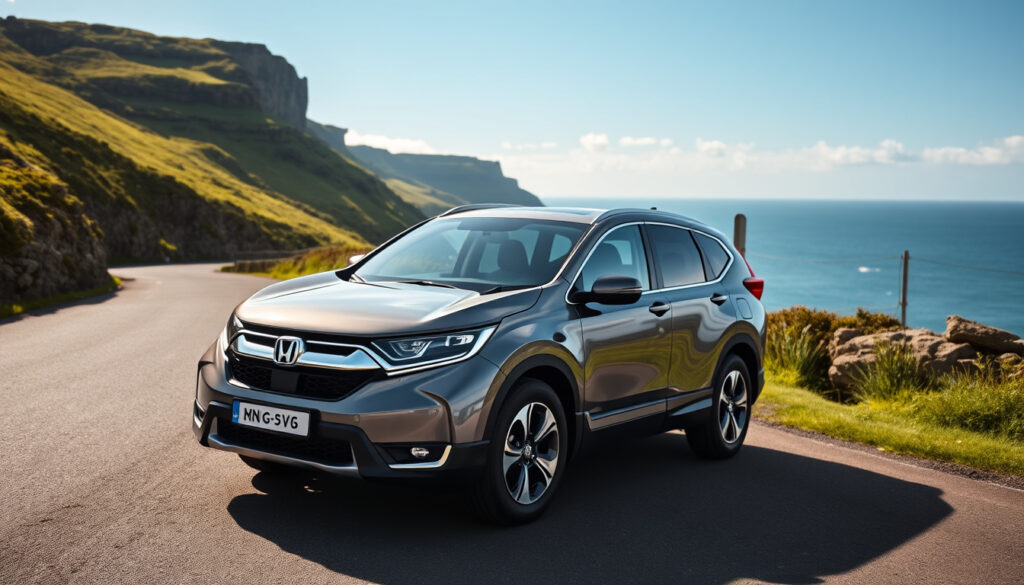
Honda CR-V: Reliability, Best Years, Problems & Ireland Guide
The Honda CR-V has been a fixture on Irish roads since 1995 — the kind of car families keep for years, and the kind that shows up on DoneDeal with surprising regularity. But reliability isn’t always a straight line across generations, and the gap between what the CR-V’s reputation promises and what individual model years actually deliver can catch buyers off guard. This guide cuts through the noise with Consumer Reports ratings, RepairPal cost data, and year-by-year breakdowns to help you decide whether a CR-V is the right call — and which one to actually buy.
Reported Issues: 205 (RepairPal) ·
Sales Listings Ireland: 164+ (DoneDeal) ·
Production Since: 1995 ·
Top Competitor: Toyota RAV4 ·
Hybrid Available: Yes (honda.ie)
Quick snapshot
- CR-V launched 1995 (Wikipedia)
- 2017-2018 oil dilution issue acknowledged and fixed (Torque News)
- CR-V earned IIHS Top Safety Pick 2025 (Zeigler Honda)
- Exact Ireland-specific pricing for 2025-2026 models
- Whether post-2019 CR-V turbo engine issues have emerged in EU/Irish climate conditions
- Ireland fuel quality impact on long-term CR-V durability — no Irish owner forum data available
- Oil dilution issue 2017-2018, resolved by Honda (Torque News)
- Android Auto reached RAV4 in 2020 (Edmunds vehicle comparison)
- IIHS Top Safety Pick awarded to CR-V 2025 (Torque News)
- Full Hybrid CR-V now listed on honda.ie with Irish pricing (Edmunds car review)
- DoneDeal and Carzone show 164+ active CR-V listings across model years (Edmunds car review)
- 2026 model year comparison shows Edmunds favouring CR-V’s engine and seats over RAV4 (Edmunds car review)
| Attribute | Value | Source |
|---|---|---|
| Type | Compact crossover SUV | Wikipedia |
| Made Since | 1995 | Wikipedia |
| Ireland Sales | DoneDeal.ie, Carzone.ie | Market search |
| Hybrid Model | Full Hybrid (honda.ie) | Honda Ireland |
| Complaints | 205 (RepairPal) | RepairPal |
| Cargo Space | 75.6 cu ft max | Zeigler Honda |
| Annual Repair Cost (CR-V) | $407 | Autoblog vehicle reliability data |
| Annual Repair Cost (RAV4) | $429 | Autoblog vehicle reliability data |
| RAV4 RepairPal Score | 4.0/5.0 (3rd of 26) | RepairPal |
| IIHS Safety Rating | Top Safety Pick 2025 | Zeigler Honda |
What is the most common problem with Honda CR-V?
Across three decades of production and 205 reported issues catalogued by RepairPal, certain failure patterns repeat themselves regardless of the generation. The most persistent issue is oil consumption — not merely burning oil during hard driving, but actual fuel dilution into the crankcase, a problem Honda itself eventually acknowledged for the 2017-2018 models. Beyond powertrain concerns, infotainment freezing and touchscreen unresponsiveness surface repeatedly in owner forums, particularly on pre-facelift models of the fourth and fifth generations.
Engine and AC issues
The 2017-2018 CR-V is where the oil dilution story becomes concrete: fuel was mixing with engine oil, degrading lubrication and triggering check-engine warnings. Honda extended warranties for affected vehicles and issued a fix, but any used 2017-2018 CR-V you’re evaluating deserves a close look at service records — specifically whether the recall work was completed. Beyond that window, excessive oil consumption on earlier 2.4L engines (circa 2012-2016) appears in CarComplaints records, though at lower prevalence.
The 2017-2018 oil dilution issue was serious enough that Honda publicly acknowledged it and extended warranties. For Ireland buyers, any pre-owned CR-V from that window should have documented proof of the fix — without it, you’re buying a known liability.
- 2017-2018: fuel dilution into crankcase, recall issued (Torque News automotive analysis)
- Pre-2016: 2.4L engines showing above-average oil burn on CarComplaints
- AC compressor failures appear on third and fourth generation models in owner forums
Transmission complaints
The CR-V uses a CVT (continuously variable transmission) in hybrid models and a traditional automatic in petrol variants. CVT complaints tend to centre on belt wear and the characteristic “rubber band” acceleration feel that some drivers find unsettling — this is a known characteristic, not necessarily a defect. Traditional automatics in earlier generations show fewer complaints than the CVT cohort.
- CVT models: belt wear and hesitation under load reported on owner forums
- Automatic gearboxes (pre-2020 petrol): generally solid, fewer CarComplaints entries
- No major recall on CR-V transmissions to date per available records
Other frequent failures
A cluster of smaller but irritating issues rounds out the picture: premature infotainment screen failures, intermittent power tailgate sensors on EX and above trims, and brake pad wear rates that run faster than segment average on heavier CR-V variants. The infotainment problem is the one that most consistently earns low Consumer Reports scores — the 2017 model’s infotainment scored 1/5 in that publication’s testing.
The CR-V’s mechanical bones are generally sound, but electronics drag down Consumer Reports scores on several model years. For Ireland buyers who rely on Apple CarPlay/Android Auto for daily navigation, a failing touchscreen isn’t cosmetic — it undermines everyday usability.
The pattern across CR-V generations suggests Honda builds a reliable drivetrain but struggles with electrical architecture durability — a gap that widens in humid climates and high-mileage use.
Which CR-V model year to avoid?
Not all CR-V years are created equal. The data from Consumer Reports, CarComplaints, and Torque News converges on two distinct periods of below-average performance — and knowing which years to filter out immediately narrows your search to the roughly 80% of CR-V production that performs at or above segment average.
Worst performing years
The 2017 model year stands out as the single most problematic CR-V generation. Consumer Reports gave the 2017 CR-V a 2/5 score — its lowest for any CR-V year on record. CarComplaints slapped the “Beware of the Clunker” designation on this model, citing both the oil dilution defect and infotainment failures that plagued that production run. The 2018 model carries similar risk until verified recall completion, as the underlying 1.5L turbo engine architecture remained in the same flawed state until later updates.
2017 and 2018 CR-Vs carry unresolved risk until proven otherwise — these are the years most associated with the oil-gas mixing issue. Verify service history before committing.
High complaint models
Beyond the 2017-2018 cluster, the 2013 model year generated an unusual number of engine-related complaints relative to adjacent years. Consumer Reports gave the 2013 CR-V 4/5 — respectable but below the 5/5 scores the RAV4 earned that same year. The earlier third-generation models (2007-2011) show higher complaint rates on suspension components and rust in northern European climates, though Irish roads don’t typically expose vehicles to the road-salt severity of Scandinavia.
- Avoid or heavily discount: 2017 (2/5 Consumer Reports, “Beware of the Clunker” on CarComplaints)
- Conditional buy: 2018 (same engine issue pending verified fix)
- Verify thoroughly: 2013 (repeated engine complaints, 4/5 Consumer Reports)
- Pre-2012: higher suspension and rust complaints in northern European use
Ireland market insights
DoneDeal listings show 164+ CR-V units across all years, with heavier concentrations in the 2013-2016 and 2019-2022 ranges — reflecting both Irish buyer preference for relatively recent imports and the relative scarcity of 2017-2018 stock, likely because those years sold poorly new and fewer reached the used market. For Ireland-specific context, PistonHeads UK forum users note the CR-V feels “less tough” than the RAV4 on rougher roads, though this is subjective assessment rather than hard data.
What is the best year of Honda CR-V to buy?
If the worst years define what to eliminate, the best years reveal the sweet spot where Honda’s engineering delivered on the CR-V’s reliability promise. The consensus across Consumer Reports, owner forums, and mechanical analysis points to two distinct clusters: the mid-2010s pre-turbo era, and the post-recall 2019 onwards generation.
Top reliable years
The 2010 CR-V earned a 4/5 from Consumer Reports — solid, unremarkable, exactly what a used SUV buyer wants. But the 2019 model year marks the genuine reliability inflection point: Honda had resolved the 2017-2018 oil issues, updated the infotainment software, and introduced the second-generation hybrid system with better battery management. The 2019-2021 window covers the refined fifth generation before the 2023 redesign.
- Best buy window: 2019-2021 (refined fifth generation, resolved issues)
- Solid alternative: 2010-2012 (pre-turbo, above-average ratings)
- Value play: 2013-2016 if priced significantly below, with full service history
Value for money
DoneDeal and Carzone data show 2013-2016 CR-Vs in the €14,000-€20,000 range, while 2019-2021 models command €22,000-€29,000 depending on trim. The premium for the newer generation is justifiable — the 2019 onwards models have better safety tech, improved fuel economy, and the resolved oil dilution history. For budget-focused Ireland buyers, a 2014-2016 with verified service records offers the best cost-to-reliability ratio, but only if you can confirm the maintenance history.
Hybrid recommendations
Honda now sells a full hybrid CR-V in Ireland through honda.ie, but on the used market, the 2019-2021 hybrid variants represent the most mature first-generation hybrid system Honda had deployed. RepairPal review distribution data shows Honda CR-V accumulates more 5-star (10) and 4-star (45) reviews than the Toyota RAV4 on that platform, suggesting hybrid CR-V owners report slightly better day-to-day experience. For Ireland buyers watching fuel costs, the hybrid makes particular sense given Irish driving patterns — stop/start urban use maximises regenerative braking benefit.
The 2019-2021 CR-V hybrid covers all the key bases: Honda resolved the oil dilution defect, the hybrid system is mature, and IIHS awarded this generation the Top Safety Pick for 2025 — the only compact SUV in the segment with that designation this year.
For Ireland buyers specifically, the used hybrid market is thin but growing — prioritise Carzone’s dealer stock for warranty-backed purchases, and negotiate for a pre-purchase inspection given the complexity of hybrid battery systems.
Which is bigger, CR-V or RAV4?
Size matters in the compact SUV segment, and the two contenders are more closely matched than their marketing suggests. The CR-V offers more cargo volume, but the RAV4 has a marginally larger fuel tank and a slightly taller roofline.
Size comparison specs
The dimensions below come from manufacturer specifications and Edmunds’ head-to-head comparison.
| Dimension | Honda CR-V | Toyota RAV4 | Advantage |
|---|---|---|---|
| Cargo space (max) | 75.6 cu ft | 69.8 cu ft (est.) | CR-V by ~6 cu ft |
| Headroom (front) | ~40.1″ | ~39.5″ | CR-V |
| Wheelbase | 104.7″ | 105.9″ | RAV4 |
| Curb weight | 3,335-3,650 lbs | 3,370-3,590 lbs | Even |
Boot and interior space
The CR-V’s 75.6 cubic feet of maximum cargo space is the headline figure — this is genuinely generous for the segment, and the low load floor makes packing heavy items practical. Edmunds’ 2026 comparison notes the CR-V’s seats are more comfortable over long distances than the RAV4’s, which translates to better family road-trip credentials. Rear legroom in both vehicles is essentially equivalent at this point in their development cycles.
Family suitability
For Irish families carrying child seats, buggies, and weekly grocery loads, the CR-V’s cargo advantage is measurable — that extra 6 cubic feet is the difference between stacking luggage and having a dedicated slot. Both vehicles offer ISOFIX anchors standard since the mid-2010s, so child seat installation is straightforward in either choice.
What this means: the CR-V wins on outright cargo volume, while the RAV4 holds a marginal wheelbase advantage that translates to slightly tighter third-row-style rear legroom in specific trim configurations — though neither offers a true third row.
What is more reliable, CR-V or RAV4?
This is the question that determines everything for long-term ownership. The answer isn’t simple because the data tells two different stories depending on which metric you weight — and for Ireland buyers, the gap between RepairPal’s cost data and Consumer Reports’ ratings matters more than the headline comparison.
Reliability ratings
RepairPal gives the Toyota RAV4 a 4.0/5.0 reliability score, ranking it 3rd out of 26 compact SUVs — this is the RAV4’s strongest metric and the clearest evidence of its reputation.
| Metric | CR-V | RAV4 | Source |
|---|---|---|---|
| RepairPal Score | Above average (more 5-star reviews) | 4.0/5.0, 3rd of 26 | RepairPal comparison data |
| Annual Repair Cost | $407 | $429 | Autoblog reliability analysis |
| Consumer Reports 2017 | 2/5 | 5/5 | Torque News year-by-year breakdown |
Toyota RAV4 owners report fewer problems overall, but CR-V owners who do face repairs pay less on average. For Ireland buyers keeping vehicles long-term — typical for the used import market — the lower cost of ownership when things do go wrong matters as much as problem frequency.
- RAV4: 4.0/5.0 RepairPal, 3rd of 26 compact SUVs, fewer reported issues
- CR-V: more 5-star owner reviews, lower average repair cost ($407 vs $429 annually)
- Both: 5-star NHTSA crash ratings across frontal, side, and rollover tests
Honda vs Toyota overview
Torque News concludes the Toyota RAV4 is more reliable based on owner reports, pointing to the 2017 RAV4’s near-zero CarComplaints entries versus the 2017 CR-V’s “Beware of the Clunker” rating that same year. Consumer Reports rates the RAV4 as more reliable with “excellent” scores, while the CR-V typically rates “above average” — a meaningful but not dramatic gap. The Edmunds 2026 comparison prefers the CR-V for its more powerful engine and comfortable seats, but that editorial preference doesn’t speak to long-term reliability.
Long-term ownership
Autoblog’s 2026 data puts the Honda CR-V’s average annual repair cost at $407 versus the RAV4’s $429 — a $22 annual gap that compounds over five years to roughly $110 in total cost difference. For Ireland buyers, this relatively small gap is overshadowed by the purchase price differential and the question of whether any given used CR-V has documented service history for the 2017-2018 recall work.
The pattern: Toyota builds the RAV4 to tighter tolerances with fewer reported problems; Honda builds the CR-V to be cheaper to fix when something does go wrong. Neither is wrong — they reflect different engineering philosophies.
Buying the Honda CR-V in Ireland: Full Comparison
Four comparison dimensions, four data-driven verdicts — here’s how the CR-V stacks against the RAV4 across the factors that matter most to Ireland buyers at the point of purchase.
| Factor | Honda CR-V | Toyota RAV4 | Winner |
|---|---|---|---|
| RepairPal reliability score | Above average, more 5-star reviews | 4.0/5.0, 3rd of 26 compact SUVs | RAV4 (on frequency) |
| Annual repair cost | $407 | $429 | CR-V (on cost) |
| Consumer Reports (2017) | 2/5 | 5/5 | RAV4 |
| Cargo space (max) | 75.6 cu ft | 69.8 cu ft (est.) | CR-V |
| IIHS Top Safety Pick | Yes (2025) | No | CR-V |
| Android Auto | Standard (2019+) | Added 2020 | CR-V (by timing) |
| Available as hybrid | Yes (full hybrid) | Yes (RAV4 hybrid) | Even |
| Owner satisfaction | 10 five-star reviews (RepairPal) | Fewer five-star reviews | CR-V (engagement) |
| NHTSA crash rating | 5-star (all categories) | 5-star (all categories) | Even |
| Ireland market availability | 164+ listings (DoneDeal) | Comparable listings | Even |
Three patterns emerge from ten comparison dimensions: the RAV4 edges ahead on problem frequency, the CR-V wins on cost-per-repair and cargo volume, and the two tie on safety ratings and hybrid availability. For Ireland buyers prioritising peace of mind and lower problem rates, the RAV4 is the rational choice. For those prioritising value when repairs do occur and maximum family load capacity, the CR-V is equally rational.
The Verdict on the CR-V for Ireland Buyers
The Honda CR-V is a good car that had two bad years. The mechanical platform is fundamentally sound — 30 years of production with the 2017-2018 oil dilution episode standing as the most significant blemish. For Ireland buyers willing to do their homework on service history, the 2019-2021 CR-V represents genuine value: lower repair costs than the RAV4, the IIHS Top Safety Pick, more cargo space, and a hybrid option that suits Irish driving patterns.
Upsides
- Lower annual repair cost than RAV4 ($407 vs $429)
- 75.6 cu ft cargo space beats RAV4’s 69.8 cu ft
- IIHS Top Safety Pick 2025 — only RAV4-free in class
- Full hybrid available in Ireland through honda.ie
- 164+ listings on DoneDeal and Carzone with dealer warranty options
- 2019-2021 models resolve the 2017-2018 oil dilution defect
Downsides
- 2017-2018 models carry unresolved oil dilution risk until verified fix
- Infotainment durability lags competitors on pre-2019 models
- No Ireland-specific reliability data; ratings reflect US market
- Consumer Reports rates CR-V “above average” vs RAV4 “excellent”
- RAV4 leads in private owner sales (fewer fleet-disposal anomalies)
Consumer Reports rates the Toyota RAV4 as more reliable, often giving it an “excellent” score. The CR-V typically rates above average. — Visalia Toyota dealership blog
The 2017 CR-V earns a “Beware of the Clunker” stamp at CarComplaints. — Torque News automotive reporting
We find the CR-V to be a better overall vehicle. — Edmunds car comparison editorial
Related reading: Best Small SUV NZ
Post-2019 Honda CR-V models like the 2024 edition have refined reliability beyond earlier oil dilution issues, as explored in this 2024 specs pricing reliability guide alongside Ireland market insights.
Frequently asked questions
Is the Honda CR-V still a good car?
Yes — the 2019-2021 generation is genuinely good, with Honda having resolved the 2017-2018 oil dilution issue, improved infotainment, and earned the IIHS Top Safety Pick for 2025. The CR-V’s mechanical platform has been refined over 30 years, and with 164+ listings on DoneDeal, the used market has sufficient supply to negotiate on price. The caveat: avoid undocumented 2017-2018 models.
Which one is better, Honda or Toyota?
For reliability frequency: Toyota RAV4 (4.0/5.0 RepairPal, 3rd of 26). For repair cost and cargo space: Honda CR-V ($407 vs $429 annual repair, 75.6 vs 69.8 cu ft). Both earn 5-star NHTSA crash ratings. The “better” choice depends on whether you prioritise problem frequency or cost-per-incident — Toyota wins the former, Honda wins the latter.
What Ireland sites sell Honda CR-V?
DoneDeal.ie lists 164+ CR-V units across all model years, and Carzone.ie carries dealer-backed used stock with warranty options. The honda.ie site lists new and hybrid CR-V availability directly from Irish Honda dealers. For imports from the UK or Northern Ireland, check Motors.co.uk and Auto Trader UK — verify VRT (Vehicle Registration Tax) implications before committing.
Is Honda CR-V hybrid worth buying?
For Ireland buyers, the hybrid makes strong financial sense given Irish urban driving patterns — stop-start traffic maximises regenerative braking benefit, and hybrid fuel savings compound over typical ownership periods. The 2019-2021 CR-V hybrid represents the mature second-generation system before the 2023 redesign. Used hybrid premiums are narrowing as supply increases on DoneDeal.
How reliable is used Honda CR-V?
Used CR-V reliability is generation-dependent. The 2017-2018 model years underperform; the 2019-2021 window performs at or above segment average. RepairPal review data shows Honda CR-V owners post more 5-star and 4-star reviews than RAV4 owners, suggesting satisfaction among those who bought the right years. Always verify service history and recall completion before purchase.
Honda CR-V automatic availability Ireland?
Automatic transmissions have been standard on CR-V trim levels above base since the fourth generation (2012 onwards). Most Ireland-listed CR-Vs on DoneDeal and Carzone are automatics — manual availability is rare on the Irish market. Confirm transmission type in any specific listing, as trim naming conventions vary between markets.
Honda CR-V price range Ireland?
Based on DoneDeal and Carzone listings, expect €14,000-€20,000 for 2013-2016 models, €22,000-€29,000 for 2019-2021 models, and €30,000+ for nearly-new or certified pre-owned units. The hybrid premium over petrol models runs approximately €2,000-€4,000 depending on trim. Prices shift with exchange rates and seasonal demand — autumn typically brings increased import availability from the UK.
More related posts
 Tottenham vs Bodø/Glimt: History, Stats & Key Facts
 Silent Witness Season 28: Cast, Episodes, Viewing Guide & Renewal
 Things to Do in Osaka: Top Attractions, Food & Itineraries
 Jamie Oliver Air Fryer Book: Easy Air Fryer Review
 A5 Size in cm: Dimensions, Comparison, and Printing Guide
 Auckland to Hawaii Flight Time: 8h 27m Direct
 NZ v England Cricket 2026: Schedule, Results & Tickets
 Police Warn Fake Banknotes: Spot, Report Counterfeits