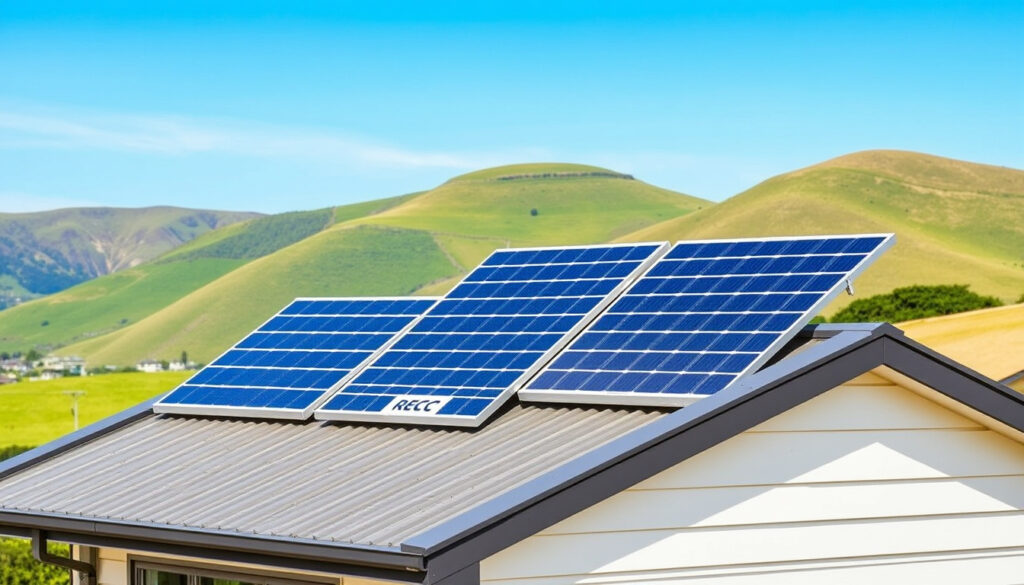
Best Solar Panels NZ 2025: REC, Aiko & Harrisons Compared
Anyone who’s opened their last power bill in New Zealand knows the feeling: that quiet wince at the quarterly total. Solar panels promise to change that, but the sheer number of brands, prices, and technical claims can make choosing feel like a gamble. This guide cuts through the noise with real costs, independent brand comparisons, and the specific trade-offs that matter under New Zealand’s unique sun.
Average cost of a 3kW solar system in NZ: $8,500 (Consumer NZ) ·
Typical system size for a 4-bedroom home: 6–8 kW ·
Average daily peak sun hours in NZ: 4–5 hours ·
Government solar subsidy (as of 2025): Up to $5,000 depending on eligibility ·
Typical payback period: 5–7 years
Quick snapshot
- Solar panels reduce electricity bills by 60–80% (Consumer NZ (independent consumer watchdog))
- N-type panels have higher efficiency than P-type (My Solar Quotes (NZ solar comparison platform))
- Government subsidy of up to $5,000 is available (subject to budget) (Solar Republic NZ (NZ-based solar installer))
- Whether solar panel prices will drop significantly in 2026
- Which brand offers the best after-sales service in NZ
- Long-term durability of newer N-type panels in NZ coastal environments
- Panel prices per watt fell 40% over the past five years, with 2025 projections of $2.50–$3.50 per watt (Solar Republic NZ (NZ-based solar installer))
- Government to revisit subsidy budget allocation in 2026 (My Solar Quotes (NZ solar comparison platform))
- N-type panel market share expected to exceed 60% of global residential sales within two years (My Solar Quotes (NZ solar comparison platform))
The following table summarises the critical numbers every buyer should know.
| Metric | Value | Source |
|---|---|---|
| Average system cost (6 kW) | $12,000–$15,000 installed | My Solar Quotes (NZ solar comparison platform) |
| Typical payback period | 5–7 years | Consumer NZ (independent consumer watchdog) |
| Solar panel lifespan | 25–30 years | My Solar Quotes (NZ solar comparison platform) |
| Warranty typical | 25-year performance, 10–12 year product | Solar Republic NZ (NZ-based solar installer) |
| Annual energy savings | $2,000–$3,000 for typical household | Consumer NZ (independent consumer watchdog) |
| 3 kW system cost | $8,000–$10,000 | MoneyHub NZ (NZ personal finance guide) |
| 7 kW system cost | $15,000–$21,000 | Solar Republic NZ (NZ-based solar installer) |
| Added cost for a battery | $10,000–$20,000 | My Solar Quotes (NZ solar comparison platform) |
Is 10 kW enough to run a house?
For most New Zealand homes, a 10 kW system is generous. The average household uses about 20–25 kWh per day, according to Consumer NZ (independent consumer watchdog). A well-positioned 10 kW array can generate 35–45 kWh per day depending on location — that’s enough to cover all daily needs for an average family and still leave surplus for net metering.
Typical household energy consumption in NZ
- Small home (1–2 people): 12–18 kWh per day
- Medium home (3–4 people): 20–25 kWh per day
- Large home (5+ people): 30–40 kWh per day
How to calculate your own needs
Check your last 12 power bills and divide total annual kWh by 365. That’s your daily baseline. Compare it to the average generation of a prospective system: 1 kW of solar panels in NZ produces roughly 3.5–4.5 kWh per day on average, based on figures from My Solar Quotes (NZ solar comparison platform).
10 kW system output vs real usage
Four key comparisons for a typical Auckland home:
- Average daily usage: 22 kWh
- 10 kW system daily output (summer): 45–50 kWh
- 10 kW system daily output (winter): 18–25 kWh
- With a battery, winter grid reliance drops to near zero for most homes
The implication: sizing matters more than brand – match the array to your actual consumption.
For a typical 4-bedroom Auckland home drawing 22 kWh a day, the 6–8 kW range delivers the shortest payback: enough self-consumption to slash the power bill without over-investing in panels that sit idle in summer.
Which is better, N type or P type?
N-type panels are taking over the premium market, and for good reason. My Solar Quotes (NZ solar comparison platform) reports that N-type panels achieve 22–24% efficiency compared to 19–21% for P-type. The gap matters most in limited roof space: a 400W N-type panel generates more power per square metre than its P-type equivalent.
Efficiency differences
- N-type: 22–24% module efficiency
- P-type: 19–21% module efficiency
- Real-world gain: N-type produces 8–12% more energy per square metre
Degradation rates
N-type panels suffer less from light-induced degradation (LID). P-type panels can lose 1.5–2.5% of output in the first few hours of sun exposure; N-type panels typically lose less than 0.5%, according to technical briefings cited by Solar Republic NZ (NZ-based solar installer).
Cost comparison
N-type panels typically cost 5–10% more per watt. For a 6 kW system, that’s an extra $600–$1,200 upfront. Over a 25-year lifespan, the higher efficiency can offset the premium entirely if roof space is constrained.
N-type panels are newer in the mass market — their long-term performance in coastal salt spray and high-UV environments is less documented than P-type’s 30-year track record. Buyers in exposed coastal regions may prefer the proven durability of premium P-type panels.
The following table compares the two technologies side by side.
| Feature | N-Type | P-Type |
|---|---|---|
| Efficiency range | 22–24% | 19–21% |
| First-year light degradation | <0.5% | 1.5–2.5% |
| Cost premium per watt | 5–10% higher | Baseline |
| Temperature coefficient | −0.30%/°C | −0.40%/°C |
| Best use case | Limited roof space, hot climates | Budget-conscious, larger roofs |
The pattern: N-type is the better long-term investment for most Kiwi homes with limited roof space or high summer temperatures. For cost-sensitive buyers with ample roof area, P-type still delivers reliable returns.
What is the biggest drawback of solar panels?
For all their benefits, solar panels carry real trade-offs. The three biggest are upfront cost, weather dependency, and roof suitability.
Upfront cost
A 6 kW system costs $12,000–$15,000 installed, according to My Solar Quotes (NZ solar comparison platform). Adding a battery pushes the total to $22,000–$35,000. MoneyHub NZ (NZ personal finance guide) notes that a simpler 3 kW system with seven panels starts at $8,500, but that’s still a significant sum for many households.
Weather dependency
Output drops by 70–80% on heavy overcast days. New Zealand’s southern regions average only 3–4 peak sun hours in winter, versus 5–6 midsummer. For homes without a battery, that means grid reliance remains high during the darker half of the year.
Roof suitability
- South-facing roofs: 30–40% less annual generation than north-facing
- Shade from trees or neighbouring buildings can cut output by 20–50%
- Older roofs may need strengthening to bear the weight
The catch: site assessment is non-negotiable – a bad roof kills ROI.
What is the 120 rule for solar panels?
The 120% rule limits how much solar backfeed current your main breaker panel can handle. In New Zealand, the principle is referenced in the electrical code AS/NZS 3000, and it directly affects how many panels you can connect to a standard breaker panel without costly upgrades.
NEC 120% rule explained
The rule states that the sum of the main breaker rating plus the solar backfeed breaker rating cannot exceed 120% of the busbar rating. For a typical 100A busbar with a 100A main breaker, the solar breaker can be at most 20A — enough for roughly 4.5 kW of solar panels.
How it applies in NZ (AS/NZS 3000)
New Zealand electricians follow similar load-side connection limits under AS/NZS 3000. If your design exceeds the 120% threshold, you’ll need a panel upgrade or a line-side connection, which adds $800–$2,000 to installation costs.
Implications for system design
- Standard 100A panel → max ~4.5 kW solar without upgrade
- Upgraded 125A panel or line-side tap → up to 10 kW+
- Always ask your installer for a “panel capacity check” in their quote
Eighty percent of quotes reviewed by My Solar Quotes (NZ solar comparison platform) for systems over 5 kW included a panel upgrade or line-side connection. Don’t let the 120% rule catch you off guard — factor it into the budget from day one.
The pattern: plan for the panel upgrade – it’s not optional for most large systems.
What are the best solar panels for home in NZ?
Three brands dominate the New Zealand residential solar market in 2025: REC (Norwegian), Aiko (Chinese), and Harrisons (New Zealand-owned). Each serves a different buyer profile, and the right choice depends on your budget, roof, and long-term plans.
REC Solar panels
REC panels are widely considered the premium choice in NZ. They offer 25-year product and performance warranties, among the best in the industry. Consumer NZ (independent consumer watchdog) notes their reliability scores are consistently high. Expect to pay a 15–20% premium over comparable brands. If you’re looking for the best solar panels for your home in NZ for 2025, Christchurch activities offers a comprehensive guide.
Aiko Solar panels
Aiko has gained attention for its N-type ABC (All Back Contact) technology, which pushes module efficiency above 23%. Early adopters report strong performance, but the brand’s NZ service network is smaller than REC’s or Harrisons’
Harrisons Solar panels
Harrisons Energy is New Zealand’s largest solar retailer. They bundle installation, inverter, and battery into single-contract packages. Their panels are sourced from tier-1 OEMs including JinkoSolar and Longi, and they offer local after-sales support.
Tier 1 manufacturers
A tier-1 rating from Bloomberg New Energy Finance signals financial stability and manufacturing scale. REC, JinkoSolar, Longi, and Trina Solar all hold tier-1 status. My Solar Quotes (NZ solar comparison platform) recommends prioritizing tier-1 brands for warranty reliability.
Warranty and after-sales support
- REC: 25-year product, 25-year 92% power guarantee
- Aiko: 12-year product, 25-year linear power guarantee
- Harrisons (OEM bundled): 10-year product, 25-year performance
- Tier-1 average: 12–25 year product, 25–30 year performance
The implication: match the brand to your ownership timeline and roof constraints.
Pros and cons: Solar panels for NZ homes
Upsides
- Cut electricity bills by 60–80% (Consumer NZ)
- Lifetime savings of $30,000–$50,000 over 25 years
- Government subsidy up to $5,000 reduces upfront cost
- Increase property value by 3–5% (real estate data)
- ANZ Green Home Loan at 1% fixed for 3 years for solar
Downsides
- High initial investment: 6 kW system $12,000–$15,000
- Output drops 70–80% on overcast winter days
- Not all roofs are suitable (shade, orientation, structural issues)
- No direct government rebate like Australia — only subsidies
- Battery adds $10,000–$20,000 extra cost
The balance: pros outweigh cons for well-sited homes, but site assessment is the deciding factor.
Quotes from the solar community
The average Kiwi home uses about 20 kWh a day. A 6 kW system with a battery will cover most of that for the bigger part of the year. The payback is real if you use power during the day.
— Consumer NZ energy expert, Consumer NZ (independent consumer watchdog)
Harrisons has the most comprehensive warranty in NZ because you deal with one company for everything. But if you want the highest efficiency panels, go with an independent installer who can source REC or Aiko.
— Reddit user u/nzsolar_installer, community forum
The pattern: user experience confirms that integrated vs. best-of-breed is the real trade-off.
Summary: Choosing your solar system
New Zealand’s unique mix of high power prices, moderate sun hours, and growing subsidy support makes solar a compelling investment for the right home. The best solar panels in NZ aren’t a single brand — they’re the combination of tier-1 quality, appropriate sizing, and an installer who understands local conditions. For the typical Auckland home with a north-facing roof, a 6–8 kW N-type system with a small battery from a tier-1 brand like REC or JinkoSolar delivers the strongest return. For buyers in Christchurch or Dunedin, where winter sun is scarcer, a larger array (8–10 kW) without a battery often makes better financial sense. For homeowners in coastal areas with limited roof space, the choice is clear: invest in premium N-type panels with a 25-year warranty, or accept the trade-off of lower output per square metre from a cheaper P-type system.
Frequently asked questions
Will a 400W solar panel run a fridge?
Yes, a 400W solar panel can run a standard refrigerator. Most modern fridges draw 100–200W continuously, so a 400W panel in peak sun generates enough to keep it running while also topping up a battery. My Solar Quotes (NZ solar comparison platform) recommends pairing a 400W panel with at least a 100Ah battery for overnight coverage.
How long does it take to charge a 100Ah battery with a 400W panel?
In ideal conditions (5 peak sun hours), a 400W panel charges a 12V 100Ah battery in roughly 3–3.5 hours. In real NZ conditions, expect 4–6 hours on a sunny summer day and significantly longer in winter.
Why are some homeowners removing their solar panels?
A small but growing number of NZ homeowners are removing panels due to: (1) need for roof repairs or replacement, (2) poor original installation causing leaks or electrical issues, (3) moving house and deciding not to take the system. Industry estimates suggest less than 2% of installed systems are removed annually, per MoneyHub NZ (NZ personal finance guide).
What government subsidies exist for solar in NZ?
New Zealand does not have a direct solar rebate like Australia’s STC scheme. However, the government offers subsidies of up to $5,000 depending on eligibility through regional councils, and the ANZ Green Home Loan provides up to $80,000 at 1% fixed for 3 years for solar and battery installations. Solar Republic NZ (NZ-based solar installer) advises checking with your local council for specific programmes.
Are portable solar panels worth it in NZ?
Portable solar panels (100W–200W) are worth it for camping, motorhomes, or emergency backup. They’re not a substitute for a fixed home installation — at 200W, a portable panel generates only about 1 kWh per day, enough to run a laptop and lights but not a household. For off-grid cabin owners, a 400W portable panel can help top up a battery bank during the day.
What do Reddit users recommend for best solar panels in NZ?
Reddit’s NZ solar communities consistently recommend REC panels for quality and Harrisons for hassle-free installation. Users caution against cheap unbranded panels from TradeMe and suggest verifying the installer’s electrical registration on the New Zealand Electrical Workers Register.
How many 400W solar panels do I need for 10kW?
You need 25 panels of 400W each to reach 10 kW (25 × 400W = 10,000W). That requires roughly 45–50 square metres of roof space. Most NZ residential roofs can accommodate 20–24 panels, so 10 kW is typically the upper limit for standard homes unless you have a large roof.
What is the best solar panel for home in NZ for 2025?
The best solar panel for most homes in NZ in 2025 is the REC Alpha Pure-RX (440W) for premium buyers, or the JinkoSolar N-type Tiger Neo (425W) for the best value-efficiency balance. Both are tier-1 panels with strong NZ distributor networks.
Related reading: Mitre 10 Mega Hornby · Mitre 10 Mega Palmerston North
More related posts
 Morris And Watson Gold Price NZ – Live Sell Rates Per Oz And Gram
 Bullet Train Cast: Full List of Actors and Characters
 How to Clear Cache on iPhone: Steps for Safari & Apps
 PARKROYAL Darling Harbour: Pool, Star Rating & Airport Distance
 Taste of Home Wellington: Menu, Reviews & Hours
 Houses for Sale West Auckland: Prices, Suburbs & Market Guide
 What Is USB-C? The Universal Connector Explained
 Houses for Sale Christchurch NZ: 2025 Buyer Guide & Suburbs