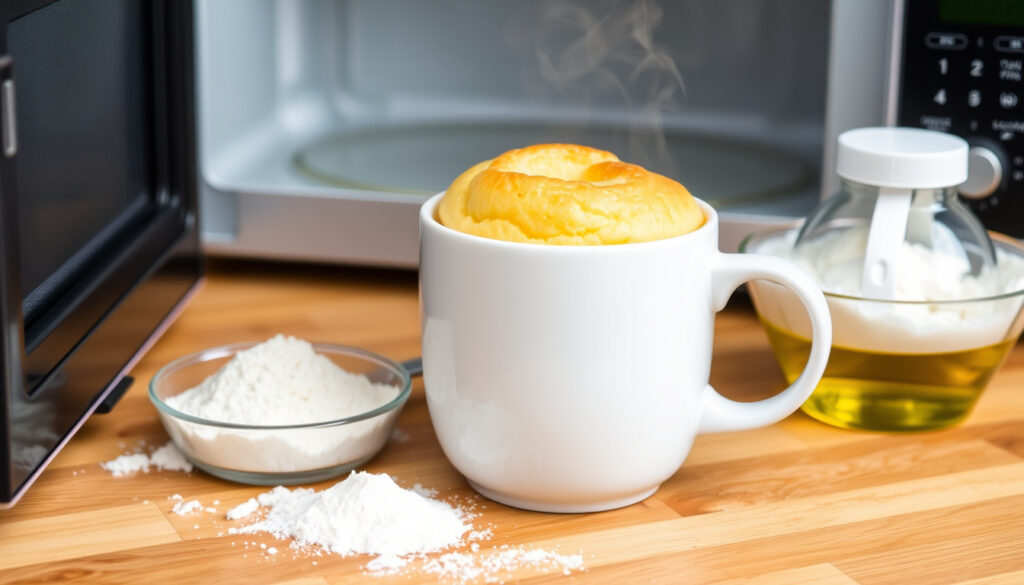
3 Ingredient Mug Cake: Quick Microwave Recipe No Egg
A mug cake delivers a fresh, warm dessert in roughly 90 seconds — no oven, no bowl, no waiting. That contrast with traditional baking is what makes this method genuinely useful when you need something sweet without a full production.
Ingredients Count: 3 · Prep Time: 1-2 minutes · Cook Time: 90 seconds · Equipment Needed: Microwave-safe mug · Common Variations: No egg, vanilla, cocoa
Quick snapshot
- Microwave times range from 60–90 seconds on high (900W) (J Cooking Odyssey)
- Use an 8–12 ounce microwave-safe mug to prevent overflow (Lamberts Lately)
- Exact calorie counts vary without full nutrition data on all ingredient combinations
- Optimal microwave timing can shift depending on your appliance’s wattage
- Full preparation: 2–3 minutes total including mixing
- Cooling time before eating: approximately 1–2 minutes
- Vanilla, chocolate, and peanut butter variations
- Substitutions for dietary needs (vegan, gluten-free, egg-free)
The table below consolidates the core specifications from multiple tested recipes so you can see the range at a glance.
| Property | Value |
|---|---|
| Core Ingredients | Flour/syrup/cocoa or mix/water/oil |
| Standard Time | 2 minutes total |
| Equipment | Microwave-safe mug |
| Calories Approx | 200–300 per serving |
How to make a mug cake with 3 ingredients?
The simplest 3-ingredient approach leans on boxed cake mix as the base. According to Lamberts Lately, a standard ratio is 6 tablespoons of dry cake mix, 4 tablespoons of milk, and 2 tablespoons of oil — combine these in an 8–12 ounce microwave-safe mug, stir until the dry mix is fully incorporated, and microwave for roughly 1 minute, adding 15 seconds if the top still looks wet.
Basic 3-ingredient recipe steps
- Add dry cake mix to your mug first (this prevents lumps)
- Pour in the liquid ingredients — milk and oil — then stir briskly
- Mix just until combined; over-stirring develops gluten and leads to a dense, chewy texture
- Microwave on high for 60–90 seconds, depending on your microwave’s wattage
- Remove and let cool for 1–2 minutes before eating; the center will firm up as it rests
“I was skeptical that a boxed cake mix could produce anything worth eating, but the texture came out surprisingly moist for such a brief cook time.” — home baker reviewing the Lamberts Lately method
Microwave cooking times
Cooking times shift based on wattage. J Cooking Odyssey specifies 60–90 seconds on a high-powered microwave (900W), starting with 60 seconds and adding more only if needed. In Laura’s Bakery recommends 140 seconds (about 2 minutes 20 seconds) at 800 watts for a chocolate version. Test doneness with a skewer — it should come out clean.
The implication: starting too low costs you 15–30 seconds of waiting; starting too high leaves you with a rubbery, dried-out center that nothing rescues.
How to make a quick and easy mug cake?
The appeal of a mug cake is speed and minimal cleanup. From measuring ingredients to eating, the entire process takes under three minutes, and you use just one mug. Home-Cooked Roots documents a vanilla mug cake with a prep time of just 2 minutes and a cook time of 1 minute. For more quick meal inspiration, explore Recipes with Few Ingredients: Easy Quick Meal Ideas.
2-minute preparation tips
- Measure all ingredients into the mug before you turn on the microwave — no bowl needed
- Use a fork rather than a whisk; it’s easier to maneuver inside a narrow mug
- Grease the mug lightly with cooking spray if you’re worried about sticking
- Don’t fill the mug more than halfway; the batter rises during cooking
One-mug method
The “one-mug” method means everything happens in a single vessel — mixing, cooking, and serving. Choose a mug that’s wide enough for a fork to reach the bottom and tall enough to contain the rising batter without spilling over.
“The convenience factor alone sold me — I can have a dessert on the table in less time than it takes to scroll through delivery apps.” — food blogger at Home-Cooked Roots
The one-mug method trades a few minutes of oven preheating for roughly 90 seconds of microwave time — a trade-off that makes mug cakes genuinely useful when you want dessert now.
What is the 321 mug cake?
The “321” ratio is a formula that works across multiple flavor profiles without relying on a boxed mix. The name refers to the proportional relationship: 3 parts the main dry ingredient, 2 parts liquid, and 1 part fat. Apply it with self-raising flour, sweetened condensed milk, and oil, or swap components to create chocolate, vanilla, or peanut butter versions.
321 recipe breakdown
- 3 parts dry base (e.g., 3 tablespoons self-raising flour)
- 2 parts liquid (e.g., 2 tablespoons sweetened condensed milk mixed with water)
- 1 part fat (e.g., 1 tablespoon neutral oil or melted butter)
Simple ratio explained
The ratio exists because it produces a batter with the right moisture-to-structure balance for microwaving. Too much liquid and the cake collapses; too much fat and it stays dense. The 3:2:1 split, as documented by J Cooking Odyssey, consistently yields a light, moist crumb in a single-serving microwave setting.
The pattern: once you internalize the 3-2-1 split, you stop needing recipes and start improvising based on whatever flavors you have on hand.
Knowing the ratio means you can improvise flavors without hunting down a specific recipe — if you can measure three ingredients in roughly those proportions, you can make a mug cake.
What are common mug cake mistakes?
Mug cakes fail for a handful of predictable reasons, most of them tied to time, temperature, and mixing technique. In Laura’s Bakery notes that testing doneness with a skewer is essential, and Lamberts Lately stresses using the right mug size to prevent overflow. Planning a gathering? Pair your mug cake with Easy Appetizers for Parties: No-Cook Make-Ahead Ideas.
Overcooking issues
- Microwaves vary widely in power; a recipe’s stated time is always approximate
- Overcooked mug cakes turn dry, dense, and rubbery — especially in the center, which continues cooking from residual heat
- Letting the cake rest after microwaving allows carryover cooking to finish the job
Mixing errors
- Overmixing the batter develops gluten strands, resulting in a chewy rather than tender crumb
- Mixing dry ingredients separately before adding liquid helps avoid pockets of unincorporated flour
- Using cold ingredients can cause uneven mixing — room temperature liquids blend more smoothly
The catch: most of these mistakes compound each other — overmixing plus overcooking produces the worst texture, so fixing just one variable noticeably improves results.
How to make 3 ingredient mug cake no egg?
Eggless versions work because the leavening comes from baking powder or self-raising flour rather than beaten eggs. J Cooking Odyssey offers a recipe that uses self-raising flour, sweetened condensed milk, and oil — the condensation provides sweetness and moisture while the flour handles the structure.
Eggless vanilla version
- Use the 321 ratio with vanilla-extract-flavored cake mix or add ½ teaspoon vanilla to a plain base
- Substitute almond milk or oat milk for regular milk if you want a dairy-free option
- Add a pinch of cinnamon or nutmeg for warmth without extra ingredients
Cocoa powder no egg
A flourless chocolate option uses butter, cocoa powder, and maple syrup — three ingredients that blend into a rich, dense cake. Scotch and Scones describes a chocolate microwave mug cake that’s eggless, dairy-free, and vegan, ready in roughly 5 minutes. Whisk the butter, cocoa, and syrup together, microwave for 60–90 seconds, and serve immediately.
The implication: cocoa-only cakes behave differently than flour-based ones — they cook faster and need closer monitoring to avoid burning the edges while the center stays raw.
Cocoa powder versions tend to bake faster than flour-based ones because there’s no starch to absorb moisture — watch them closely after 45 seconds to avoid burning the edges while the center stays raw.
Frequently asked questions
Can I use a regular coffee mug?
Yes, as long as it’s microwave-safe and holds at least 10–12 ounces, giving the batter room to rise without spilling over. Avoid thin-walled mugs or those with metal accents.
What if my mug cake is rubbery?
Rubbery texture usually means it cooked too long or was overmixed. Reduce your microwave time by 10–15 seconds next time, and stir the batter just until the dry ingredients disappear — a few streaks are fine.
Is 3 ingredient mug cake gluten-free?
The cake mix version is not gluten-free unless you use a GF cake mix. For the 321 ratio method, substitute all-purpose flour with a gluten-free flour blend — the texture may differ slightly, so Bake Angel notes that GF flour blends work best with a small amount of added xanthan gum.
How to make it vegan?
Swap dairy milk for plant-based milk (oat, almond, soy), use oil or vegan butter instead of butter, and ensure your cake mix is egg-free. The 321 ratio adapts easily since the fat component is a simple swap rather than a structural requirement.
Does it taste like real cake?
A well-made mug cake has a tender, moist crumb and convincing cake flavor — it’s not identical to a layer cake baked in an oven, but for a single serving made in minutes, it satisfies a craving surprisingly well.
What microwave power setting?
Always use full power (high) for the fastest, most even cooking. Lower settings extend cooking time and can produce uneven results. If your microwave runs particularly hot or cool, adjust the time in 5-second increments.
Can I add toppings?
Yes — add chocolate chips, crushed nuts, or a drizzle of peanut butter before microwaving, or top with whipped cream, ice cream, or a dusting of powdered sugar after. Toppings won’t significantly change cook time if kept to a tablespoon or two.
More related posts
 Royal Canin Cat Food: Vet Insights and Cost Analysis
 Diamond Lake and Rocky Mountain Track: Complete Hiking Guide
 Cheap Travel Insurance NZ: Best & Cheapest Options Compared
 Honey Soy Chicken Drumsticks: 3 Easy Methods
 How to Track a Package on UPS: Online, App, Phone & More
 Recipes with Few Ingredients: Easy Quick Meal Ideas
 Prezzy Card Balance Check: Online Login & Phone Guide
 Severe Weather Warning NZ Today: Red Alerts & Cyclone Updates