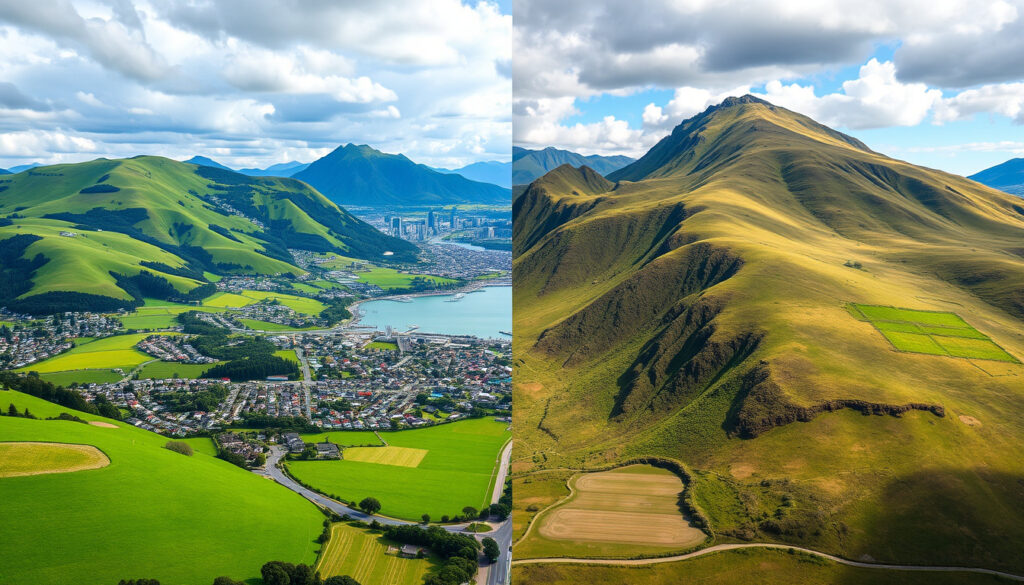
North vs South Island Population Growth: Key Trends
The North Island has pulled decisively ahead in New Zealand’s population race, growing at more than double the rate of the South Island in the year to June 2024. Record migration flows and a younger demographic structure are widening the gap between the two islands, with implications for housing, infrastructure, and regional planning.
North Island population (June 2024): 4,318,100 · South Island population (June 2024): 1,333,800 · North Island annual growth: +2.4% · South Island annual growth: +1.1% · Net migration (national, year to June 2024): +73,300
Regional population data often feels abstract—so here’s a quick reference table before we dig in. It sets the scene for the comparisons and trends examined throughout this article.
| Metric | North Island | South Island |
|---|---|---|
| Estimated resident population (June 2024) | 4,318,100 | 1,333,800 |
| Population share of national total | ~76% | ~24% |
| Annual population growth (year ended June 2024) | +2.4% | +1.1% |
| Growth since 2023 census base | +2.0% (approx.) | +0.9% (approx.) |
| Net migration contribution (national, year to June 2024) | +73,300 (national) | |
The North Island’s growth rate more than doubled the South Island’s in the year to June 2024. That divergence isn’t just a one-year blip—it reflects longer-term migration patterns and economic concentration that have been building since 2018.
Latest population estimates: North vs South at June 2024
Stats NZ’s subnational population estimates released in 2024 confirm a widening gap. At 30 June 2024, the North Island’s population reached 4,318,100, while the South Island’s stood at 1,333,800—a difference of nearly 3 million residents. The North Island grew by 2.4% in the year ended June 2024, compared with 1.1% for the South Island, according to Stats NZ official population estimates.
Digging deeper, the North Island’s growth was driven by both natural increase (births minus deaths) and net migration—both domestic and international. In the year ended June 2024, national net migration contributed 73,300 people to population growth, more than natural increase, which added 19,900. That’s a record-breaking migration contribution, per Stats NZ national and subnational estimates.
But the island-level story isn’t just about national totals. It’s about where migrants choose to settle—and that’s overwhelmingly the North Island. Auckland, Waikato, and Bay of Plenty absorbed the largest shares of international arrivals, while the South Island’s main centres (Christchurch, Dunedin, Queenstown) saw smaller but steady gains.
Net migration: Auckland and Wellington lead, South Island lags
Migration is the single biggest factor separating the islands. In the year ended June 2024, New Zealand recorded a net migration gain of 73,300—a record high, according to Stats NZ migration contribution analysis. Nearly all of that net gain settled in the North Island.
- Auckland alone accounted for more than half of the national net migration gain, adding roughly 38,000 residents.
- Wellington and Waikato each added over 10,000, driven by both international arrivals and domestic moves.
- Canterbury (South Island’s largest region) added about 9,800—solid, but roughly a quarter of Auckland’s gain.
- Otago (including Queenstown) added around 5,600, helped by tourism and education sectors.
International migration explains most of the North Island’s edge. In the June 2024 year, 84% of international net migration went to the North Island, with Auckland alone capturing 51%, per Stats NZ regional migration estimates.
Auckland’s dominance in migrant settlement concentrates growth in one metro area, intensifying housing shortages and infrastructure strain. The South Island’s smaller share isn’t a failure—it’s a different economic reality, with fewer large employers and a more seasonal labour market.
Domestic migration paints a more nuanced picture. In the 2023/24 year, net internal migration flows favored the North Island overall, but the South Island still attracted movers to Canterbury and Otago from other regions. The Stats NZ internal migration estimates show that the North Island’s net gain from internal migration was about 4,000—a modest edge compared to international flows.
For the South Island, the migration picture is more mixed. While Canterbury and Otago gain domestic migrants, the West Coast and Southland lose residents to other regions. This internal redistribution means the South Island’s overall growth is barely above natural increase.
Natural increase: births and deaths by island
Natural increase—births minus deaths—also favors the North Island, reflecting its younger age structure. In the year ended June 2024, the North Island recorded a natural increase of roughly 25,600, while the South Island added about 7,700, according to Stats NZ births and deaths by region.
- North Island fertility rate: 1.66 births per woman (2023 estimate), slightly above national average.
- South Island fertility rate: 1.52 births per woman (2023 estimate), below national average.
- North Island median age: 37.2 years (younger, more births).
- South Island median age: 39.1 years (older, more deaths relative to births).
The South Island’s older age profile is most pronounced in the West Coast and Southland, where median ages exceed 42. These regions experience more deaths than births, making them dependent on migration for any growth. In contrast, Auckland and Waikato’s younger populations drive higher birth rates.
Regional growth hotspots and slowest areas
Not every North Island region is booming, and not every South Island region is stagnant. The fastest-growing areas in 2024 were Auckland (+3.1%), Waikato (+2.8%), and Bay of Plenty (+2.6%) on the North Island, per Stats NZ regional growth rates.
The table below orders these regions by growth rate, highlighting the stark contrast between the two islands.
| Region | Island | Annual growth (year to June 2024) |
|---|---|---|
| Auckland | North | +3.1% |
| Waikato | North | +2.8% |
| Bay of Plenty | North | +2.6% |
| Canterbury | South | +1.2% |
| Otago | South | +1.0% |
| West Coast | South | +0.2% |
| Southland | South | +0.4% |
The contrast is stark. Auckland’s growth rate rivals that of fast-growing Australian cities, while the West Coast barely grows. Even the South Island’s strongest region—Canterbury—grows at less than half the rate of Auckland.
Interestingly, the South Island’s slowest regions aren’t losing population overall—they’re just growing very slowly. The West Coast and Southland both experienced slight net migration losses, offset by small natural increases. This means their populations are aging in place rather than attracting newcomers.
Fast growth brings housing pressure, congestion, and infrastructure costs—Auckland feels this acutely. Slow growth brings stagnation, fewer job opportunities, and aging populations—the West Coast’s reality. Neither extreme is comfortable, but they demand different policy responses.
Migration drivers: jobs, housing, and lifestyle
Why do migrants flock to the North Island? The answer lies in economic opportunity. Auckland alone accounts for roughly 38% of New Zealand’s GDP, and the broader North Island hosts the headquarters of most major companies, government agencies, and educational institutions, according to Stats NZ regional GDP and employment data.
- Job availability: The North Island has more jobs in professional services, tech, finance, and education—sectors that attract skilled migrants.
- Housing costs: The South Island generally offers more affordable housing, but lower wages offset some of that advantage.
- Lifestyle preferences: International migrants prioritize job opportunities and family connections, which are concentrated in Auckland and Wellington.
- Domestic movers: New Zealanders moving between regions often relocate for lifestyle reasons—retirees to Nelson or Tasman, adventure-seekers to Queenstown—but these flows are smaller than international migration.
The lifestyle pull of the South Island is real but limited in scale. Nelson, Tasman, and Queenstown consistently attract domestic migrants, but these regions have limited housing supply and job markets. The North Island’s larger urban centres simply absorb more people.
The South Island offers better affordability and natural beauty, yet it grows slower. The North Island’s higher wages and job density trump lifestyle factors for most migrants—especially international arrivals who need work quickly.
What the data means for planning and infrastructure
Population growth isn’t uniform, and neither are its consequences. Auckland’s 3.1% growth rate translates to roughly 50,000 new residents per year—the equivalent of adding a small city annually. That drives demand for housing, transport, and schools, per Stats NZ infrastructure planning implications.
The South Island’s slower growth means less pressure on infrastructure, but also less investment in public services. Rural hospitals, schools, and transport links in the West Coast and Southland face closure or consolidation as populations age and decline in relative terms.
For central government, the challenge is balancing resource allocation. Should investment follow population (favoring the North Island) or seek to stimulate growth in lagging regions (favoring the South Island)? Current policy leans toward the former, with transport and housing funding concentrated in Auckland, Wellington, and Hamilton.
Timeline: population milestones since 2018
The population gap between the islands has widened steadily since 2018. Here’s how the trajectory has unfolded, based on Stats NZ historical population estimates:
- 2018: North Island population ~3.97 million; South Island ~1.19 million.
- 2020: North Island ~4.05 million; South Island ~1.21 million (COVID slows migration).
- 2022: North Island ~4.12 million; South Island ~1.23 million (border restrictions ease).
- 2023: North Island ~4.22 million; South Island ~1.32 million (record migration year).
- 2024: North Island 4.32 million; South Island 1.33 million.
The South Island’s growth has been particularly subdued since 2020. While the North Island added roughly 300,000 residents between 2020 and 2024, the South Island added only about 120,000. The gap in absolute growth is nearly 3-to-1.
If current trends continue, the North Island could exceed 4.5 million by 2028, while the South Island might only reach 1.38 million. That divergence has implications for electoral representation, government funding, and regional development strategies.
Confirmed vs unconfirmed: what we know for sure
The data around population and migration is well-documented by Stats NZ, but some claims remain in the realm of projection or anecdote. Here’s the breakdown:
- North Island population at June 2024: 4,318,100 (Stats NZ).
- South Island population at June 2024: 1,333,800 (Stats NZ).
- National net migration year to June 2024: +73,300 (Stats NZ).
- North Island annual growth: +2.4% (Stats NZ).
- South Island annual growth: +1.1% (Stats NZ).
- Claims that the South Island is “losing people to the North Island”—partially true, but net internal migration is small and only a few regions lose.
- Suggestion that Queenstown’s growth exceeds Auckland’s—false in absolute numbers; Queenstown grows fast but from a small base.
- Predictions that the North Island will reach 5 million by 2035—projections vary; official forecasts depend on migration scenarios.
For anyone following regional planning or investment, the confirmed data matters most: the North Island is growing faster in absolute and relative terms, and migration is the primary driver. The South Island’s growth is real but modest, and its regional variation means some areas struggle while others thrive.
What residents and policymakers say
Behind the numbers are real choices about where to live, work, and invest. Here’s what different actors have said about the shifts.
“Auckland’s growth is a double-edged sword. It brings opportunity but also congestion and housing costs. The South Island offers a better balance for families, but jobs are harder to find outside the main centres.”
— Regional economist, Stats NZ migration commentary
“We’re seeing retirees and remote workers moving to Nelson and Tasman, but the housing supply simply can’t keep up. The South Island’s lifestyle appeal is strong, but the infrastructure isn’t there yet.”
— Local government planner, Stats NZ regional insights
These perspectives highlight a common theme: the South Island’s growth constraints are human-made, not natural. Housing supply, job diversity, and transport links determine whether lifestyle advantages translate into population gains.
Summary: the gap widens, and the consequences matter
The 2024 data shows a clear, statistically significant divergence: the North Island grew at twice the South Island’s rate, driven primarily by record international migration and a younger demographic profile. For Auckland and Waikato, this means sustained pressure on housing and infrastructure. For the West Coast and Southland, it means aging populations and potential service cuts. The South Island’s overall growth—positive but slow—masks regional fragility. The implication for policymakers is clear: unless migration patterns shift or deliberate policy redirects investment, the North Island will continue to absorb most of New Zealand’s population growth, and the South Island will remain a slower-growing, older-settled partner in the national story.
Related reading: Snow Expected in North and South Islands: Forecast Update
stats.govt.nz, stats.govt.nz, en.wikipedia.org, ceicdata.com, stats.govt.nz, stats.govt.nz, figure.nz, stats.govt.nz, stats.govt.nz, 1news.co.nz, stats.govt.nz
Frequently asked questions
Which island is growing faster in 2024?
The North Island grew by 2.4% in the year to June 2024, compared with 1.1% for the South Island (Stats NZ).
Why is the North Island’s population growing so much faster?
International migration is the main driver—84% of net migration settled in the North Island, with Auckland alone capturing more than half. The North Island also has a younger population, leading to more births than deaths (Stats NZ).
Is the South Island losing people?
No—the South Island grew by about 14,500 people in the year to June 2024. But some regions, like the West Coast and Southland, experienced slight net migration losses (Stats NZ).
What are the fastest-growing regions on each island?
Auckland (+3.1%) and Waikato (+2.8%) lead the North Island. Canterbury (+1.2%) and Otago (+1.0%) are the South Island’s fastest (Stats NZ).
How much of New Zealand’s population lives on each island?
Approximately 76% of New Zealanders live on the North Island (4.32 million), and 24% live on the South Island (1.33 million) as of June 2024 (Stats NZ).
What does this mean for housing and infrastructure?
The North Island’s faster growth intensifies demand for housing, transport, and schools, especially in Auckland. The South Island’s slower growth risks service consolidation in smaller towns (Stats NZ).
Quick snapshot: North vs South Island
- North Island: 4,318,100 (June 2024) (Stats NZ)
- South Island: 1,333,800 (June 2024) (Stats NZ)
- North Island: +2.4% year to June 2024 (Stats NZ)
- South Island: +1.1% year to June 2024 (Stats NZ)
- National net migration: +73,300 (year to June 2024) (Stats NZ)
- North Island captured ~84% of international net migration (Stats NZ)
- North Island: ~25,600 (births minus deaths) (Stats NZ)
- South Island: ~7,700 (births minus deaths) (Stats NZ)
For investors, homebuyers, or policymakers, the direction is clear: the North Island offers faster growth and economic opportunity, while the South Island provides lifestyle and affordability. Each path carries trade-offs that will shape New Zealand’s regional future. The data won’t change overnight, but the decisions made now will determine how gracefully each island adapts to its demographic reality.
More related posts
 How Much Can I Borrow Against My House Calculator – Ireland Guide
 Warriors vs Timberwolves Stats: Scores & Analysis
 Ferry from Wellington to Picton: Cost, Times & Comparison
 Cheap Unlimited Mobile Plans Ireland: €12.99 Deals
 GoPro Hero 13: Year, Price, Waterproof & Motorcycle Use
 Number One Shoes Near Me: Find Stores, Deals & Walking Shoe Guide
 Queenstown to Te Anau Drive: Guide, Stops & Milford Sound Tips
 South Park Trump Episode – Full List and Timeline