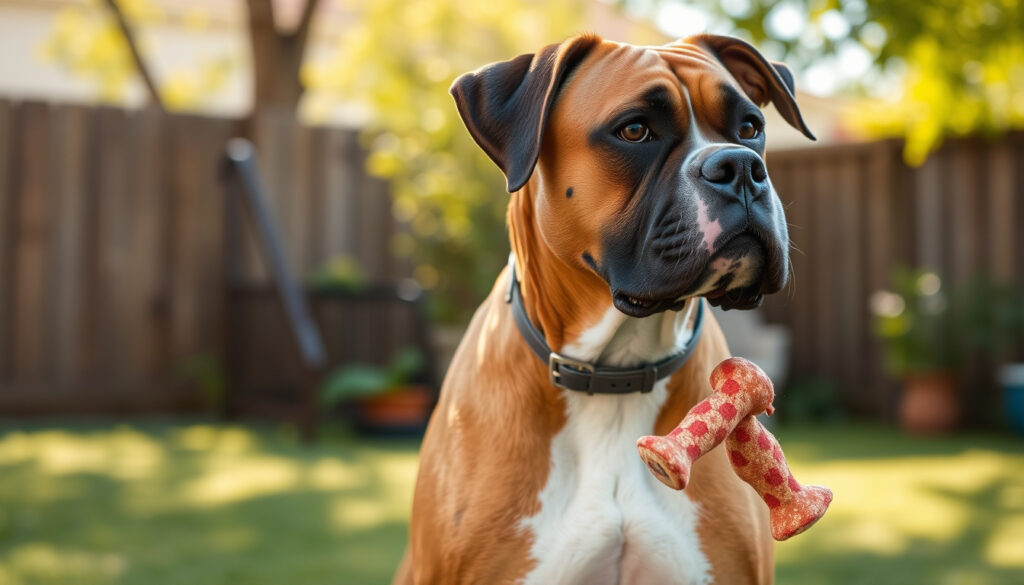
Boxer Dog Breed: Temperament, Health, Pros and Cons
Anyone who has watched a Boxer bounce around a living room knows the breed has two modes: full-throttle play and full-body cuddle. The American Kennel Club’s breed standard calls the Boxer “playful with family, patient with children” — a useful counterweight to its tough-guy reputation (American Kennel Club, official breed standard). But those same traits raise real questions about energy, health risks, and family fit. The answers come down to matching the breed’s needs with a household’s reality.
Life Expectancy: 10–12 years ·
Weight (Male): 65–75 lb (29–34 kg) ·
Height: 21–25 in (53–63 cm) ·
Temperament: Playful, affectionate, loyal ·
Exercise Needs: 1–2 hours per day
Quick snapshot
- Developed in Germany in the 19th century (Encyclopaedia Britannica, reference work), descended from the Bullenbeisser hunting breed (The Kennel Club, UK canine registry)
- Typical lifespan of 10–12 years (PetMD, veterinary resource)
- Brachycephalic breed, prone to overheating and breathing issues (PetMD, veterinary resource)
- The breed’s exact pre-19th-century origins are not fully documented (Encyclopaedia Britannica, reference work)
- Whether early Boxers were used mainly for hunting or bull-baiting is debated by breed historians (Encyclopaedia Britannica, reference work)
- 1880s: the modern Boxer era began when the old type was crossed with a taller English import (American Boxer Club, national breed club)
- 1904: the American Kennel Club recognized the breed (Chewy, pet care resource)
- 1935: the American Boxer Club formed (Chewy, pet care resource)
- Look for breeders who screen hips through the BVA/Kennel Club Hip Dysplasia Scheme (PDSA, UK veterinary charity)
- Ask about cardiac screening — aortic stenosis can be genetic (WebMD, pet health reference)
Seven numbers, one pattern: a medium-to-large German working dog with a short fawn or brindle coat, a 10–12 year lifespan, and an energy load that demands daily exercise.
The Boxer’s trait profile sets up a clear trade-off: high energy for high affection, with health risks concentrated in the heart and airways.
| Attribute | Boxer fact |
|---|---|
| AKC Group | Working |
| Country of Origin | Germany |
| Weight | Male: 65–75 lb (29–34 kg), Female: 55–65 lb (25–29 kg) |
| Height | 21–25 in (53–63 cm) |
| Coat | Short, smooth, fawn or brindle |
| Lifespan | 10–12 years |
| Energy Level | High — needs 1–2 hours daily exercise |
Is Boxer a good family dog?
Yes, with conditions. The Kennel Club calls the Boxer “a much-loved family companion” (The Kennel Club, UK canine registry). That is the good news.
The conditions matter just as much. Hill’s Pet notes Boxers do well with kids and other pets when socialized early, but their enthusiasm can be too much for small children or elderly people (Hill’s Pet, veterinary nutrition company). WebMD frames the same concern practically: a Boxer’s size and energetic behavior can make it difficult for older adults and small children to manage (WebMD, pet health reference).
Is a Boxer a high risk dog?
Energy: High ·
Size: 55–75 lb ·
Supervision: Needed around toddlers
- Over-exuberance is the real risk, not malice: a dog this size launching into full play can knock a small child over (WebMD, pet health reference)
- Heat is the second risk: the breed’s short muzzle makes overheating and breathing trouble more likely (PetMD, veterinary resource)
- Protective instinct needs training: the goal is a calm, neutral response to strangers, not a suspicious one
“High risk” is the wrong frame; “high supervision” is the right one. A Boxer brings big-dog strength and puppy-level enthusiasm into the home, and both need to be managed.
The family that gets the Boxer’s loyalty also gets its exercise bill. The breed’s joyful, bouncy nature is the same trait that makes it a poor fit for households that cannot provide daily structured activity.
The implication: a Boxer can be a superb family dog — for a family able to provide daily exercise, early training, and adult supervision around the youngest children. For a quieter household, a calmer, smaller breed is the safer match.
What personality does a boxer have?
Ask a Boxer owner to describe the breed and “clown” usually comes up fast, followed by “velcro.” Encyclopaedia Britannica describes the Boxer as a highly energetic dog that is affectionate with family and generally moderately friendly with strangers and other dogs (Encyclopaedia Britannica, reference work).
The United Kennel Club points to the breed’s Bulldog and terrier heritage as the source of its speed and agility (United Kennel Club, US canine registry). Put that heritage together with a playful, high-energy temperament and you get a confident, quick companion with a strong streak of silliness.
Do Boxers like to be cuddled?
Affection: High with family ·
Barking: Rarely without cause ·
Energy first: Exercise, then cuddles
Yes — and this is one of the breed’s best-known traits. The affectionate side of the Boxer is exactly what the kennel clubs describe: a dog that stays playful into adulthood and wants to be close to its people. In practice, that means a Boxer on the couch, against your leg, ideally with a toy in its mouth.
The pattern: the Boxer is a working dog hardwired for affection. Owners who meet its exercise needs get one of the most devoted companions in the dog world; owners who do not get a restless, barking, bored dog with strong opinions.
How aggressive are Boxer dogs?
This is where the Boxer’s reputation and its reality diverge. The Kennel Club, which groups the breed under Working dogs in the UK, calls the Boxer “an excellent guard dog” and a breed valued for tracking and military work (The Kennel Club, UK canine registry). Guarding traits are useful — but, left untrained, they can read as aggression.
That guarding heritage was shaped over a century of selective breeding into a family companion, yet the instinct remains. The breed standard expects a dog that is “wary but not timid with strangers” (American Kennel Club, official breed standard) — attentive, not hostile.
Why do Boxer dogs have a bad reputation?
- Origin story: a breed developed to hunt big game in 19th-century Germany still carries an intimidating image, even though the modern Boxer was shaped into a family dog
- Misuse as guard dogs: the same protective instinct that makes a Boxer a good watchdog can be amplified by harsh training into actual aggression
- Physical presence: a muscular, short-muzzled dog with a deep bark looks intimidating even when its tail is wagging
The paradox is that the Boxer’s guarding instinct is the flip side of its family loyalty: the alertness that notices a stranger at the door is the same alertness that watches over children.
Are Boxers known to turn on their owners?
No major kennel club or veterinary resource surveyed for this guide describes the Boxer as a breed prone to attacking its own family. The Kennel Club’s profile places the breed among family companions, and the breed standard expects patience with children.
That does not mean any individual Boxer is automatically safe. Aggression in dogs of any breed is usually a response to specific circumstances: abuse, inadequate socialization, pain, or fear. The Boxer’s reputation problem comes from what people do with a powerful, protective dog — not from a breed-wide pattern of turning on owners.
The takeaway: the Boxer’s protective instinct is exactly what makes it a good family guardian — and exactly what makes it a liability in an irresponsible home. Training decides which outcome you get.
What are common problems with Boxer dogs?
PDSA, the UK veterinary charity, is direct about the list: Boxers may develop brachycephalic obstructive airway syndrome, hip dysplasia, epilepsy, eye problems, heart problems, and skin problems (PDSA, UK veterinary charity). Heart issues deserve special attention: aortic stenosis can be genetic, and Boxers also have a higher chance of developing cardiomyopathy (CareCredit, pet care financing resource).
Six health and care areas, one pattern: Boxer conditions cluster in the heart, hips, and airways. Knowing the list beforehand turns a potential crisis into a screening checklist.
| Health or care area | What owners should know |
|---|---|
| Brachycephalic airway syndrome | Short muzzle raises the risk of overheating and breathing issues |
| Hip dysplasia | Large-breed joint condition; breeders should screen via x-ray schemes |
| Aortic stenosis | Often genetic; can appear in puppies or seniors |
| Cardiomyopathy | Boxers have a higher chance of developing this heart condition |
| Skin problems | Allergies and skin conditions are recurrent concerns |
| Breeder screening | Breeding dogs should be x-rayed under the BVA/Kennel Club Hip Dysplasia Scheme |
The Boxer’s charm is inseparable from its short muzzle — the anatomy that makes the breed so expressive also makes hot days a genuine safety issue. Plan walks for early morning or evening, and never leave a Boxer in a hot car, even for a few minutes.
The implication: Boxer ownership comes with a health checklist, not a guarantee of illness. Hip x-rays, heart checks, and skin history are the most valuable conversation you can have with a breeder before buying a puppy.
What are the pros and cons of Boxer dogs?
Every breed is a bundle of trade-offs, and the Boxer’s trade-offs are unusually clear. The pros come from its temperament and its willingness to be part of family life; the cons come from its energy, its health profile, and the supervision it demands.
Upsides
- Loyal and affectionate — the breed standard’s own words are “playful with family, patient with children”
- Good with kids and other pets when socialized early (Hill’s Pet, veterinary nutrition company)
- Easy to groom — the short, smooth coat needs minimal maintenance
- Typical lifespan of 10–12 years for a large breed
Downsides
- High exercise needs — 1–2 hours of daily activity is the baseline
- Enthusiasm can be too much for small children or elderly people (Hill’s Pet, veterinary nutrition company)
- Heat-sensitive brachycephalic anatomy
- Recurring health risks: airway, heart, hip, and skin conditions (PDSA, UK veterinary charity)
- Stubborn streak that demands consistent, early training
The trade-off: owners get a devoted, funny, protective companion in exchange for daily exercise, deliberate training, and a financial buffer for breed-typical health care. The Boxer is not a low-maintenance dog; it is a high-reward one.
Confirmed facts vs. what’s still unclear
When you are choosing a breed, the solid facts matter more than the rumors. This recap separates what is documented in the sources above from what is still a matter of debate.
Confirmed facts
- The Boxer was developed in Germany in the 19th century
- It descends from the Bullenbeisser, a German hunting breed
- Boxers are brachycephalic — short-muzzled — and prone to overheating
What’s unclear
- Exactly how the breed developed before the 19th century
- Whether early Boxers were used mainly for hunting or bull-baiting
- The precise contribution of Bulldog and Great Dane ancestors to the modern Boxer
- How directly the ancient Assyrian roots connect to the modern breed
What the experts say
Bright and alert, sometimes silly, but always courageous.
— American Kennel Club, official breed description
The Boxer is not a nervous dog and does not bark without cause.
— American Boxer Club, national breed club
The Boxer is a medium to large, short-haired dog breed of mastiff-type, developed in Germany.
— Wikipedia, Boxer breed article
Should you get a Boxer?
Owning a Boxer is not a neutral decision. The breed delivers a devoted, funny, protective companion with a shorter muzzle and a longer list of potential health issues than many families expect. The evidence points to one conclusion: Boxers thrive in active households that treat exercise, training, and breeder screening as non-negotiables. For a family considering a Boxer, the decision is clear: commit to the daily exercise, early training, and health-screening standards the breed demands — or choose a lower-energy breed that matches a quieter household.
Frequently asked questions
How much exercise does a Boxer dog need?
Roughly 1–2 hours of daily physical activity. Boxers were bred to work, so they carry energy reserves that an hour of walking won’t fully drain; structured play, running, or agility work makes the difference between a calm dog and a destructive one.
Are Boxer dogs easy to train?
They are intelligent and eager to please, but they also have a stubborn streak. Early, consistent training with positive reinforcement works best; harsh methods tend to make them shut down.
What is the best diet for a Boxer dog?
A high-quality, age-appropriate diet suited to a large, active breed. Portions should match the dog’s actual activity level — a Boxer getting 1–2 hours of exercise burns far more than a couch-surfing one. Your veterinarian is the best guide for food type and portion size.
How much does a Boxer puppy cost on average?
Prices vary widely by region, breeder reputation, and lineage, so a single national average is not meaningful. What matters more: a breeder who performs recommended health screenings, including hip x-rays through the BVA/Kennel Club Hip Dysplasia Scheme, and who socializes puppies early.
Do Boxer dogs drool excessively?
Many Boxers drool, especially after drinking, eating, or vigorous exercise. The short, brachycephalic muzzle and loose lips make some drool inevitable, though the amount varies by individual.
How often should a Boxer be bathed or groomed?
The short, smooth coat is low-maintenance: a weekly brushing removes loose hair, and baths are only needed when the dog is visibly dirty. Regular nail trims, ear checks, and teeth brushing matter more than frequent baths.
Related reading
More related posts
 Lilo & Stitch Movie: Age Rating, Streaming, and More
 Venues for Hire Auckland: Party, Cheap & Council Options
 Is Harbour Bridge Open Today? Auckland & Sydney Live Status
 Te Kuiti Death Notices: Complete Search Guide
 Bed Bath and Beyond Pyjamas: Safety, Comfort & Buying Guide
 The Wolf of Wall Street: True Story & Controversy
 Road Accidents Today Christchurch: Incidents & Traffic Updates
 south china morning post