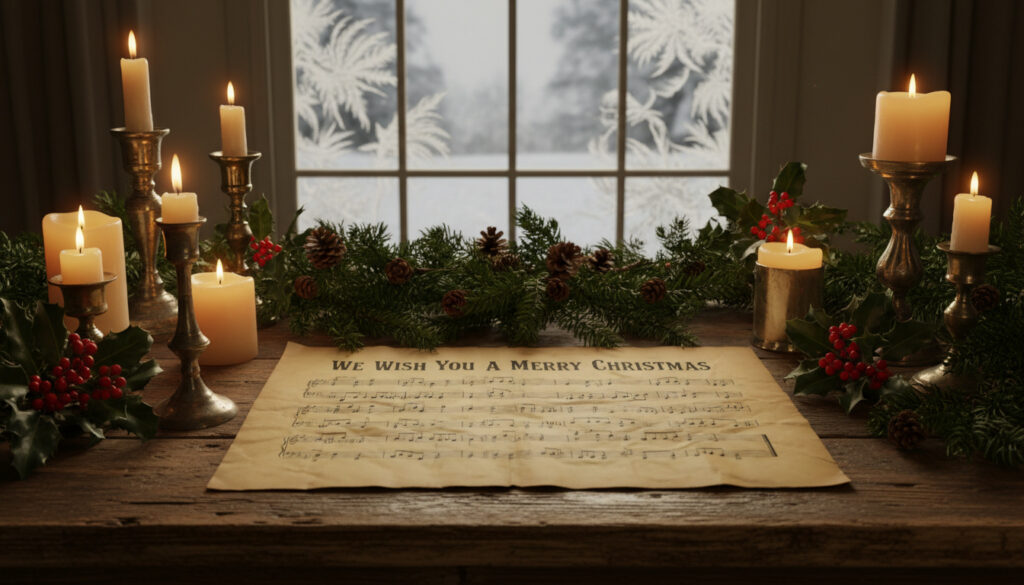
We Wish You a Merry Christmas – History, Lyrics and Origins
“We Wish You a Merry Christmas” stands as one of the most recognizable English carols, yet its origins remain shrouded in the folk traditions of England’s West Country. Dating from around the 16th century, this secular greeting emerged from the practice of wassailing, where groups of carolers demanded treats from wealthy households. Despite its ancient roots, the carol existed only in oral tradition until the 20th century, with no documented publication predating 1935.
The carol’s journey from local custom to global phenomenon reflects a unique path through English musical history. Unlike sacred carols, it carries a jocular, demanding tone, playfully insisting upon figgy pudding as repayment for its goodwill wishes. Its survival owes much to Arthur Warrell, a Bristol music director who arranged the first known written version in 1935, preserving what had previously been a regional folk memory.
Listed as numbers 230 and 9681 in the Roud Folk Song Index, the piece confirms its status as an English traditional song. The greeting itself dates to the early 18th century, though the complete musical work remained unrecorded in major Victorian collections.
What Are the Lyrics to We Wish You a Merry Christmas?
- Traditional English carol from the West Country
- Lyrics focus: Simple secular holiday greeting
- Structure: Short repetitive verses
- Modern use: Ubiquitous in global media
- No attributed author or composer exists
- Sung by “waits” or wassailers demanding figgy pudding
- Warrell’s 1935 version uniquely used “I wish” rather than “we”
- Listed in Roud Folk Song Index as numbers 230 and 9681
- First known written arrangement appeared in 1935
- 1830s variant requested “a cellar full of beer”
- No religious themes, distinguishing it from sacred carols
| Fact | Details |
|---|---|
| First Known Publication | 1935 (musical arrangement) |
| Author/Composer | Unknown |
| First Arranger | Arthur Warrell |
| Origin Region | West Country, England (likely Somerset) |
| Roud Folk Song Index | 230, 9681 |
| First Performance | December 6, 1935 by Bristol Madrigal Singers |
| Copyright Date | 1939 (year of Warrell’s death) |
| Content Type | Secular (no religious themes) |
Who Wrote We Wish You a Merry Christmas and What Is Its History?
Origins in the English West Country
The carol emerged from 16th-century English folk traditions, specifically in Somerset and the broader West Country. Poor carolers known as “waits” or wassailers would visit wealthy homes on Christmas Eve, performing in exchange for treats like figgy pudding. Dr. Ian Coates of the University of Bristol traces its roots to Tudor Somerset, while the Roud Folk Song Index entries confirm its regional origins.
Arthur Warrell’s 1935 Arrangement
Despite centuries of oral tradition, no written record existed until Arthur Warrell, music director at the University of Bristol, created an arrangement in 1935. Performed by the Bristol Madrigal Singers on December 6, 1935, this marked the carol’s earliest known score. Warrell, who grew up in the West Country, likely drew from local oral traditions he encountered in his youth. He copyrighted the arrangement in 1939, the year of his death, as documented by Galaxy Music Notes.
The Carol’s Absence from Victorian Collections
Notably, the carol appears in no major 19th-century collections, including Davies Gilbert (1822-1823), William Sandys (1833), or the original Oxford Book of Carols (1928). This gap suggests the piece remained localized folk tradition rather than widely distributed printed music until Warrell’s intervention. Oral tradition recordings preserve the sound of these early practices.
No 19th-century publications of this carol exist in major archives, confirming its status as oral tradition rather than printed repertoire until 1935.
What Does We Wish You a Merry Christmas Mean?
Wassailing and the Envoie Tradition
The carol embodies wassailing, a custom where performers brought luck to households in exchange for refreshments. Editors Hugh Keyte and Andrew Parrott, in the New Oxford Book of Carols (1992), identify the piece as a “remnant of an envoie much used by wassailers”—a concluding verse demanding payment for performance. The tradition survived suppression during Oliver Cromwell’s rule (1647-1660), when church caroling was banned, forcing performances into secular door-to-door venues.
The Demand for Figgy Pudding
The lyrics’ humorous, demanding tone reflects social dynamics of the period. Carolers essentially held householders hostage with their performance until receiving figgy pudding—a plum or raisin pudding—and perhaps “a cup of good cheer.” This secular, slightly rebellious character distinguishes it from reverent religious carols. The social context of these demands reveals much about historic class relations.
The tradition involved poor carolers visiting wealthy homes on Christmas Eve, refusing to leave until receiving treats, making the carol’s demands historically accurate rather than merely playful.
Popular Versions of We Wish You a Merry Christmas
Warrell’s original 1935 arrangement used the singular “I wish you a merry Christmas,” though the plural “we” became standard in later renditions. The BBC Chorus broadcast the carol in December 1940, introducing it to national audiences. Its inclusion in Carols for Choirs (1961) cemented its status in choral repertoire. An 1980s gramophone record held in museum collections preserves another early secular interpretation.
A variant documented in the 1830s and appearing in Charlotte Yonge’s 1858 story The Christmas Mummers substitutes the greeting for practical demands: “A pocket full of money, and a cellar full of beer.”
Warrell’s 1935 original used “I wish” rather than “we wish,” a distinction often lost in modern performances that default to the plural form.
When Did We Wish You a Merry Christmas First Appear?
- : Presumed oral origin in Southwest England
- : Greeting phrase “a merry Christmas and a happy New Year” first recorded
- : “Cellar full of beer” variant sung by mummers
- : Variant appears in Charlotte Yonge’s The Christmas Mummers
- : Arthur Warrell creates first arranged score; performed December 6 by Bristol Madrigal Singers
- : Warrell copyrights the arrangement
- : BBC Chorus radio performance broadcasts the carol nationally
- : Republished in Carols for Choirs
- : New Oxford Book of Carols describes it as “English traditional”
What Is Known and Unknown About the Carol’s Origins?
| Established Facts | Uncertain Details |
|---|---|
| First written arrangement by Arthur Warrell in 1935 | Original composer remains unknown |
| West Country, England origin (likely Somerset) | Exact century of oral origin unverified |
| Roud Folk Song Index entries 230 and 9681 | Why it appeared in no 19th-century printed collections |
| Secular character with no religious themes | Specific melody’s first composer |
| Warrell copyrighted the arrangement in 1939 | Complete original lyrics before 1935 |
Why Is We Wish You a Merry Christmas So Popular?
The carol’s secular nature allows universal performance regardless of religious affiliation, distinguishing it from sacred hymns. Its short, repetitive structure makes it accessible to casual singers and children. The tradition of Christmas carols gained Victorian revival momentum, and Warrell’s 1935 arrangement arrived just as radio broadcasts could disseminate music nationally, propelling the piece from regional curiosity to global standard.
Connection to historic holiday customs like wassailing adds cultural depth, while the figgy pudding reference provides nostalgic charm. Its demand for treats resonates with the universal experience of holiday hospitality.
What Do Music Experts Say About This Carol?
“Remnant of an envoie much used by wassailers.”
Hugh Keyte and Andrew Parrott, New Oxford Book of Carols (1992)
The score is attributed to Arthur Warrell, with roots in Tudor Somerset.
Eugene Byrne, Bristol Times (2017), with University of Bristol Special Collections
Roots in Tudor Somerset.
Dr. Ian Coates, University of Bristol
What Is the Lasting Significance of We Wish You a Merry Christmas?
“We Wish You a Merry Christmas” represents a rare survival of English folk custom into global popular culture. Its transformation from 16th-century wassailing practice to 20th-century choral standard demonstrates how oral traditions require documentation to achieve permanence. The carol endures as both a seasonal greeting and a window into historic social dynamics, preserving the voice of working-class carolers who once demanded figgy pudding at the doors of the wealthy.
Frequently Asked Questions
Is We Wish You a Merry Christmas a religious carol?
No. It is entirely secular, lacking religious themes. It emerged from folk wassailing traditions rather than church music.
What is figgy pudding?
Figgy pudding is a traditional English pudding made with plums or raisins (not necessarily figs), similar to plum pudding. It was a Christmas treat demanded by carolers in exchange for their performance.
Is the carol in the public domain?
The traditional lyrics and melody are considered traditional, but Arthur Warrell’s specific 1935 arrangement was copyrighted in 1939. Modern performances may require caution regarding specific choral arrangements.
What is the difference between the “I wish” and “we wish” versions?
Arthur Warrell’s 1935 original arrangement used the singular “I wish you a merry Christmas.” The plural “we wish” became the standard in later popular versions.
Why do the lyrics demand figgy pudding?
The demand reflects the wassailing custom where performers expected food and drink from wealthy households. It was a playful but serious social transaction, not merely a request.
How long is the carol?
The standard version comprises just two short verses, making it one of the shortest Christmas carols. The lyrics repeat the greeting and the demand for figgy pudding.
More related posts
 18 Free Things to Do in Queenstown – Local Budget Guide
 Best Running Shoes 2025: Expert & Podiatrist Picks
 90-Day Trial Period NZ: Legal Guide for Employers & Employees
 Find A Brand Jeans NZ: Stockists, Online Shops & Sales
 What Date is Easter 2025? Sunday April 20, UK Holidays
 Best Online Grammar Checkers: Free & AI Tools Compared
 Scrap Metal Palmerston North: Prices & Recyclers Guide