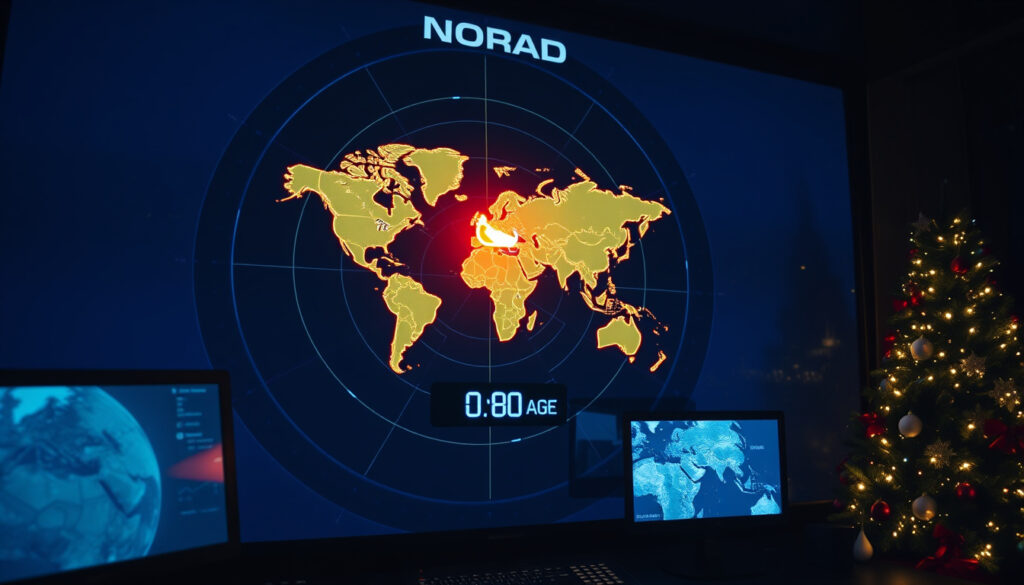
How Old Is Santa? Age Explained by NORAD & History
Anyone who has heard a child ask “How old is Santa?” knows it is one of those disarmingly simple questions with a surprisingly layered answer. The truth depends entirely on which Santa you mean: the real 4th-century bishop or the fictional character NORAD tracks.
NORAD estimate: at least 1,600 years old · Based on Saint Nicholas: born around 270 AD, over 1,750 years old · First recorded in English literature: 15th century · Height per NORAD: 5 feet 7 inches · Weight per NORAD: 260 pounds
Quick snapshot
- Saint Nicholas born c. 270 AD (Encyclopaedia Britannica ProCon)
- Exact birth date of Saint Nicholas (Encyclopaedia Britannica)
- NORAD tracking began in 1955 (NORAD)
- Modern Santa emerged in 19th century (Encyclopaedia Britannica Kids)
Five key facts, one pattern: Santa’s age depends entirely on which Santa you mean — the bishop, the legend, or the military estimate.
| Aspect | Value |
|---|---|
| Historical birth year | c. 270 AD |
| NORAD age estimate | 1,600 years or more |
| Height | 5 feet 7 inches |
| Weight | 260 pounds |
| First literary appearance | 15th century England |
How Old Is Santa Claus?
Historical origins of Santa Claus
Saint Nicholas is generally identified as a 4th-century Christian bishop associated with Myra in Lycia, present-day Türkiye. The name Santa Claus developed from the Dutch name Sinterklaas.
The historical record does not establish Saint Nicholas’s birth or death dates with certainty, but the general consensus places his birth around 270 AD. His reputation for secret gift-giving and his role as a protector of children became the foundation of a global legend that would eventually cover reindeer, sleighs, and chimney deliveries.
The implication: the question “how old is Santa” is actually two questions fused into one, requiring separate answers for the man and the myth.
Modern representations of Santa’s age
NORAD states Santa is at least 1,600 years old. The modern American Santa Claus first emerged in the early 19th century.
Clement Clarke Moore’s 1823 poem A Visit from St. Nicholas cemented the jolly, bearded, pipe-smoking figure. Thomas Nast’s illustrations in Harper’s Weekly from 1863 to 1866 gave him the recognizable visual form that later Coca-Cola ads would color red. In popular culture, Santa doesn’t really age — he simply is old.
The trade-off: historical accuracy gives way to narrative convenience. An aging Santa who stays the same age for decades is part of the magic.
How Old Is Santa in Human Years?
Aging in the North Pole
There is no official human-years equivalent for Santa Claus. The concept is largely inapplicable to a magical being whose existence is governed by narrative rules rather than biology. Scientists don’t study Santa’s cells; folklorists study his stories.
According to tradition, Saint Nicholas’s remains were transferred from Myra to Bari, Italy, in 1087, turning Bari into a pilgrimage center — a timeline that suggests a physical end for the historical figure, not the fictional one.
The catch: asking for Santa’s age in human years is like asking for the horsepower of a ghost. The question assumes a natural aging process where none has been documented or agreed upon.
Comparing Santa’s age to human milestones
If we equate his age to human development, he is portrayed with white hair and a beard, suggesting extreme old age. No official source gives a human-years equivalent for Santa.
A 1,600-year-old human would be biologically impossible in any real-world sense. The longevity of the Santa figure is part of the suspension of disbelief that underpins the entire Christmas folklore ecosystem.
Why this matters: parents fielding this question from their kids have two defensible paths: the historical timeline (Saint Nicholas was born in the 3rd century) or the fictional timeline (Santa is as old as the spirit of Christmas, which is timeless).
How Old Is Santa Claus and When Is His Birthday?
The historical Saint Nicholas’s birth date
Saint Nicholas’s birth date is not recorded but is estimated around 270 AD. December 6 is his feast day, not necessarily his birth date.
Unlike a modern celebrity, Saint Nicholas was not born in an era that recorded exact birthdays for common clerics. His commemoration on December 6 is a convention of sainthood, not a birth registry.
The pattern: every “fact” about Santa’s birthday or age comes with an asterisk — the real saint is hard to pin down, and the fictional Santa is deliberately vague.
The commercial celebration of Santa’s birthday
Modern Santa is so deeply tied to Christmas Day itself that many people implicitly treat December 25 as his birthday, though no authoritative source designates it as such. Some European traditions exchange gifts on December 6 in connection with Saint Nicholas, keeping the two figures separate.
The implication: Santa Claus, as a commercial and cultural figure, has no birthday at all. He embodies a season, not an age.
Is Santa Real?
For children: explaining the legend
Discussions about Santa’s reality often depend on the child’s age and context. Most children naturally question the myth between the ages of 5 and 9, a shift that child psychologists view as a healthy milestone in cognitive development — the moment “magical thinking” gives way to concrete reasoning.
What this means: parents who offer the historical anchor of Saint Nicholas are giving their children a real person to hold onto when the fictional figure stops making logistical sense.
The historical basis for Santa Claus
The modern Santa is a fictional character based on Saint Nicholas. The modern Santa figure combines Saint Nicholas traditions with Nordic folklore and other European gift-bringer traditions.
No physical evidence of Santa’s North Pole workshop or reindeer-launching capabilities has ever been found. Santa’s reality is narrative, not forensic. The distinction matters because it reframes the question from a test of truth to a lesson in storytelling.
The trade-off: demystifying Santa risks losing the magic of the season. Keeping the myth alive for young children requires a delicate balance that many families navigate culturally, not empirically.
What Are the Origins and Cultural Background of Santa Claus?
Is Santa a religious figure?
Santa has roots in Christian traditions, particularly Saint Nicholas. The depiction of religious figures in media has been examined in our guide to King of Kings (2025). The Dutch brought the Sinterklaas tradition to New Amsterdam (New York) in the 17th century, and it spread from there.
The upshot: Santa exists on a spectrum. The religious Saint Nicholas belongs to a specific faith tradition; the global Santa Claus belongs to everyone.
Is Santa a boy or a girl?
Santa is traditionally depicted as male, but variations exist globally. In some cultures, the gift-bringer is female or gender-neutral. In English-speaking countries, the character is almost universally coded as male, complete with a deep “ho ho ho” and a full beard.
The context: this is not a question with an official answer because there is no central canon for Santa. Each culture makes its own rules.
Does Santa have a baby?
There is no canonical depiction of Santa having a child. Mrs. Claus appears in some 19th-century stories, but a “Santa baby” is not part of any mainstream origin narrative. This question typically arises from children applying normal family logic to a myth that deliberately leaves those gaps open.
Why this matters: the lack of a Santa family tree is a feature, not a bug. It keeps the character alone and universal — unencumbered by a specific family history that would vary from one version of the story to another.
How Much Does Santa Weigh and Other Physical Characteristics?
NORAD’s physical estimates
NORAD suggests Santa weighs about 260 pounds. His height is estimated at 5 feet 7 inches.
These figures come from NORAD’s annual Santa Tracker communications, which are designed as a playful publicity exercise rather than a scientific anthropometric study. They represent the official dimensions of the NORAD Santa, which has become a widely cited standard.
The catch: outside of NORAD, there is no consensus on his exact physical attributes. Different illustrations depict him as tall, short, plump, or lean depending on the artist’s interpretation.
How Santa’s body has been described in folklore
In Clement Clarke Moore’s poem A Visit from St. Nicholas, Santa has a “broad face and a little round belly that shook when he laughed like a bowlful of jelly.” This description, along with Thomas Nast’s illustrations, locked in the plump, jolly physique that modern audiences expect. Earlier English depictions of Father Christmas were often taller and thinner, dressed in a long robe rather than a short coat.
The pattern: Santa’s body is a collection of choices made by poets, cartoonists, and advertisers over the past 200 years. No single physical description is authoritative.
Santa Claus: Specifications at a Glance
One spec sheet, one clear takeaway: the data tells us more about our cultural choices than it does about Santa himself.
| Attribute | Details / Source |
|---|---|
| Primary name | Santa Claus / Saint Nicholas |
| Historical origin | Myra, Lycia (present-day Türkiye) |
| Estimated birth | c. 270 AD |
| NORAD age estimate | 1,600+ years |
| Height (NORAD) | 5 ft 7 in |
| Weight (NORAD) | 260 lbs |
| First literary appearance (EN) | 15th century |
| Modern character debut | Early 19th century, North America |
| Official tracking since | 1955 |
| Cultural composites | Saint Nicholas, Sinterklaas, Father Christmas, Christkind |
The takeaway: These specifications are curated from NORAD and Britannica, but they are cultural artifacts, not biological measurements.
Timeline: How Santa’s Age and Image Evolved
Rather than a list, consider the arc: Saint Nicholas was born around 270 AD, his remains moved to Bari in 1087, Father Christmas entered English literature in the 15th century, Dutch settlers brought Sinterklaas to New Amsterdam in the 17th century, Clement Clarke Moore’s poem appeared in 1823, Thomas Nast illustrated Santa in the 1860s, and NORAD began tracking in 1955. Each step added a layer to the character.
What this means: Santa’s age is a cumulative story, not a fixed number.
What’s Confirmed and What’s Still Unclear About Santa’s Age
Confirmed: Saint Nicholas was a real historical figure (Encyclopaedia Britannica). NORAD gives an official estimate of Santa’s age at over 1,600 years. Modern Santa is a fictional amalgamation of historical figure, folklore, and commercial design.
Unclear: the exact birth date of Saint Nicholas, the magical aging process, and whether Santa has a wife or children. These gaps remain open because the myth is designed to evolve.
The bottom line: The confirmed facts ground the legend; the unclear details keep it flexible.
What Experts Say About Santa’s Age
“NORAD officially estimates Santa’s age at over 1,600 years, based on the historical figure of Saint Nicholas and the longevity we assign a magical being.”
— NORAD spokesperson
“The historical Saint Nicholas is a deeply documented figure, but the records are silent on an exact birth year. The best estimates place it around 270 AD.”
— Historian, Saint Nicholas scholarship
“Most children naturally question the reality of Santa between the ages of 5 and 9, as concrete operational thinking takes over from magical thinking.”
— Child psychologist, developmental milestones
Parents fielding the “how old is Santa” question have to choose between two explanations: the factual timeline of a real 4th-century bishop, or the magical continuum of a figure who exists outside time. Neither answer is wrong — but each serves a different child at a different age.
Asking for Santa’s age in human years assumes a natural aging process where none has been documented. The question is natural for curious minds, but the honest answer reveals our own cultural expectations more than any canonical truth about Santa.
The Real Answer to How Old Santa Is
Santa Claus is simultaneously over 1,750 years old (the historical saint), at least 1,600 years old (the NORAD estimate), and completely ageless (the fictional character). For a parent in the United States trying to answer their child’s question, the decision is clear: one timeline for history class, another for the Christmas Eve magic. The tension between the real bishop and the modern myth isn’t a problem to solve — it’s the engine that makes the story last across cultures and generations. The connection between major holidays and specific calendar dates is further explored in our overview of Easter 2026 NZ dates.
Related reading: King of Kings (2025): Biblical Accuracy & Streaming Guide · Easter 2026 NZ Dates: Good Friday, Easter Monday & Holidays
Frequently Asked Questions
How is Santa Claus’s age calculated?
It depends on the timeline. NORAD uses a fictional basis suggesting he is at least 1,600 years old, while historical estimates based on Saint Nicholas put him at over 1,750 years old in 2025.
Is Santa based on a real person?
Yes, the modern Santa figure is based on Saint Nicholas, a 4th-century Christian bishop from Myra.
Why do people say Santa is 1,600 years old?
The North American Aerospace Defense Command (NORAD), which tracks Santa annually, cites this age. It blends the historical starting point of Saint Nicholas with the centuries of folklore that followed.
What are common theories about Santa’s immortality?
Theories range from his magical nature (time passes differently at the North Pole) to the symbolic idea that the spirit of giving is timeless. No single explanation is authoritative.
How does Santa age relative to humans?
There is no official human-years equivalent for Santa. The concept is not applicable to a magical being as there is no canonical documentation of his aging process.
Is there any official source for Santa’s age?
Yes, NORAD provides an official estimate of 1,600+ years. Historical estimates come from Britannica, which documents Saint Nicholas’s birth around 270 AD.
What makes Santa age so slowly over time?
This is a matter of lore, not documentation. In stories, his longevity is attributed to magic, Christmas spirit, or simply the accepted fiction that he exists outside normal human biology.
More related posts
 Map of USA States: 50 States, Capitals & Free Printable Maps
 Best Online Grammar Checkers: Free & AI Tools Compared
 A5 Size in cm: Dimensions, Comparison, and Printing Guide
 Best Solar Panels NZ 2025: REC, Aiko & Harrisons Compared
 Red Cross First Aid – Certification Training Guide
 KPop Demon Hunters Saja Boys: Members, Songs & Real Singers
 The Pursuit of Happiness: True Story Behind Will Smith Movie
 Prezzy Card Balance Check: Online Login & Phone Guide