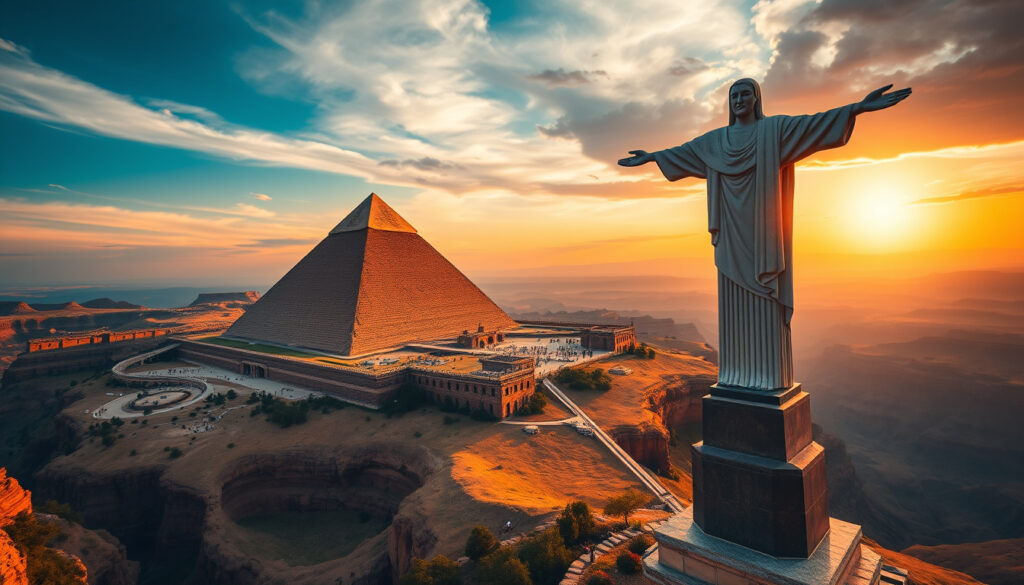
What Are the Seven Wonders of the World? Ancient, Modern, Natural
Most people can name the Great Pyramid or the Taj Mahal, but pinning down what actually belongs on a “seven wonders of the world” list is trickier than it looks. The phrase points to at least three different rosters — an ancient traveler’s list, a global public vote from 2007, and a separate natural-wonders campaign — and each era made its own rules, so once you see how each list was made, it’s easy to tell which wonder belongs where — and why the answer keeps changing.
Ancient Wonders Originated: 2nd century BCE ·
Only Surviving Ancient Wonder: Great Pyramid of Giza ·
New7Wonders Campaign Launch: 2001 ·
New7Wonders Results Announced: July 7, 2007 ·
New7Wonders of Nature Announced: 2011
Quick snapshot
- The ancient Seven Wonders are the Great Pyramid, Hanging Gardens, Statue of Zeus, Temple of Artemis, Mausoleum, Colossus, and Lighthouse (Wikipedia: Seven Wonders of the Ancient World).
- The 2007 New7Wonders are Chichén Itzá, Christ the Redeemer, Colosseum, Great Wall of China, Machu Picchu, Petra, and Taj Mahal (New7Wonders official list).
- The Great Pyramid is the only ancient wonder still standing (Wikipedia: Seven Wonders of the Ancient World). (Wikipedia: Seven Wonders of the Ancient World)
- Whether the Hanging Gardens of Babylon physically existed — no archaeological evidence has been found (Wikipedia: Seven Wonders of the Ancient World). (Wikipedia: Wonders of the World)
- No consensus exists on a single official natural-wonders list (Wikipedia: Wonders of the World).
- The 2007 vote was organized and certified by the New7Wonders Foundation itself (New7Wonders Foundation (campaign organizer)).
- 226 BCE — Colossus of Rhodes destroyed by earthquake (Wikipedia: Seven Wonders of the Ancient World). (BBC Bitesize)
- 2007 — New7Wonders results announced on 7/7/7 after a global vote of about 100 million ballots (BBC Bitesize).
- 2011 — New7Wonders of Nature announced (Wikipedia: Wonders of the World). (BBC Bitesize)
- UNESCO’s natural World Heritage list is the closest expert-vetted registry, though it is not a “seven wonders” list (UNESCO World Heritage Centre (natural heritage list)).
- The “eighth wonder” title will keep being applied unofficially; no body has authority over it (Wikipedia: Wonders of the World). (UNESCO World Heritage Centre (natural heritage list))
Six data points summarize the whole debate — the author, the survivor, the organizer, two announcement years, and the count of what remains.
| Fact | Value |
|---|---|
| Original list creator | Antipater of Sidon (2nd century BCE) (Wikipedia: Seven Wonders of the Ancient World) |
| Only surviving ancient wonder | Great Pyramid of Giza (Wikipedia: Seven Wonders of the Ancient World) |
| New7Wonders campaign organizer | New7Wonders Foundation (New7Wonders Foundation (campaign organizer)) |
| Year New7Wonders results announced | 2007 (BBC Bitesize) |
| New7Wonders of Nature announced | 2011 (Wikipedia: Wonders of the World) |
| Number of ancient wonders still standing | 1 (Wikipedia: Seven Wonders of the Ancient World) |
What are the true 7 wonders of the world?
“True” depends on which list you mean. The ancient canon, first set down by Antipater of Sidon in the 2nd century BCE, names the Great Pyramid of Giza, the Hanging Gardens of Babylon, the Statue of Zeus at Olympia, the Temple of Artemis at Ephesus, the Mausoleum at Halicarnassus, the Colossus of Rhodes, and the Lighthouse of Alexandria (Wikipedia: Seven Wonders of the Ancient World).
The modern list, chosen by a worldwide public vote in 2007, is completely different: Chichén Itzá, Christ the Redeemer, the Colosseum, the Great Wall of China, Machu Picchu, Petra, and the Taj Mahal (New7Wonders official list). About 100 million votes were cast, according to BBC Bitesize.
- Ancient Seven: one survivor (the Great Pyramid) and six lost monuments.
- New7Wonders: seven monuments in seven countries — Mexico, Brazil, Italy, China, Peru, Jordan, and India (New7Wonders official list).
What are some ancient and modern wonders of the world?
- Great Pyramid of Giza — completed around 2560 BCE and the only ancient wonder still standing (Wikipedia: Seven Wonders of the Ancient World).
- Petra — Jordan’s rock-cut archaeological city, selected in the 2007 vote (New7Wonders official list).
- Machu Picchu — a 15th-century Inca site in Peru (New7Wonders official list).
- Chichén Itzá — a Maya pyramid site on the Yucatán Peninsula in Mexico (New7Wonders official list).
Why this matters: the ancient and modern lists answer different questions — one asked what classical travelers should see, the other asked what the whole planet votes for. Both call their result “the seven wonders.”
What happened to the original 7 Wonders?
Six of the original seven are gone, and they fell in different ways. The Colossus of Rhodes was toppled by an earthquake in 226 BCE; the Lighthouse of Alexandria was badly damaged by earthquakes in 1303 CE and then crumbled in stages; fire destroyed the Temple of Artemis, and the Statue of Zeus was lost as well (Wikipedia: Seven Wonders of the Ancient World).
- Confirmed lost: Colossus, Lighthouse, Mausoleum, Temple of Artemis, Statue of Zeus.
- Never confirmed to exist: the Hanging Gardens of Babylon — no archaeological evidence has been found, and some historians view it as a poetic invention (Wikipedia: Seven Wonders of the Ancient World).
- Still standing: the Great Pyramid of Giza.
The one ancient wonder everyone can still see — the Great Pyramid — is also the oldest entry on the list. It was ancient when the list was written, and it has outlived every rival since.
The pattern: the ancient list was a guide to spectacle, not survival. That is why its oldest entry is its only survivor.
Is it 7 or 8 wonders of the world?
On every official-style list, the number is seven. The ancient canon has seven entries (Wikipedia: Seven Wonders of the Ancient World); the 2007 New7Wonders has seven (New7Wonders official list); and the 2011 New7Wonders of Nature also has seven (Wikipedia: Wonders of the World).
So where does “eight” come from? “Eighth wonder” is an honorary phrase, not a category — Angkor Wat, Niagara Falls, and the Grand Canyon are all routinely described that way, but no organization has ever certified an eighth slot (Wikipedia: Wonders of the World). The modern list alone spans seven countries, and counting them is its own rabbit hole — see How Many Countries Are in the World? UN vs FIFA Counts for why even that number is contested.
Is there any 8th wonder in the world?
- No official 8th wonder has ever been certified on the ancient or modern list (Wikipedia: Wonders of the World).
- The label keeps moving because it expresses admiration, not membership — there is no ninth slot either.
When a headline calls something the “eighth wonder,” treat it as a compliment, not a classification — there is no eighth position to win, only seven official-style slots.
Why this matters: the seven-count is the entire point — a canon with an eighth slot would stop being a canon and start being a list.
What is the oldest wonder of the world?
The Great Pyramid of Giza, completed around 2560 BCE, is the oldest of the ancient Seven Wonders — and the only one still standing (Wikipedia: Seven Wonders of the Ancient World). It predates every other entry on the ancient list by more than a thousand years.
If you want to stand in front of an ancient wonder, the choice is essentially made for you: the Great Pyramid is the only option left, and it happens to be the oldest.
What this means: age and survival are not the same thing, but in the ancient canon they ended up aligned — the oldest wonder is the one that never fell.
What are the 7 new natural wonders of the world?
The natural-wonders category is the loosest of the three. There is no single official list recognized by governments or scientists. The best-known version is the New7Wonders of Nature, announced in 2011 after another worldwide vote: the Amazon rainforest, Halong Bay, Iguazu Falls, Jeju Island, Komodo Island, Puerto Princesa Underground River, and Table Mountain (Wikipedia: Wonders of the World).
Is Niagara Falls a 7 wonder?
- No. Niagara Falls is not on the 2007 New7Wonders list nor on the 2011 New7Wonders of Nature list (Wikipedia: Wonders of the World).
- Unofficial only: it is often described as an “eighth wonder” by travel writers — the same honorary label applied to several other sites (Wikipedia: Wonders of the World).
Is the Grand Canyon considered a wonder of the world?
- In the 1997 CNN natural-wonders list, yes. It appears alongside the Aurora, the Great Barrier Reef, the Harbor of Rio de Janeiro, Mount Everest, Parícutin volcano, and Victoria Falls (Wikipedia: Wonders of the World).
- In the 2011 New7Wonders of Nature vote, no. The Grand Canyon reached the finalist stage but did not make the top seven (Wikipedia: Wonders of the World).
A question like “how many tourists have fallen into the Grand Canyon?” mixes park safety with wonder status — but it has no bearing on any official list.
The trade-off: the natural-wonder vote captured attention, but UNESCO’s natural World Heritage list (UNESCO World Heritage Centre (natural heritage list)) remains the expert-vetted registry travelers can actually rely on.
Is the Taj Mahal a 7 wonder of the world?
Yes — on the modern list. The Taj Mahal was chosen as one of the New7Wonders of the World in the 2007 public vote (New7Wonders official list). It is not part of the ancient Seven Wonders, which confuses many travelers because the mausoleum looks far older than it is.
Built between 1632 and 1653 as a white marble mausoleum in Agra, India, it is also a UNESCO World Heritage Site (UNESCO World Heritage Centre (natural heritage list)). For trip planning, the Taj sits on the same practical must-see tier as the Colosseum and the Great Wall — see Where to Travel on Budget: 26 Cheap Destinations Worldwide for how those sites fit a realistic itinerary.
Ancient, modern, and natural: side by side
Three lists, three selection processes, three geographic footprints — the pattern is clear: every era rebuilds the canon to fit its own map of the world.
| Dimension | Ancient Seven Wonders | New7Wonders (2007) | New7Wonders of Nature (2011) |
|---|---|---|---|
| List took shape | 2nd century BCE (Wikipedia: Seven Wonders of the Ancient World) | 2007, after a worldwide vote (BBC Bitesize) | 2011, after a worldwide vote (Wikipedia: Wonders of the World) |
| Selection method | Classical canon credited to Antipater of Sidon (Wikipedia: Seven Wonders of the Ancient World) | Public vote, roughly 100 million ballots (BBC Bitesize) | Public vote run by the New7Wonders Foundation (New7Wonders Foundation (campaign organizer)) |
| Geographic footprint | Mediterranean and Near East (Wikipedia: Seven Wonders of the Ancient World) | Seven countries across the Americas, Europe, Asia, and the Middle East (New7Wonders official list) | Seven sites across Asia, Africa, and South America (Wikipedia: Wonders of the World) |
| Survival record | 1 of 7 still stands (Wikipedia: Seven Wonders of the Ancient World) | All 7 sites exist and are visitable (New7Wonders official list) | All 7 natural sites exist (Wikipedia: Wonders of the World) |
What this means: “what are the seven wonders of the world” has three official-style answers, each built by a different process — and all of them call themselves the same thing.
The wonders timeline
Ancient dates come from the historical record; modern dates come from the New7Wonders Foundation’s own campaigns.
| Date | Event | Evidence |
|---|---|---|
| c. 2560 BCE | Great Pyramid of Giza completed | (Wikipedia: Seven Wonders of the Ancient World) |
| 2nd century BCE | Antipater of Sidon compiles the first known list of the Seven Wonders | (Wikipedia: Seven Wonders of the Ancient World) |
| 226 BCE | Colossus of Rhodes destroyed by an earthquake | (Wikipedia: Seven Wonders of the Ancient World) |
| 1303 CE | Lighthouse of Alexandria severely damaged by earthquakes; final collapse follows over later centuries | (Wikipedia: Seven Wonders of the Ancient World) |
| 2001 | New7Wonders campaign launched by Bernard Weber and the New7Wonders Foundation | (New7Wonders Foundation (campaign organizer)) |
| 2007 | New7Wonders results announced on 7/7/7 | (BBC Bitesize) |
| 2011 | New7Wonders of Nature announced | (Wikipedia: Wonders of the World) |
The pattern: the first four dates are a record of collapse; the last three are a record of campaigning. The ancient list was lost to gravity, the modern one built by publicity.
What’s confirmed, what’s unclear
Confirmed facts
- The ancient canon, as recorded by Antipater, includes the Great Pyramid, Hanging Gardens, Statue of Zeus, Temple of Artemis, Mausoleum, Colossus, and Lighthouse (Wikipedia: Seven Wonders of the Ancient World).
- The Great Pyramid is the only ancient wonder still standing (Wikipedia: Seven Wonders of the Ancient World).
- The 2007 New7Wonders list contains the seven sites chosen by public vote (New7Wonders official list).
- The New7Wonders of Nature list was announced in 2011 (Wikipedia: Wonders of the World).
What’s unclear
- Whether the Hanging Gardens of Babylon physically existed — no archaeological evidence has been found (Wikipedia: Seven Wonders of the Ancient World).
- The exact appearance of the destroyed ancient wonders; only written descriptions remain (Wikipedia: Seven Wonders of the Ancient World).
- What would ever qualify as an official “eighth wonder” — no certifying body exists (Wikipedia: Wonders of the World).
- How representative the 2007 vote was, since the organizer also certified its own results (New7Wonders Foundation (campaign organizer)).
The balance of doubt: the ancient list is stable on membership but thin on details; the modern list is fully documented in process but self-certified in authority. The confirmed facts are the geography; the unclear items are the interpretation.
Voices on the wonders
“It was a statue of the Sun god Helios, 33 meters tall, but it stood only 56 years.”
— Philostratus of Athens, ancient writer, on the Colossus of Rhodes (Wikipedia: Seven Wonders of the Ancient World)
“No archaeological evidence has been found to prove their existence.”
— National Geographic, on the Hanging Gardens of Babylon (Wikipedia: Seven Wonders of the Ancient World)
“The New7Wonders campaign received over 100 million votes from the public.”
— New7Wonders Foundation, announcing the 2007 results (BBC Bitesize)
What this means: a wonder is a story carried by a place — the Colossus stood for only 56 years, the Gardens remain unproven, and the modern vote turned personal preference into a tourism economy.
The practical takeaway
If you need one answer for a trivia night, use the list that matches the context: the ancient Seven Wonders for the classical world, the 2007 New7Wonders for global monuments, and the 2011 natural list for landscapes. Do not mix them — the Taj Mahal is a modern wonder, not an ancient one, and no “eighth wonder” has ever been certified on any official roster. For travelers, the choice is clear: prioritize the seven modern wonders if you want standing relics you can book today, or fly to Cairo for the one surviving ancient wonder — and treat every “eighth wonder” headline as marketing.
new7wonders.com, en.wikipedia.org, world.new7wonders.com, world.new7wonders.com, americanenglish.state.gov, world.new7wonders.com
Frequently asked questions
What is the difference between the ancient and the modern Seven Wonders?
The ancient list was a 2nd-century BCE canon of monuments in the Mediterranean and Near East, credited to Antipater of Sidon. The modern New7Wonders list was chosen by a worldwide public vote in 2007 and includes one site in each of seven countries (Wikipedia: Seven Wonders of the Ancient World; New7Wonders official list).
Why was the Taj Mahal included in the New7Wonders list?
Because the public voted it in. The Taj Mahal won a place through the New7Wonders Foundation’s 2007 worldwide vote; it was built between 1632 and 1653 as a white marble mausoleum in Agra and is a UNESCO World Heritage Site (New7Wonders official list; UNESCO World Heritage Centre (natural heritage list)).
Are there any Seven Wonders of the medieval world?
Not with the same authority as the ancient canon. Writers have proposed medieval lists, but no fixed medieval canon was ever certified the way the ancient list was (Wikipedia: Wonders of the World).
Who decides which natural sites are wonders?
For the 2011 New7Wonders of Nature, the New7Wonders Foundation organized the vote. For official, expert-vetted heritage status, UNESCO’s World Heritage Centre maintains the closest thing to a recognized registry (New7Wonders Foundation (campaign organizer); UNESCO World Heritage Centre (natural heritage list)).
How were the original Seven Wonders chosen?
The ancient list is traditionally credited to Antipater of Sidon, writing in the 2nd century BCE. It reflected the landmarks a Greek-speaking traveler could admire around the Mediterranean and Near East (Wikipedia: Seven Wonders of the Ancient World).
Do all seven ancient wonders have confirmed locations?
No. The Great Pyramid, Temple of Artemis, Mausoleum, Colossus, Statue of Zeus, and Lighthouse all have well-documented sites. The Hanging Gardens of Babylon do not — no archaeological trace has ever been found (Wikipedia: Seven Wonders of the Ancient World).
More related posts
 Best Magnetic Knife Holder NZ: Reviews, Buying Guide & Tips
 Police Warn Fake Banknotes: Spot, Report Counterfeits
 Mitre 10 Mega Palmerston North – Hours, Address, Phone Guide
 Chappell Roan Grammy Outfit: Prosthetic Nipples & Mugler
 Signs of Colon Cancer: 7 Early Warning Signs and Symptoms
 Cast of Warfare (2025) – Full List of Actors and Characters
 Brian Cox (Actor): Biography, Net Worth, and Controversies
 Albacete vs Real Madrid: 3-2 Copa del Rey Upset Explained