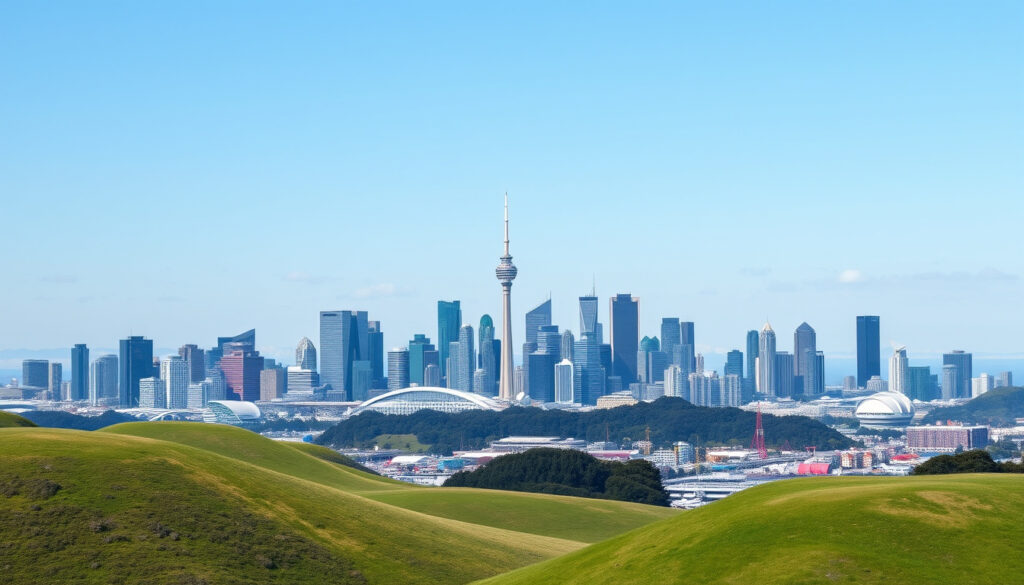
Biggest Cities in New Zealand 2025: Ranked by Population
Anyone planning a trip to New Zealand or thinking about where to settle quickly runs into the question of scale — just how big are its cities, really? With Auckland dominating the population charts at over 1.5 million and the South Island’s largest city, Christchurch, sitting at just over 400,000, the size gap between New Zealand’s urban centres is starker than in many other countries.
Largest city by population: Auckland: 1.5 million+ in urban area ·
Capital city: Wellington: 209,800 urban area population ·
South Island’s largest city: Christchurch: 407,800 urban area population ·
Number of cities defined by Statistics NZ: 16 (as of 2018 census) ·
Rapidly growing city: Tauranga: 169,633 population (2025 estimate)
Quick snapshot
- Auckland is the largest city with 1.5 million+ people (World Population Review)
- Christchurch is the largest city in the South Island (EHINZ)
- Wellington is the capital and third-largest urban area (EHINZ)
- Ranking depends on definition (urban area vs city council vs territorial authority)
- Fastest-growing city varies between Tauranga and Hamilton depending on source
- “Richest” city depends on metric: GDP, median income, or property values
- Auckland could become a 2-million-person metro by early 2030s
- Tauranga and Hamilton may challenge Wellington for third place in coming decades
- South Island growth lags North Island — 76.3% of Kiwis now live north of Cook Strait
| City | Urban area population (2025 est.) | Source |
|---|---|---|
| Auckland | 1,536,416 | World Population Review |
| Christchurch | 410,972 | World Population Review |
| Wellington | 207,964 | World Population Review |
| Hamilton | 194,076 | World Population Review |
| Tauranga | 169,633 | World Population Review |
| Dunedin | 113,000 (approx.) | Stats NZ |
What are the top 5 biggest cities in New Zealand?
1. Auckland
- Auckland’s urban area population: 1,536,416 (World Population Review)
- Auckland City (territorial authority): 1,656,500 in 2023 (EHINZ)
- Home to approximately one-third of New Zealand’s total population
Auckland is more than three times the size of Christchurch, the second-largest city. The gap isn’t small — it’s structural. Auckland’s economy, driven by immigration and service industries, has pulled away from every other urban centre in the country.
Auckland’s 1.5 million population makes it larger than the next four biggest cities combined. For anyone choosing where to live, this means Auckland offers the most jobs, the most diversity, and the most congestion — in roughly equal measure.
2. Christchurch
- Urban area population: 410,972 (World Population Review)
- Christchurch City (territorial authority): 391,400 in 2023 (EHINZ)
- Largest city in the South Island
Christchurch wears the crown for the South Island, but that crown is lighter than it sounds. Its population barely reaches a third of Auckland’s. Still, as the Canterbury region’s hub, it anchors the South Island economy and has seen steady reinvestment since the 2010-2011 earthquakes.
3. Wellington
- Urban area population: 207,964 (World Population Review)
- Wellington City: 202,700 in 2023 (EHINZ)
- Capital city — smallest national capital by population among OECD countries
Wellington punches well above its weight politically and culturally, but population-wise, it sits firmly in third place — and that spot is under pressure from fast-growing northern cities.
4. Hamilton
- Urban area population: 194,076 (World Population Review)
- Hamilton City: 174,700 in 2023 (EHINZ)
- Fast-growing due to Auckland spillover — drive time to Auckland: 90 minutes
Hamilton’s growth is the story of Auckland’s success ricocheting outward. People chased cheaper housing and found a university city with decent infrastructure and direct rail to the country’s biggest job market.
5. Tauranga
- Urban area population: 169,633 (World Population Review)
- Tauranga City: 152,800 in 2023 (EHINZ)
- Fastest-growing city by percentage — lifestyle migration from retirees and remote workers
The pattern is clear: the five biggest cities form a “North Island heavy” top tier, with only one South Island entry. And the gap between spot three (Wellington) and spot five (Tauranga) is just 38,000 people — close enough that the ranking could shuffle within a decade if Tauranga’s growth continues at 2-3% annually.
What is the largest city in New Zealand?
Auckland population and size compared to other cities
Auckland is the largest city in New Zealand across every major ranking source — but the reported number varies depending on whether you use urban area, territorial authority, or “greater Auckland” definitions. World Population Review puts the Auckland urban area at 1,536,416. EHINZ, using 2023 Census data, reports Auckland City (the territorial authority) at 1,656,500. The difference isn’t a mistake — it’s a matter of boundary definitions.
By either count, Auckland is more than 3.7 times the size of Christchurch and roughly 7.5 times the size of Wellington. That’s not a small lead; it’s a category difference.
Why is Auckland so much larger than other NZ cities?
- International migration is the main driver of population growth, per Stats NZ
- Auckland’s economy accounts for roughly 38% of New Zealand’s GDP
- Natural geography (isthmus with two harbours) concentrated early settlement
Stats NZ projects Auckland’s population reaching 2 million by 2033, driven almost entirely by net migration. The implication: the gap between Auckland and the rest of the country is going to grow, not shrink.
What are the top 3 cities in New Zealand?
1. Auckland
Urban area: 1,536,416 — largest by every definition, economic powerhouse, most diverse.
2. Christchurch
Urban area: 410,972 — South Island’s largest, rebuilt and recovering, gateway to Canterbury.
3. Wellington
Urban area: 207,964 — capital city, compact, cultural hub, smallest of the top three by a wide margin.
How does the top 3 compare to the next cities?
The gap between spot #3 (Wellington) and spot #4 (Hamilton) is just 13,888 people. That’s a hair’s breadth in population terms. And Tauranga, at #5, is only 38,000 behind Wellington. A decade of current growth rates would bring both Hamilton and Tauranga within striking distance of the capital.
The pattern: New Zealand’s city hierarchy has a clear king (Auckland), a solid second (Christchurch), but the bronze medal is up for grabs. Wellington’s status as capital masks its vulnerability on population.
Which is the nicest city in New Zealand?
Criteria for ‘nicest’: lifestyle, scenery, culture, safety
There is no objective answer to this question, and every local will argue their city is best. But a few patterns emerge from travel guides, resident surveys, and visitor data.
Wellington’s compact city and arts scene
Wellington consistently ranks high in quality-of-life surveys for its walkability, café culture, and arts scene. The city’s compact size — 202,700 people in a tight grid — means you’re never far from waterfront, bush walks, or a live gig.
Christchurch’s garden city and rebuild
Christchurch earned its “Garden City” nickname from its green spaces, and the post-earthquake rebuild has added modern architecture and a new biking network. It’s quieter than Auckland but offers better housing affordability.
Queenstown’s stunning landscape but smaller size
Queenstown is famous for its lake-and-mountain setting and adventure tourism, but its population sits around 29,000 — not in the same size category as the top five. For scenery, it wins; for services and job diversity, it loses.
Tauranga’s beaches and warm climate
Tauranga offers the warmest average temperatures in the North Island and stretches of white-sand beaches. Its growth is driven largely by lifestyle migration from Auckland and Hamilton. The trade-off: infrastructure hasn’t kept pace, and congestion is a growing complaint.
What is the richest city in New Zealand?
Auckland as the economic hub
Auckland produces roughly 38% of New Zealand’s GDP and has the highest concentration of high-income households, corporate headquarters, and investment capital. Stats NZ data shows Auckland’s median household income is among the highest of any city region.
Wealth per capita in different cities
Wellington, however, has a higher median personal income in some metrics, driven by government and professional services roles. The capital’s smaller population concentrates high-paying jobs in a tighter area. Auckland’s wealth is broader; Wellington’s is denser per person.
Real estate values
Property values are highest in Auckland by a clear margin. The median house price in Auckland sits around $1 million NZD, roughly double the national median. Wellington’s market is the second most expensive.
Is London bigger than Auckland?
Geographic size comparison
London covers 1,572 square kilometres — about 45% larger than Auckland’s 1,086 square kilometres. Both are spread-out cities compared to European or Asian metro areas.
Population comparison
London’s population of 8.9 million is approximately 5.8 times larger than Auckland’s 1.5 million. The density gap is even wider: London packs about 5,600 people per square kilometre versus Auckland’s 1,400. Auckland is a sprawling low-density city by global standards.
Implications of size differences
For New Zealanders, the comparison matters when assessing global competitiveness. Auckland’s economy is smaller and less diverse than London’s, but its quality of life indices often rank higher. London wins on scale and opportunity; Auckland wins on space and natural environment.
How do the biggest cities in New Zealand compare by population?
The pattern: A sharp drop-off after Auckland, but the real story is how close the middle of the pack has become.
| City | 2025 Population Estimate | Growth Rate (approx.) | Key Driver |
|---|---|---|---|
| Auckland | 1,536,416 | 1.2% per year | International migration |
| Christchurch | 410,972 | 0.7% per year | Post-quake rebuild, lifestyle |
| Wellington | 207,964 | 0.4% per year | Government jobs, education |
| Hamilton | 194,076 | 1.8% per year | Auckland spillover, university |
| Tauranga | 169,633 | 2.3% per year | Lifestyle migration, retirees |
| Dunedin | 113,000 | 0.3% per year | University, heritage |
The implication: Tauranga and Hamilton are growing 2-3 times faster than the national average, while Wellington’s growth is sluggish. If current trends hold, the ranking in 2035 could look quite different. Auckland’s lead is unassailable, but the order below it is contested.
South Island largest cities
- Christchurch: 410,972 — uncontested largest in the South Island
- Dunedin: ~113,000 — largest in the lower South Island, but a distant second
- Invercargill: ~50,000 — third-largest south of Cook Strait
The gap between Christchurch and Dunedin (roughly 300,000 people) illustrates the South Island’s population concentration in one major hub.
geonames.org, outthere.kiwi, worldometers.info, datacommons.org, en.wikipedia.org
Frequently asked questions
What is the biggest city in New Zealand?
Auckland is the biggest city in New Zealand by population, with an urban area population of 1,536,416 according to 2025 estimates from World Population Review.
How many people live in Auckland?
Auckland’s urban area population is estimated at 1,536,416 in 2025. The Auckland territorial authority recorded 1,656,500 in the 2023 Census (EHINZ).
Is Wellington or Christchurch bigger?
Christchurch is larger than Wellington. Christchurch’s urban area population is 410,972, while Wellington’s is 207,964 — Christchurch is roughly twice the size.
Which city in New Zealand has the highest population density?
Auckland has the highest population density among major cities, at roughly 1,400 people per square kilometre — but still low by global standards. Wellington’s compact city centre is denser in its core.
What is the fastest growing city in New Zealand?
Tauranga is the fastest-growing city by percentage, growing at an estimated 2-3% annually, driven by lifestyle migration and remote work (World Population Review).
Are there any cities in New Zealand with more than 1 million people?
Only Auckland exceeds 1 million people. No other city in New Zealand has a population above 500,000.
What is the largest city in the South Island?
Christchurch is the largest city in the South Island, with an urban area population of 410,972. Dunedin is the second-largest at approximately 113,000.
How does the size of Auckland compare to other world cities?
Auckland is smaller than major global cities. London (8.9 million) is about 6 times larger by population. Sydney (5.3 million) is about 3.5 times larger. Auckland’s urban area (1,086 sq km) is smaller than London (1,572 sq km) but larger than cities like Dublin (318 sq km).
For residents and newcomers alike, New Zealand’s city hierarchy offers a clear choice: Auckland for scale and opportunity, Christchurch for a manageable big-city experience in the South Island, and rapidly growing mid-sized cities like Tauranga and Hamilton for those betting on lifestyle and future growth. The data shows one thing plainly: the gap between the biggest and the rest is wide, but the movement within the middle ranks is where the real story lies.
More related posts
 The Leg of Lamb Recipe: Perfect Oven Roast Every Time
 What Happens When We Die? Medical & Spiritual Perspectives
 Severe Weather Warning NZ Today: Red Alerts & Cyclone Updates
 Prezzy Card Balance Check: Online Login & Phone Guide
 Rugby League World Cup 2026: Hosts, Dates & Format
 New Balance Buy Online: Be t Iri h Deal & Retailer
 Indiana Pacers vs Oklahoma City Thunder Stats: Game 7 Recap
 Maori vs Indigenous 2026 NRL All Stars: 16-16 Draw