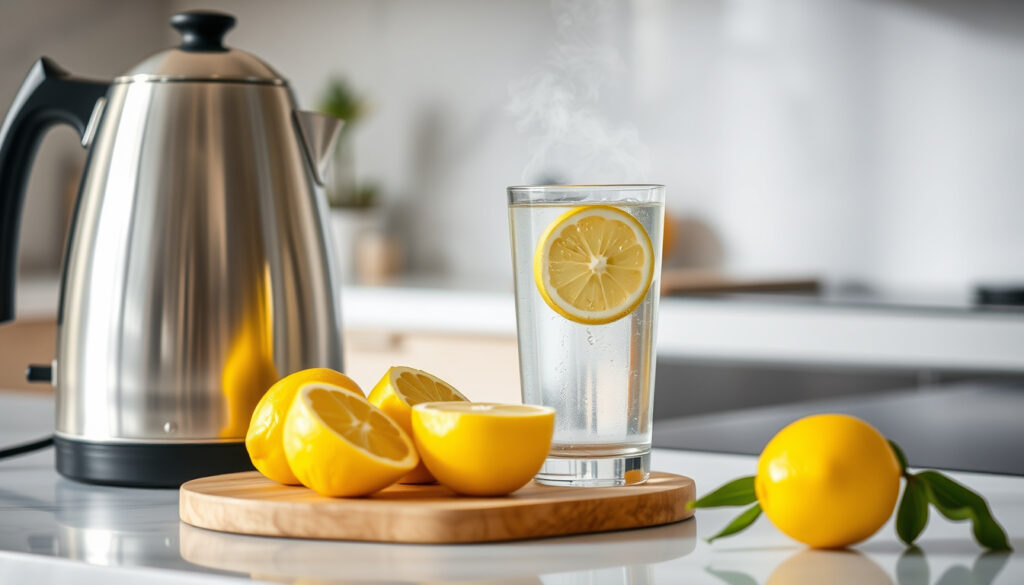
How to Descale a Kettle with Lemon: Step-by-Step Guide
If you’ve spotted a chalky white crust inside your kettle, that’s limescale — and it’s a sure sign of hard water. Before you reach for a chemical descaler, there’s a natural alternative that uses something you probably already have: a lemon.
Lemons needed: 1–2 (Better Homes and Gardens Australia) ·
Soak time: 5–60 minutes ·
Bottled ratio (if used): 1 part lemon juice to 3 parts water ·
Final step: Boil fresh water after rinse
Quick snapshot
- Lemon juice dissolves limescale because citric acid reacts with calcium carbonate (Lincoln Rowing)
- Standard method: boil lemon slices, let sit, then rinse thoroughly (Better Homes and Gardens Australia)
- Whether lemon is as effective as commercial descalers for heavy, thick buildup
- Long-term health effects of ingesting trace amounts of limescale particles
- Modern guides now recommend letting the lemon solution sit 5–60 minutes, not just a quick boil — a shift toward deeper cleaning (Business Magazine 24)
- After descaling, boil a full kettle of fresh water and discard it to remove any lemon taste or residue (Savers)
Four key parameters, one pattern: each affects how well and how quickly the lemon works. Here’s what the numbers say.
| Factor | Recommended value | Source |
|---|---|---|
| Number of lemons | 1–2 | Better Homes and Gardens Australia |
| Soak time (light scale) | 5–10 minutes | Better Homes and Gardens Australia |
| Soak time (heavy scale) | Up to 1 hour | Business Magazine 24 |
| Bottled lemon juice ratio | 1:3 (juice to water) | Better Homes and Gardens Australia |
The implication: these four settings — lemon count, soak time, method, and ratio — determine whether the treatment succeeds in one pass or needs a repeat.
Does lemon remove limescale from the kettle?
Yes — and the chemistry is straightforward. Limescale is primarily calcium carbonate, a mineral that forms when hard water is heated. Citric acid, which makes up about 5–6% of lemon juice, reacts with calcium carbonate to form soluble calcium citrate, which rinses away. The reaction is the same one used by commercial descalers, only with a lower acid concentration.
Can I use lemon juice as a descaler?
- For light to moderate limescale, lemon juice works well (Homes & Gardens).
- For thick, stubborn scale, you may need multiple treatments or a stronger acid like vinegar.
- Bottled lemon juice works too — just adjust the ratio (Better Homes and Gardens Australia).
Lemon is a capable natural descaler for regular maintenance, but it’s not a heavy-duty solvent. For most households with hard water, a monthly lemon treatment keeps buildup in check without synthetic chemicals.
The pattern: lemon is an effective, food-waste-reducing option for routine descaling, but don’t expect it to erase years of neglect in one go.
Is it okay to drink water from a kettle with limescale?
Yes, drinking water with limescale is generally considered safe. Calcium carbonate is not toxic — in fact, it’s a common calcium supplement. However, limescale can harbor bacteria in its porous surface, and over time it reduces heating efficiency (Savers). The main concerns are not acute toxicity but taste, energy waste, and potential damage to the kettle.
What happens if I don’t descale my kettle?
- Energy efficiency drops — limescale insulates the heating element, so it takes longer to boil.
- The kettle’s lifespan may shorten due to overheating and strain on the element.
- Water may develop a metallic or chalky off-flavor.
If you see flaking scale in your cup, that’s a sign the buildup is heavy. At that stage, regular lemon descaling may not be enough — consider a stronger citric acid product or vinegar.
The catch: limescale is not a health crisis, but it’s a maintenance issue that compounds over time. The longer you wait, the more effort it takes to undo.
What is the best way to clean the inside of an electric kettle?
Several natural methods work, each with different strengths. The lemon method is the most food-friendly; vinegar is faster on heavy scale; baking soda can help with stubborn stains. Below is a focused step-by-step for the lemon approach.
How do I remove limescale from inside a kettle?
- Step 1: Fill the kettle with enough cold tap water to cover the limescale deposits (Homes & Gardens).
- Step 2: Add the juice of 1–2 lemons (or drop in lemon halves/wedges). Remove seeds first (YouTube cleaning guide).
- Step 3: Boil the mixture, then let it sit for 5–60 minutes depending on the scale thickness (Better Homes and Gardens Australia).
- Step 4: Pour out the solution, rinse the kettle two or three times with fresh water (Business Magazine 24).
- Step 5: Boil a full kettle of fresh water and discard it to remove any remaining lemon taste or residue (Savers).
- Step 6: Repeat if needed for heavy buildup.
How do I get calcium buildup cleaned off of my electric kettle?
If the scale is particularly stubborn, increase the soak time to several hours or use bottled lemon juice at a 1:3 ratio (Better Homes and Gardens Australia). Some guides suggest leaving the solution overnight (Savers). After treatment, wipe the interior with a soft cloth to dislodge any loosened particles.
The trade-off: the lemon method is gentle and non-toxic, but it requires patience. For a quick fix, vinegar works in half the time.
Can I use lemon juice as a descaler?
Yes, but with a few caveats. Lemon juice (either fresh or bottled) is a mild acid that breaks down calcium carbonate gradually. It’s slower than vinegar or commercial descalers, but it leaves behind a fresh scent and avoids the strong odor of acetic acid.
- Best for: light limescale, regular maintenance, households that prefer natural cleaners.
- When not ideal: heavy, crusty buildup that has been accumulating for months.
- Comparison to vinegar: Vinegar (acetic acid) has a higher acidity (5%) and works faster, but leaves a lingering smell. Lemon is milder and more pleasant (Homes & Gardens).
What this means: choosing lemon over vinegar means trading speed for comfort and sustainability. If you’re sensitive to smells or want to avoid buying a separate product, lemon is the better everyday choice.
What happens if I don’t descale my kettle?
Over months of use, limescale accumulates into a thick, insulating layer. This forces the heating element to work harder and longer, increasing electricity consumption. In extreme cases, the element can overheat and burn out, shortening the kettle’s life (Food Republic). Additionally, particles of scale can break off and float in your drink, affecting taste and texture.
- Energy waste: A scaled kettle can use up to 30% more energy per boil.
- Kettle damage: Overheating may cause the automatic shutoff to fail or the element to crack.
- Off-tastes: Scale can trap minerals and bacteria that alter water flavor.
The catch: descaling isn’t just about aesthetics — it’s about appliance longevity and energy bills. A monthly lemon treatment costs pennies and can add years to your kettle.
Clarity check
Confirmed facts
- Lemon juice contains citric acid that dissolves limescale (Lincoln Rowing).
- Drinking water from a kettle with limescale is generally safe (Savers).
- The standard method (boil + soak + rinse) is widely recommended across multiple guides.
What’s unclear
- Whether lemon is as effective as commercial descalers for heavy, thick buildup.
- Long-term health implications of ingesting trace amounts of limescale particles.
Expert perspectives
Using lemon halves to descale kettles reduces food waste and is effective for mild limescale.
— Homes & Gardens (editorial team)
A common lemon method uses the juice of one to two lemons, enough water to cover the limescale, and a final rinse with fresh water.
— Better Homes and Gardens Australia (cleaning guide)
Summary paragraph: For the average household with hard water, the choice is clear: a monthly lemon descaling routine costs about 50 cents and takes less than an hour. The environmental upside — repurposing citrus that would otherwise be discarded — makes it a small but worthwhile habit. For those with heavy scale, a stronger acid or professional descaling product may be needed, but for most people, a lemon is all it takes to keep the kettle running efficiently.
youtube.com, reddit.com, youtube.com, reddit.com, express.co.uk
Frequently asked questions
How often should I descale my kettle?
Every 4–6 weeks if you have hard water; every 2–3 months if you have soft water. Signs you need to descale: visible white buildup, longer boil times, or flaking particles in your cup.
Can I use bottled lemon juice instead of fresh?
Yes. Use a 1:3 ratio of bottled lemon juice to water (Better Homes and Gardens Australia). Fresh lemons are slightly more effective because of natural oils, but bottled works well.
Does lemon damage the kettle’s interior?
No — lemon juice is mild enough that it won’t corrode stainless steel or plastic interiors. Avoid using on aluminum kettles without checking the manufacturer’s guidance.
What is the recommended ratio of lemon to water?
For fresh lemons: juice of 1–2 lemons in a full kettle of water. For bottled: 1 part juice to 3 parts water (Better Homes and Gardens Australia).
How long do I leave the lemon solution in the kettle?
At least 5 minutes for light scale; up to 1 hour for moderate buildup (Better Homes and Gardens Australia). Some guides suggest leaving it overnight for heavy scale (Savers).
Can I descale a kettle with lemon essential oil?
No — essential oils are not water-soluble and won’t provide enough citric acid to dissolve limescale. Stick to fresh lemons or bottled lemon juice.
Is lemon better than vinegar for descaling?
Lemon is gentler and leaves a pleasant scent; vinegar works faster but smells strong. For light scale, lemon wins on convenience. For heavy scale, vinegar is more efficient (Homes & Gardens).
More related posts
 Gold Coast Beach Cyclone Recovery: Are Beaches Safe Now
 Reduced to Clear Near Me: Stores, Hours & Online Shopping
 Trade Me Property for Sale: Platform Fees, Timing & Red Flags
 Marvel Movies in Order: Complete MCU Watch Guide 2025
 Game of Thrones Cast: Actors, Characters & Seasons
 Squid Game Season 3: Release Date, Episodes & Final Season
 Map of USA States: 50 States, Capitals & Free Printable Maps
 Tom Cruise Net Worth: $600 Million in 2025 Breakdown