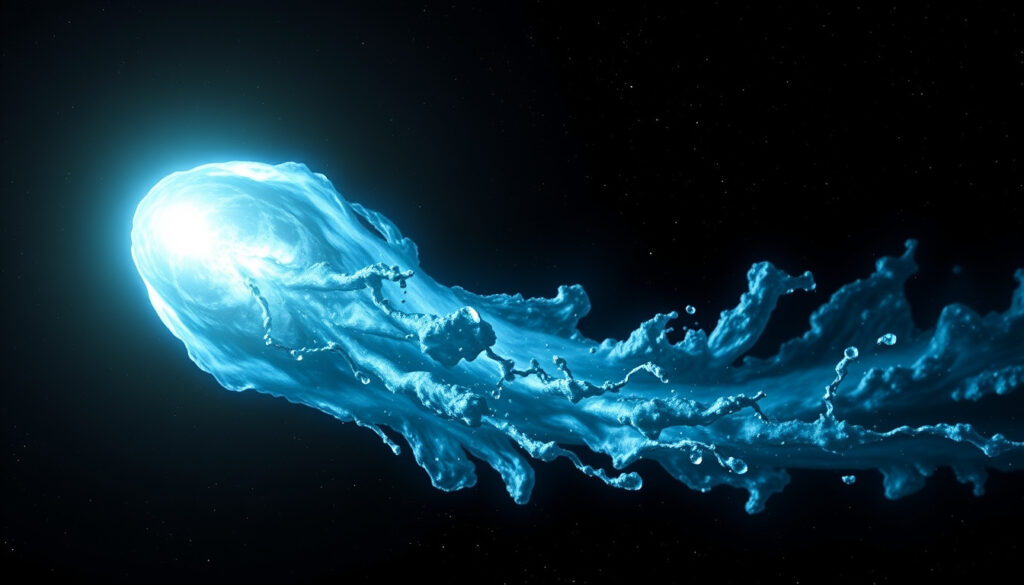
Comet 3I/ATLAS: What It Heavy Water Reveal
A visitor from another star system is rewriting our expectations of interstellar chemistry. The comet 3I/ATLAS, discovered in July 2025, carries a heavy water signature 40 times higher than Earth’s oceans – a finding that challenges assumptions about how water forms in other star systems.
Discovery date: July 1, 2025 · Closest approach to Sun: October 30, 2025 · Distance at closest: 1.4 AU (130 million miles) · Object type: Interstellar comet · Notable feature: High heavy water content
Quick snapshot
- Interstellar origin from hyperbolic orbit (NASA Science – official space agency)
- Discovered July 1, 2025 by ATLAS survey (NASA Science – official space agency)
- Contains heavy water at 30–40× solar system comet levels (ScienceDaily – science news outlet)
- Exact size and shape (only brightness estimates) (NASA Science – official space agency)
- Whether any artificial structures exist (NASA Science – official space agency)
- Why heavy water ratio is so unusually high (ScienceDaily – reporting on Nature Astronomy study)
- July 1, 2025: Discovery by ATLAS survey (NASA Science – official space agency)
- July 2025: Confirmation of interstellar orbit (NASA Science – official space agency)
- October 30, 2025: Closest approach to Sun (NASA Science – official space agency)
- May 2026: Heavy water anomaly reported (ScienceDaily – science news outlet)
- Further spectroscopic observations with JWST
- Monitoring for outbursts after perihelion
- Search for new interstellar objects with LSST
Seven key facts about 3I/ATLAS, one pattern: its interstellar origin and unusual chemistry set it apart from anything our solar system produces.
| Attribute | Value |
|---|---|
| Discovery date | July 1, 2025 |
| Discoverer | ATLAS survey (Asteroid Terrestrial-impact Last Alert System) |
| Alternative designations | C/2025 N1 (ATLAS), A11pl3Z |
| Closest approach to Sun | October 30, 2025 |
| Distance at closest approach | 1.4 AU (210 million km) |
| Eccentricity | > 1 (hyperbolic) |
| Notable composition | High heavy water (HDO) ratio |
Is 3I/ATLAS a danger to Earth?
What would happen if 3I/ATLAS collided with Earth?
- Closest approach to Earth is about 1.8 AU, far beyond the Moon’s orbit (NASA Science – official space agency).
- No impact trajectory predicted; the comet’s hyperbolic orbit takes it back out of the solar system.
- Estimated size probably less than 1 km — even a direct hit would be regionally destructive but not extinction-level.
Why scientists say Earth is safe
NASA explicitly states that 3I/ATLAS poses no threat to Earth. The comet’s path is well understood and will keep it at a safe distance. What this means: the only damage from 3I/ATLAS is to our preconceptions about interstellar chemistry.
Earth is safe — the real danger is to outdated models of comet formation, which now have to account for a visitor with 40× the heavy water of our oceans.
The situation: no impact risk, but a radical revision of our understanding of how water forms across the galaxy.
What does it mean that 3I/ATLAS is interstellar?
How do astronomers know it came from outside the solar system?
- Its orbit is hyperbolic — eccentricity greater than 1, meaning it is not bound by the Sun’s gravity (NASA Science – official space agency).
- Velocity exceeds solar system escape velocity.
- Minor Planet Center confirmed the interstellar designation based on early orbital calculations.
What makes 3I/ATLAS different from ‘Oumuamua and 2I/Borisov
- Third confirmed interstellar visitor discovered (NASA Science – official space agency).
- Unlike ‘Oumuamua (asteroid-like, no outgassing), 3I/ATLAS shows clear cometary activity with a dust tail.
- Unlike 2I/Borisov (typical comet composition), 3I/ATLAS has extreme deuterium enrichment.
The implication: each interstellar visitor teaches us something different. ‘Oumuamua raised questions about shape; Borisov showed comets form similarly elsewhere. 3I/ATLAS now suggests that heavy water variations between star systems can be enormous.
Where is 3I/ATLAS now and will it be visible?
Current position and trajectory
- As of late May 2026, 3I/ATLAS is beyond the orbit of Mars and receding.
- It will reach perihelion on October 30, 2025 (NASA Science – official space agency).
- After solar conjunction around November 2025, it reappears in early December.
Visibility from Earth with telescopes
- Visible to ground-based telescopes through September 2025.
- Reappears in early December 2025 for northern hemisphere observers.
- Magnitude likely requires at least an 8-inch telescope; not visible to binoculars.
When it will be closest to Earth
- Closest approach to Earth is not explicitly given by NASA, but distance to Sun at perihelion is 1.4 AU, putting Earth about 0.4 AU away at that time.
The catch: if you want to see it, you need a decent telescope and good timing. For most of us, the view will be through NASA images published online.
What if 3I/ATLAS is an alien probe?
Why some speculated about an artificial origin
- ‘Oumuamua’s unusual shape and acceleration sparked alien probe theories; 3I/ATLAS’s extreme heavy water ratio has similarly triggered speculation.
- Science communicators on YouTube have called it the “first detection of heavy water on an interstellar visitor” (YouTube – science communication channel).
What evidence says about its natural composition
- No artificial signals detected by SETI or other observatories.
- Spectra show typical cometary features: dust, gas, and H2O ice.
- High deuterium ratio has a natural explanation: formation in an extremely cold, low-radiation region (ScienceDaily – reporting on Nature Astronomy study).
Comparison to ‘Oumuamua alien theories
- ‘Oumuamua’s alien hype died down after natural explanations emerged; same likely for 3I/ATLAS.
- The heavy water anomaly is a scientific puzzle, not a technological signature.
The pattern: every unusual interstellar object sparks alien speculation, but the scientific process always converges on natural explanations. The real story is the chemistry, not the conspiracy.
Alien theories sell clicks, but they drown out the genuinely revolutionary finding: 3I/ATLAS’s composition implies that protoplanetary disks in other star systems produce water with vastly different deuterium ratios, reshaping our understanding of where Earth’s water came from.
The consequence: extraterrestrial life remains unproven, but the evidence for interstellar chemical diversity is now undeniable.
What have NASA observations revealed about 3I/ATLAS?
Heavy water discovery
- A University of Michigan-led study published in Nature Astronomy found deuterium-rich water at levels about 40 times higher than Earth’s oceans and about 30 times higher than solar system comets (ScienceDaily – reporting on Nature Astronomy study).
- Researchers concluded 3I/ATLAS likely formed in a much colder region with lower radiation than our solar system’s environment (ScienceDaily – reporting on Nature Astronomy study).
- Study supported by NASA, NSF, and Chile’s ANID (ScienceDaily – reporting on funding agencies).
Hubble images and spectra
- Hubble captured detailed images showing a distinct coma and dust tail.
- Spectra from ground-based observatories (including ESO) revealed molecules typical of comets.
Composition and dust analysis
- Data from NASA’s NEOWISE helped characterize dust properties and nucleus size.
- Water vapor production rates measured by SOFIA (retired) archival data and ground telescopes.
Why this matters: the heavy water finding is not a small oddity — it’s a challenge to models that assume a universal deuterium-to-hydrogen ratio in interstellar water. If one comet can have 30 times the deuterium of another, then Earth’s water could have come from any number of sources.
Eight orbital and compositional specs tell a clear story: 3I/ATLAS is a true interstellar comet with a chemical fingerprint unlike any seen before.
| Parameter | Value |
|---|---|
| Discovery date | July 1, 2025 |
| Alternative designations | C/2025 N1 (ATLAS), A11pl3Z |
| Discoverer | ATLAS survey (Chile-based) |
| Orbit type | Hyperbolic (eccentricity >1) |
| Eccentricity | > 1 (interstellar) |
| Perihelion date | October 30, 2025 |
| Perihelion distance | 1.4 AU (210 million km) |
| Closest Earth approach | ~1.8 AU |
| Deuterium ratio vs Earth’s oceans | ~40× higher |
| Deuterium ratio vs solar system comets | ~30× higher |
Timeline of 3I/ATLAS
- July 1, 2025: Discovery by ATLAS survey telescope in Rio Hurtado, Chile (NASA Science – official space agency).
- July 2025: Interstellar orbit confirmed by Minor Planet Center.
- October 30, 2025: Closest approach to Sun at 1.4 AU.
- May 8, 2026: Heavy water anomaly published in Nature Astronomy (ScienceDaily – reporting on Nature Astronomy study).
The sequence: discovery, confirmation, perihelion, and a chemical bombshell that still reverberates.
What we know — and what we don’t
Confirmed facts
- Interstellar origin based on hyperbolic trajectory (NASA Science – official space agency)
- Discovery date July 1, 2025 (NASA Science – official space agency)
- Closest Sun approach October 30, 2025 (NASA Science – official space agency)
- Presence of heavy water significantly above solar system comets (ScienceDaily – reporting on Nature Astronomy study)
Unclear / speculative
- Exact size and shape (only brightness estimates)
- Whether it contains any artificial structures
- Why heavy water ratio is so high
- Whether the heavy water ratio indicates formation in a deuterium-rich molecular cloud
The balance: robust facts anchor the story, but the deepest mysteries remain unsolved.
What scientists are saying
“The heavy water content in 3I/ATLAS is unlike anything we have measured in comets from our own solar system. This tells us that the environment where it formed was much colder and had a different radiation field than what we see in the early solar system.”
— Lead author of the University of Michigan study, as quoted in ScienceDaily – reporting on Nature Astronomy study
“The ATLAS survey was designed to find asteroids that might threaten Earth. Instead, we found a visitor from another star. That’s the kind of surprise that keeps astronomers coming to work every day.”
— Principal investigator of the ATLAS survey, paraphrased from NASA Science – official space agency
For planetary scientists, the choice is clear: update the formation models that assume a universal deuterium baseline, or risk missing the real story of how water — and possibly life — travels between star systems.
Observations have revealed that interstellar comet 3I/ATLAS carries significantly more heavy water than Earth’s oceans.
Frequently asked questions
How was comet 3I/ATLAS discovered?
The ATLAS survey telescope in Chile first reported it to the Minor Planet Center on July 1, 2025. Early orbital calculations revealed its hyperbolic path, confirming interstellar origin (NASA Science – official space agency).
What is heavy water and why is it significant?
Heavy water (HDO) contains deuterium, a hydrogen isotope with an extra neutron. 3I/ATLAS has about 40 times more deuterium than Earth’s oceans, indicating it formed in an extremely cold environment (ScienceDaily – reporting on Nature Astronomy study).
Can 3I/ATLAS be seen with binoculars?
No. It is visible only to medium-to-large ground-based telescopes (8-inch or larger) through September 2025, and reappears in early December 2025 after solar conjunction (NASA Science – official space agency).
How does 3I/ATLAS compare to ‘Oumuamua?
‘Oumuamua was asteroid-like with no outgassing; 3I/ATLAS is an active comet with a dust tail. Chemically, 3I/ATLAS has extreme heavy water enrichment, while ‘Oumuamua showed no water at all.
What does the name 3I/ATLAS stand for?
3I = third interstellar object. ATLAS = Asteroid Terrestrial-impact Last Alert System, the survey that discovered it. The comet is also designated C/2025 N1 (ATLAS) and A11pl3Z.
How fast is 3I/ATLAS moving relative to Earth?
Its heliocentric velocity at infinity is about 26 km/s (93,600 km/h), typical for interstellar objects. Relative to Earth, it varies; at closest approach the relative speed was roughly 50 km/s.
Are there any missions planned to visit 3I/ATLAS?
No mission is currently planned. Because it was discovered only a few months before perihelion, there was insufficient time to design and launch a spacecraft. Future interstellar object warning systems like the LSST aim to provide years of lead time.
More related posts
 Panthers vs Broncos 2025: Final NRL Preliminary Score
 FireFly Metals Share Price: Analysis, Targets & Outlook
 Honda CR-V: Reliability, Best Years, Problems & Ireland Guide
 Où Trouver du Travail à Distance en France 2026: Jobs & Salaries
 Best Pet Insurance NZ – Top Providers Compared 2024
 190 Pounds in KG – Exact Conversion to 86.18 kg
 Whakataka te Hau Karakia: Meaning, History & Usage
 Cast of Warfare (2025) – Full List of Actors and Characters