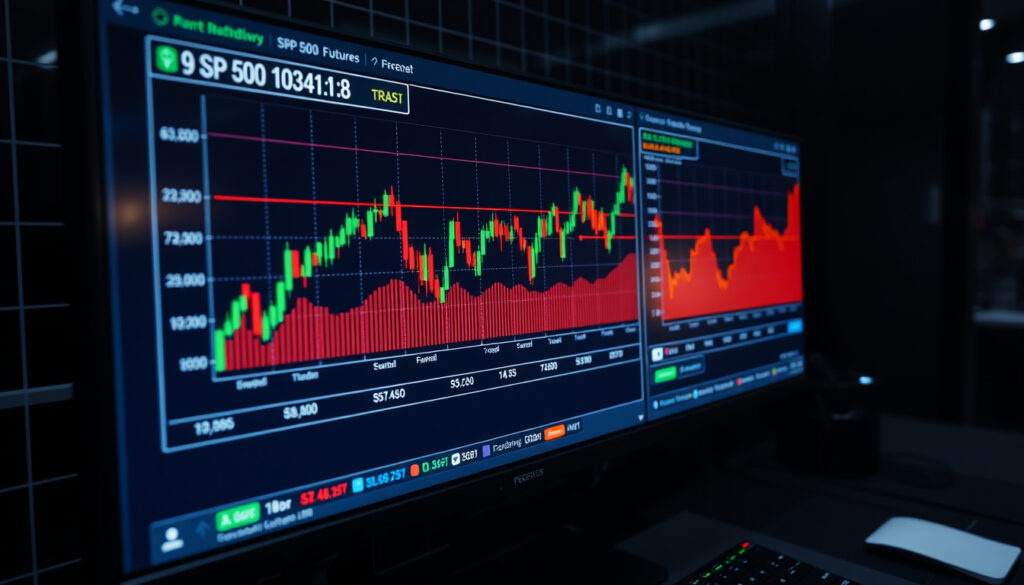
S&P 500 futures – Levande pris, analys och handelsguide
S&P 500 futures rank among the most actively traded equity-index futures contracts worldwide. Investors and traders monitor these instruments for real-time insights into market sentiment, pre-market direction, and broader economic expectations. Understanding how these contracts function, what drives their pricing, and where to access live data forms the foundation of informed participation in derivatives markets.
The CME E-mini S&P 500 futures contract, commonly displayed as ES=F on retail quote platforms, represents a tradable derivative linked to the S&P 500 Index. Unlike traditional stock investments, futures provide leveraged exposure to the index’s performance without requiring ownership of the underlying securities. This distinction, combined with nearly round-the-clock trading availability, makes futures a unique tool for both hedging and speculation.
Whether tracking overnight developments from Asian and European markets, preparing for the U.S. cash market open, or managing portfolio risk during volatile sessions, futures offer a window into market expectations. This article examines the contract’s mechanics, pricing dynamics, and practical considerations for those seeking to understand or incorporate S&P 500 futures into their market analysis.
What Are S&P 500 Futures and How Do They Work?
Live price, daily change, ticker symbol (ES=F), exchange (CME). (s and p 500 futures)
Contract type (E-mini), what it tracks (S&P 500 Index), contract size.
Nearly 24/5 schedule (Sunday–Friday), with key pre-market and regular session windows.
Hedging portfolio risk or speculating on the index’s future direction.
- Futures prices are the first reaction to overnight news, setting a tone for the U.S. stock market open.
- The “E-mini” is the most traded S&P 500 futures contract, accessible to more traders due to its smaller size compared to the standard S&P 500 futures contract.
- A sustained move in futures during pre-market hours often, but not always, leads to a similar gap at the market open.
- Volume and price action in futures can signal the conviction or lack thereof behind a pre-market move.
- The contract is cash-settled, meaning positions are settled against the index rather than involving physical delivery of stocks.
| Term | Detail |
|---|---|
| Underlying Index | S&P 500 Index |
| Ticker Symbol | ES=F (Common Quote Symbol) |
| Exchange | CME Group (Chicago Mercantile Exchange) |
| Contract Size | $50 × S&P 500 Index Price |
| Price Quotation | Index points (e.g., 7,787.00) |
| Minimum Tick | 0.25 index points ($12.50 per contract) |
| Settlement | Cash-settled |
| Contract Months | Quarterly (Mar, Jun, Sep, Dec) |
One E-mini contract is worth $50 times the S&P 500 index level. At an index level of 7,780, the notional value of a single contract approximates $389,000. Because margin requirements are typically much smaller than notional value, futures offer leveraged exposure that amplifies both gains and losses.
Live S&P 500 Futures Data and Price Tracking
Where to Find Real-Time Quotes
Accessing live futures data requires reliable financial platforms. Yahoo Finance displays the front-month contract as ES=F, while TradingView uses the symbol ES1! for charting purposes. The CME Group website provides official contract specifications and direct access to exchange data. Major financial news outlets including CNBC, Wall Street Journal, and MarketWatch offer quote pages with session statistics and contract-month views.
How to Read a Futures Quote
A futures quote displays several key components. The current price represents the last executed trade on the CME Globex electronic trading platform. Daily change shows the difference from the previous settlement price. The contract month indicates which quarterly expiration is being quoted. Some platforms display the basis, which measures the difference between the futures price and the cash index level.
Trading Hours and Market Sessions
S&P 500 E-mini futures trade nearly 24 hours per day, five days per week. Trading begins Sunday evening at 6:00 PM ET and continues through Friday afternoon. The regular U.S. stock market session runs from 9:30 AM to 4:00 PM ET, but futures activity during these hours remains substantial as traders react to real-time developments and manage positions.
Recent market data shows E-mini S&P 500 futures trading in the range of approximately 7,736 to 7,785 index points. The exact displayed price varies by platform, session timing, and whether the quote reflects live or delayed data. One market snapshot indicated a 1-day expected move of roughly ±52.3 points, though this figure fluctuates based on volatility conditions.
What Drives S&P 500 Futures Prices?
Economic Data and Federal Reserve Policy
U.S. macroeconomic releases exert significant influence on futures pricing. Reports covering inflation (CPI, PCE), employment (jobs report, unemployment claims), gross domestic product, and consumer sentiment provide data points that shape expectations for Federal Reserve policy. Interest rate decisions and statements from Fed officials can trigger immediate and substantial price movements.
Corporate Earnings and Guidance
Quarterly earnings from S&P 500 component companies affect futures prices both individually and in aggregate. When major technology firms, financial institutions, or consumer discretionary companies report results, the impact extends beyond individual stock prices to influence broader index futures. Forward guidance from corporate leadership often proves more market-moving than the actual reported figures.
Global Market Dynamics
Because futures trade nearly around the clock, overnight developments from Asian and European markets contribute to price discovery. Opening bells in Tokyo, Hong Kong, London, and Frankfurt can set early tone for U.S. futures. Geopolitical events, commodity price shifts, and currency movements all factor into the continuous valuation process.
Risk Sentiment and Market Interrelationships
Market participants constantly assess risk appetite, which manifests in relationships between equities, Treasuries, gold, and volatility indices. Rising Treasury yields often pressure equity valuations, while elevated volatility tends to coincide with risk-off positioning. The VIX volatility index and U.S. dollar movements provide contextual signals for interpreting futures price action.
Futures can trade above or below the cash index depending on financing costs, expected dividends, and market conditions. In contango, futures trade above the spot index, while backwardation occurs when futures fall below cash. This basis relationship reflects carry costs and can influence trading strategies, particularly for spread positions between contract months.
Understanding the Difference: Futures vs. the S&P 500 Index
The S&P 500 Index represents a benchmark number that tracks 500 large U.S. stocks. Investors cannot directly trade an index; instead, they access index exposure through derivatives, ETFs, or index funds. ES futures are a tradable derivative whose price derives from the underlying index plus adjustments for financing costs, anticipated dividends, and supply-demand dynamics.
A key distinction involves trading hours. The S&P 500 cash index calculation reflects only stock market session prices during regular trading hours. Futures, however, continue trading through electronic platforms outside these windows, providing continuous price discovery. This difference means futures often react to news events before the cash market opens the following morning.
A Trading Day in S&P 500 Futures: Key Milestones
- — Evening trading session begins for S&P 500 E-mini futures, setting up for the week ahead.
- — Key economic reports such as GDP figures or PCE data are often released during the overnight session, creating volatility.
- — European markets open, influencing global risk sentiment that carries into U.S. futures pricing.
- — U.S. pre-market economic data, including jobs reports or CPI, is released with major potential impact.
- — U.S. Regular Stock Market Opens. Futures trading continues alongside cash equity activity.
- — U.S. Regular Stock Market Closes. After-hours futures trading continues on electronic platforms.
- — Daily settlement price for futures contracts is typically determined based on the closing period.
What We Know—and What We Don’t—About S&P 500 Futures
| Established Information | Uncertain or Speculative |
|---|---|
| The live price quote reflects the last executed trade on the CME exchange. | Predictions for where futures will be tomorrow, next week, or at expiration involve speculation. |
| Contract specifications including size ($50 × index), tick value ($12.50), and quarterly expirations are defined by the CME. | The degree to which pre-market futures movement will translate to the cash market open is not guaranteed. |
| Futures trade nearly 24 hours each weekday on the CME Globex platform. | The impact of any single news event on price represents market consensus that can shift rapidly. |
| Historical prices and volume data constitute factual records of past market activity. | Analyst predictions and price targets express opinions rather than established facts. |
The Role of S&P 500 Futures in Market Analysis
Futures serve multiple functions within the broader market ecosystem. Institutional investors use them to hedge equity exposure, adjusting portfolio delta without trading individual stocks. Speculators seek profit from anticipated price movements. The continuous trading activity in futures contributes to price discovery, with the futures market often leading the cash market in responding to new information.
Comparing S&P 500 futures to other index derivatives reveals differences in liquidity and contract specifications. The E-mini S&P 500 (ES) represents the most liquid equity-index futures contract globally. Dow Jones futures (YM) and Nasdaq-100 futures (NQ) offer alternative exposures with different composition and volatility characteristics. The choice between instruments depends on specific hedging or trading objectives.
For practical analysis, monitoring the live chart alongside settlement prices, overnight session ranges, Treasury yield movements, and scheduled economic releases provides a comprehensive view. Platforms offering real-time charting capabilities help identify support and resistance levels that may influence intraday trading decisions.
Official Sources and Market Information
“E-mini S&P 500 futures are one of the world’s most liquid equity index derivatives.”
For authoritative contract specifications and exchange rules, the CME Group website provides comprehensive documentation. Information about the underlying index methodology and composition is available through S&P Dow Jones Indices. Macroeconomic data that influences futures pricing can be accessed via Federal Reserve Economic Data (FRED).
Educational resources about futures trading mechanics, including margin requirements and order types, are available through the Securities and Exchange Commission’s investor education portal. These official resources provide factual foundations for understanding how futures markets operate.
Summary: Key Takeaways on S&P 500 Futures
S&P 500 futures, particularly the E-mini contract traded under the ES root symbol, represent a cornerstone of modern derivatives markets. Understanding the contract specifications, trading hours, and price drivers provides context for anyone monitoring equity market sentiment. Live data sources including comprehensive S&P 500 coverage and chart analysis guides complement this information for deeper market understanding.
Frequently Asked Questions
What is the margin requirement to trade S&P 500 futures?
Margin requirements vary by brokerage and account type but typically range from 5% to 10% of the contract’s notional value. At an index level of 7,780, one contract has a notional value of approximately $389,000, meaning initial margin might range from roughly $12,000 to $15,000 or more depending on the broker.
How often do S&P 500 futures contracts expire?
The E-mini S&P 500 futures use standard quarterly expiration dates in March, June, September, and December. Trading typically ceases several business days before the third Friday of the expiration month when the contract settles.
Can I trade S&P 500 futures in my IRA?
Some brokerage firms permit futures trading within individual retirement accounts, though restrictions may apply. Investors should consult with their custodian and understand that futures trading involves leverage, which may conflict with certain retirement account objectives.
What is the difference between ES and SPX options?
ES options are exchange-listed options on E-mini S&P 500 futures contracts, while SPX options are based on the S&P 500 Index itself. ES options are physically settled, while SPX options use a cash settlement method. The contract sizes and underlying instruments differ, affecting tick values and margin calculations.
What does cash settlement mean for futures?
Cash settlement means that when an S&P 500 futures contract expires, the position is closed at the final settlement price without physical delivery of any assets. The profit or loss is credited or debited based on the difference between the entry price and the settlement price.
How does after-hours futures trading work?
The CME Globex electronic platform operates nearly 24 hours daily during weekdays, starting Sunday evening and continuing through Friday afternoon. This enables traders to react to overnight news, economic releases from other time zones, and developments after U.S. market hours.
What does it mean when futures trade at a premium to the index?
When futures trade above the cash index level, this condition is called contango. The premium reflects factors including financing costs, expected dividends, and supply-demand dynamics. A sustained premium can attract arbitrage activity that brings futures and cash prices back toward alignment.
More related posts
 Warriors vs Timberwolves Stats: Scores & Analysis
 Homes for Sale in Rotorua: Listings, Private Sales & By Owner
 Trade Me Insurance Login: How to Access Your Policy Portal
 How to Make Betty Crocker Cake Mix Even Better: Tips and Hacks
 How to Make Dumplings: Fluffy Stew Dumpling Easy Recipe
 What Is an Enzyme? Definition, Function, Examples & More
 Silent Witness Season 28: Cast, Episodes, Viewing Guide & Renewal
 £ to NZ Dollar: Current Exchange Rate & Forecast (2024)