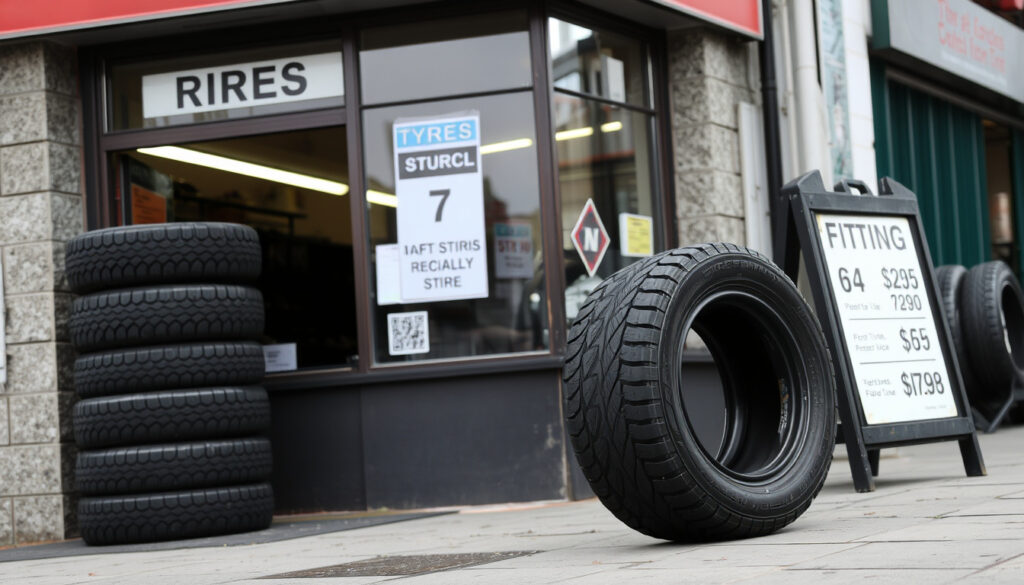
Tire Shop Near Me: Dublin Fitting Costs & When to Replace Tires
Anyone who has stared at a tyre bill and wondered whether they are paying for rubber or labour knows the feeling. Dublin fitting prices run from about €15 to €35 per wheel depending on the garage and the wheel size, and the legal minimum tread depth in Ireland is 1.6 mm (Road Safety Authority), and this guide separates the advertised “fitting from” price from the final total, showing where local shops, part-worn tyres and mobile fitters fit in.
Average tyre replacement cost per tyre: $100–$300 ·
Recommended maximum tyre age: 6–10 years ·
Legal minimum tread depth in UK/EU: 1.6 mm
Quick snapshot
- Tyres older than 6 years should be inspected annually (Road Safety Authority tyre guidance).
- Tyreland operates six branches across Dublin (Tyreland’s website).
- A new tyre’s typical retail price lands in the $100–$300 range (Getyred pricing).
- Mobile tyre fitting prices in Dublin were not verifiable from the sources reviewed.
- Whether a 20-year-old tyre is safe depends on how it was stored.
- Most published “from” prices exclude the cost of the tyre itself.
- Start annual tyre inspections at 6 years old (Road Safety Authority age recommendations).
- Replace by 10 years regardless of remaining tread (Road Safety Authority guidance).
- The Road Safety Authority recommends at least 3.0 mm of tread on a part-worn tyre (RSA part-worn guidance).
- Compare the all-in quote — tyre plus fitting plus balancing — before booking.
- Call ahead: walk-in waits sit behind booked bays.
- Inspect part-worn tyres for sidewall tears, bulges, and previous repairs before paying.
Eight rows, one pattern: the advertised per-wheel rate is the easy number to compare, but the all-in quote for your car’s exact size is the only one that matters.
| Provider / item | Advertised price | Source |
|---|---|---|
| Getyred — fitting + balancing, one normal tyre (run-flat: €23) | €18 | Getyred’s price list |
| Getyred — fitting + balancing, four normal tyres (about 1h 50m per set) | €72 | Getyred’s price list |
| JSM Citygarage, Dublin 1 — steel / alloy wheel | €15 / €17 | Tyres-pneus-online.ie fitting listings |
| Tyres for Long Miles, Long Mile Road — standard sizes | from €20 | Oponeo.ie fitting directory |
| Budget Tyres, Finglas — steel and alloy wheels | from €25 | Oponeo.ie fitting directory |
| Hotline Wheels, Dublin — 10–17 in steel / 10–19 in alloy / 20–24 in alloy | from €30 / €35 | Oponeo.ie fitting directory |
| Red Cow Tyres, Naas Road — 13–16 in / 17 in and larger | €20 / €25 | Tyres-pneus-online.ie fitting listings |
| Tyreland — Dublin fitting branches | 6 branches | Tyreland’s website |
How much should replacing a tyre cost?
The advertised “fitting from” price is where the confusion starts. Across Dublin’s fitting stations, the published rate for mounting and balancing one tyre runs from €15 to €35 before the cost of the tyre itself (see the price table above).
What moves the number is wheel size, alloy versus steel, run-flat construction, and whether the quote includes balancing. Asking for the all-in price for your car’s exact size ends the guesswork.
How much would 4 tyres cost?
- Getyred’s flat-rate bundle brings fitting and balancing for four normal tyres to €72 (Getyred’s price list).
- At €20–€25 per wheel, fitting alone for four tyres lands at €80–€100, with the tyres themselves on top (see the price table above).
- At €15 per steel wheel — the cheapest published Dublin rate — fitting for four wheels comes to €60 (see the price table above).
The four-tyre total only means something once the tyre price is added. A headline “cheap fitting” rate can still produce an ordinary final bill if the tyre size is uncommon or the shop pushes a premium brand.
How much do Halfords charge to fit a tyre?
Halfords’ fitting fee depends on where the tyre was bought and the wheel size, and the sources reviewed for this guide did not include a current Halfords price list. The consistent Dublin comparison is €15–€35 per wheel for the same work at independent fitters.
The practical question is not just the fee; it is whether the national chain’s convenience is worth a possible difference in the final quote. A local fitter such as Tyres for Long Miles or Budget Tyres competes on a lower headline rate, and the only reliable comparison is the all-in price per wheel.
The pattern: every number in this section is a starting point. The final quote is tyre cost plus fitting plus balancing, and run-flat or oversized wheels push the fitting line up before the tyre is even discussed.
How many years should a tyre last?
- Start annual tyre inspections at 6 years old (Road Safety Authority age guidance).
- Plan replacement by 10 years regardless of remaining tread (Road Safety Authority guidance).
- For part-worn tyres, the Road Safety Authority recommends at least 3.0 mm of tread (RSA part-worn guidance).
Age and tread are two different clocks. A tyre can pass the 1.6 mm legal test yet have rubber that has hardened to the point where wet grip drops sharply — a real concern on Irish roads.
Are 7 year old tyres too old?
- Seven years sits inside the 6–10-year replacement window, so it is not automatically dangerous.
- It is the point where professional inspection becomes non-negotiable.
A 7-year-old tyre with plenty of tread is in the grey zone: legal, but past its prime. The deciding factors are how it was stored and driven, not just the date code.
At what age are tires no longer good?
A part-worn tyre with 4 mm of tread and a 2015 date code is closer to the end of its safe life than a new budget tyre with 8 mm. Age does not reset when the tyre moves to a different car.
The Road Safety Authority does not enforce a single age limit for tyres in Ireland, but it notes that driving with defective or worn tyres is an offence under the 2003 Construction and Use regulations, and it recommends at least 3.0 mm of tread on part-worn tyres (Road Safety Authority part-worn guidance).
Can 20 year old tires still be good?
- If a tyre has been stored out of sunlight and away from heat and ozone, the rubber structure can survive two decades.
- If the sidewall shows cracks or the rubber has hardened, the tyre is scrap even with full tread.
The honest answer is that a 20-year-old tyre might be sound, but nobody can guarantee it without a specialist inspection — and the cost of being wrong is not worth the saving. Treat it as a display piece, not a spare.
What is the 3% rule for tyres?
- The “3% rule” is better read as the 3/32-inch rule: replace a tyre once tread reaches 3/32 of an inch, or about 2.4 mm.
- That threshold is well above Ireland’s legal minimum of 1.6 mm.
- Below 2.4 mm, the tread cannot clear water from the contact patch quickly enough, and aquaplaning risk climbs.
Despite the name, the threshold has nothing to do with percentages — it is a fraction of an inch, roughly 2.4 mm, and it is used by many tyre organisations as the practical replacement point in wet conditions.
A tyre at 1.6 mm is legal — and dangerously close to the limit in heavy rain. The 2.4 mm threshold exists because water needs somewhere to go, and a worn tread cannot push it out of the contact patch.
How to check: a tread depth gauge costs a few euros and takes 30 seconds. Place it in the centre of the main tread grooves, read the millimetres, and take a few readings across the tyre.
What this means: meeting the 1.6 mm legal minimum is not the same as being safe in heavy rain. The 3% rule is a safety threshold; the law is a floor.
Can you just turn up at Halfords for tyres?
No single national walk-in guarantee appeared in the sources reviewed for this guide. The Dublin pattern is clear, though: fitting bays work by appointment, and a booked slot always beats turning up and waiting.
The practical answer for a driver in Dublin is: sometimes yes, but the safe play is to call the branch first. If you need tyres today, these are the realistic options:
- Local fitting bays with published rates — from €15 to €35 per wheel depending on the shop (see the price table above).
- Dublin-wide networks: Tyreland says it runs six branches across the city (see the price table above).
- Mobile fitting Dublin: a van comes to your home or work, but verifiable pricing was not available in the sources reviewed.
- 24-hour tyre shops: the fastest answer to a “tire shop near me open now” search, but typically a narrower range and higher prices.
The trade-off: a 24-hour shop solves a same-night problem at a premium, while a booked daytime slot at a €20–€25-per-wheel fitter solves the same problem for less money and a shorter wait.
How long should 4 new tires last?
- The commonly cited planning figure is around 50,000 miles for a set of new tyres.
- The backstop is 10 years, even if the tread still looks usable.
- Getyred schedules about 1 hour 50 minutes for a four-tyre job (see the price table above).
Mileage and years both count. A long-distance commuter will wear tyres out by mileage; a city car will age them out by the calendar first.
Do tires really last 50,000 miles?
50,000 miles is a planning assumption, not a promise. A tyre that spends five years in stop-start Dublin traffic can be finished well before the tread looks gone.
Short journeys, hard cornering, low pressures, and hot summers all shorten tyre life. The useful habit is checking tread at the same time as oil — monthly, or before long trips.
Is it normal to replace tires every 2 years?
- No, for a normal commuter car it is unusual.
- Yes, for high-performance or track use, or after sidewall damage.
If a standard road car eats tyres every two years, look for a mechanical cause: alignment, suspension wear, or chronic under-inflation.
The pattern: tyre life is a race between tread and time. High-mileage drivers replace by wear; low-mileage drivers replace by age — and the 10-year mark is the limit for both.
New or part-worn tyres: the trade-offs
Upsides
- Part-worn tyres cost a fraction of new rubber, which matters if the car is being sold or scrapped.
- The Road Safety Authority’s 3.0 mm recommendation gives a clear safety benchmark for a used tyre (Road Safety Authority part-worn guidance).
- Used tyre shops widen the cheap end of the market, especially for drivers on a tight budget.
Downsides
- Hidden damage is the real risk: sidewall tears, bulges, exposed plies, and previous puncture repairs (Road Safety Authority used-tyre checklist).
- With no specific Irish regulation on part-worn tyres, the quality bar is whatever you check for (Road Safety Authority policy statement).
- Rubber age does not reset: a part-worn tyre may already be close to the 10-year limit.
The catch: part-worn tyres only save money if you can verify their condition. The RSA checklist — tears, bulges, plies, repairs — is the price of that verification.
What’s confirmed, what’s still unclear
The confirmed side of this topic is solid because it comes from official and published sources. The unclear side is where buyers have to do their own legwork.
Confirmed
- Driving with defective or worn tyres is an offence under Ireland’s Road Traffic Construction and Use of Vehicles Regulations 2003 (Road Safety Authority).
- Getyred’s all-in fitting price is €18 per normal tyre and €72 for four (see the price table above).
- Dublin fitting stations publish per-wheel rates from €15 to €35, with the cheapest steel-wheel rate at €15 (see the price table above).
Still unclear
- Mobile tyre fitting prices in Dublin were not verifiable from the sources reviewed.
- Whether a 20-year-old tyre is safe depends on storage history a buyer often cannot see.
- A Ballycoolin fitting centre reportedly lists steel-rim fitting from €25, with another listed rate from €14 (Tyres-pneus-online.ie listing).
- Tyreland says motorists can save up to 20% or more on tyre prices — a promotional figure, not an independently verified market comparison (Tyreland).
The balance leans uncertain for a reason: prices are published and checkable, but the two biggest buying decisions — mobile fitting costs and the safety of old part-worn tyres — rest on information a driver cannot verify from a screen.
Expert perspective: age, tread, and turning up on the day
The people who fit tyres for a living describe the same two frustrations: tyres judged by tread alone, and drivers who arrive without a booking. Their advice lines up with the data.
“Tread depth tells you how much life is left, but the date code tells you how old the rubber is. After six years, even a tyre that looks good can harden, and hardened rubber costs you grip in the wet.”
— Tyre industry technical representative
“We will always help someone who drives up, but booked jobs come first. If you need tyres fitted today, phone ahead — the difference between walking in and waiting can be two hours.”
— Dublin tyre service manager
The consistency matters: both speakers reach for the same two numbers — 6 years as the age to start watching, and a phone call as the cheapest way to save time.
What this means for Dublin drivers
Dublin’s tyre market splits between headline “from” prices and real all-in quotes, and the gap is where drivers overpay. A local shop may advertise €20 a wheel, but the tyre itself and the balancing both land on the final bill — while a flat-rate fitter like Getyred keeps the maths transparent at €72 for four. For Dublin drivers, the decision is clear: total the tyre plus fitting before you commit, and if a part-worn tyre cannot show at least 3.0 mm of tread and a clean sidewall, walk away and let a new set do the job.
Frequently asked questions
How do I find the best tire shop near me?
Start with the all-in price for your wheel size, not the shop’s name. Dublin’s published fitting rates run from €15 per steel wheel to €35 for large alloys, and the lowest headline rate is only the best deal if the final quote includes the tyre, balancing, and the exact size your car needs.
What should I check when buying used tires?
Use the Road Safety Authority’s part-worn checklist: sidewall tears, bulges, exposed plies, and previous puncture repairs. Tread should measure at least 3.0 mm to be worth buying, against the 1.6 mm legal minimum.
Is mobile tire fitting more expensive than going to a shop?
Expect a premium, because a van and a technician’s travel time are added to the same per-tyre work. The sources reviewed for this guide did not list verifiable Dublin mobile-fitting prices, so the safe assumption is that a booked bay at a fixed shop costs less.
How often should I check tire pressure?
Every two weeks and before long trips, on cold tyres. Under-inflation wears the outer shoulders and raises fuel use, and it is the most common preventable cause of short tyre life.
What is the difference between all-season and winter tires?
Winter tyres use a softer compound and deeper tread blocks for grip below 7°C; all-season tyres are a year-round compromise. For most Irish driving, all-seasons are enough, and winter tyres matter mainly in cold snaps or on mountain routes.
Can I mix different tire brands on my car?
It is possible, but tyre professionals advise against mixing different tread patterns on the same axle. Mismatched rubber changes wet-weather handling, so keep at least the two tyres on each axle identical.
How do I know if my tires need balancing?
Vibration through the steering wheel or seat at motorway speed, or scalloped wear on the tread edge. Balancing is included in the advertised rates at several Dublin fitters, including Getyred’s €18 all-in price.
Related reading
- What’s My Car Worth? Free Car Valuation Ireland 2025
- How to Stop a Car From Fogging Up: Fast Defogging Tips
If a big tyre bill gets you thinking about whether the car is worth keeping, the valuation guide answers that question first.
More related posts
 Auckland Car Dealership Liquidation: Westpac Owed $3.1M
 New Zealand vs Sri Lanka: T20 World Cup Result & Impact
 FireFly Metals Share Price: Analysis, Targets & Outlook
 East Harbour Regional Park: Maps, Walks, Camping & More
 Anna Guy and Simon Dallow: Marriage, Career, and TVNZ Farewell
 How to Get Rid of Skin Tags: Causes & Safe Removal
 New Balance Women’s 480: Colors, Comfort & Where to Buy
 What Is NFC on My Phone? Should You Keep It On or Off?