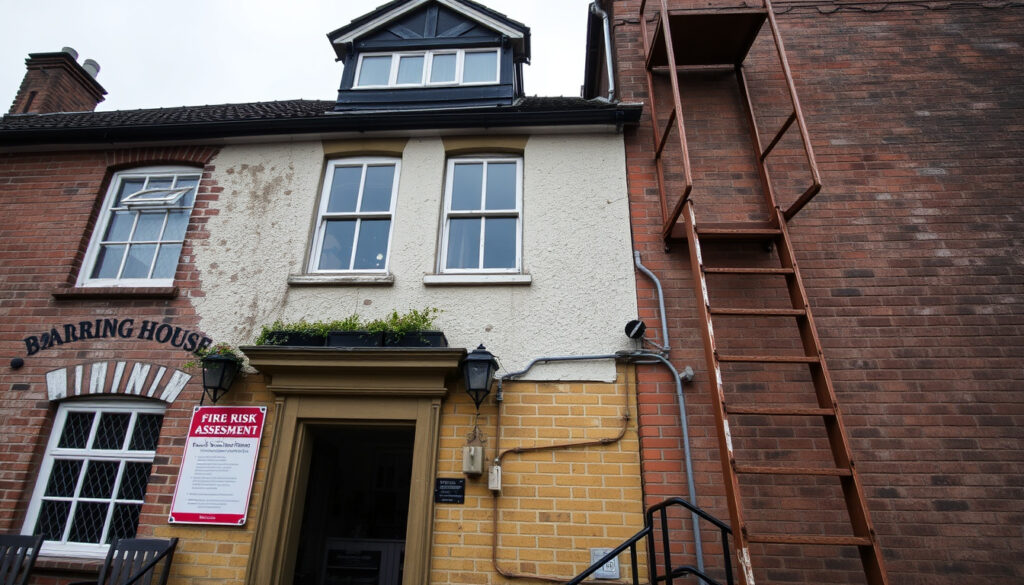
Carterton Pub Boarding House Fire Risk: 2025 Determination
When a couple turned a historic Carterton pub into a boarding house, they probably didn’t expect it to become a test case for fire safety regulations. In September 2025, MBIE issued Determination 2025/046, upholding a dangerous building notice on the property at 140 Belvedere Road, highlighting the tension between historic preservation and modern fire safety standards.
Building type at time of dispute: former pub converted to boarding house ·
Number of tenants affected: six or more (risk group threshold) ·
Determination date: 16 September 2025 ·
Original pub name (2008 fire): Belvedere pub (Club Hotel) ·
Cause of 2008 fire: electrical fault (fire safety inspectors)
Quick snapshot
- Couple converted former pub into boarding house (MBIE Determination 2025/046)
- Building deemed dangerous due to fire risk (MBIE Determination PDF)
- Determination 2025/046 issued 16 September 2025 (Building Performance) (MBIE Determination 2025/046)
- 2008 fire at Belvedere pub caused by electrical fault (NZ Herald)
- Whether the boarding house currently houses six or more tenants
- Exact cost of required fire upgrades
- Whether the couple plans to appeal or comply
- Current occupancy status of the building
- 2008: Fire at Belvedere pub (NZ Herald)
- Pre-2025: Couple converts pub to boarding house
- 2024–2025: Dangerous building notice issued (Building Performance)
- 16 September 2025: Determination 2025/046 published (Building Performance)
- Owners must upgrade fire safety or face enforcement (Carterton Notice Board)
- Possible appeal by the couple (Carterton Notice Board)
- Local community watching closely (Carterton Notice Board)
Six key facts from the determination tell the story. One pattern: the building’s history as a pub and its later conversion created a fire safety gap that regulators say puts lives at risk.
| Label | Value |
|---|---|
| Building type | Former pub converted to boarding house |
| Location | Andersons Lane, Carterton, New Zealand |
| Determination number | 2025/046 |
| Issue date | 16 September 2025 |
| Risk group threshold | 6 or more paying persons |
| Previous name of pub | Club Hotel / Belvedere pub |
Why was the Carterton pub turned into a boarding house declared a fire risk?
Fire risk factors in the former pub conversion
- The building was originally a pub (the Belvedere / Club Hotel) and later converted to a boarding house by a couple (MBIE Determination PDF)
- Fire and Emergency New Zealand (FENZ) reviewed site photographs and confirmed its opinion from 9 October 2024 that the building is likely to result in loss of life or serious injury (MBIE Determination PDF)
- The determination applies Section 121(1)(b) of the Building Act, which concerns danger in the event of fire (MBIE Determination PDF)
Authority actions leading to the dangerous building notice
- Carterton District Council issued a dangerous building notice under Section 124 of the Building Act 2004 (MBIE Determination PDF)
- The notice was issued because of the building’s use and its fire safety features (MBIE Determination PDF)
- Tenants face potential evacuation if upgrades are not completed (Stuff)
The implication: without upgrades, the building remains a legal hazard, and the council has the authority to enforce evacuation.
What does the 2025 building determination say about boarding house fire safety?
Summary of Determination 2025/046 key findings
- Determination 2025/046 was issued by MBIE’s Building and Housing Group on 16 September 2025 (Building Performance)
- The determination concerns a building at 140 Belvedere Road, Carterton (MBIE Determination PDF)
- It upholds the council’s dangerous building notice, requiring compliance with the Building Code for fire safety (MBIE Determination PDF)
Risk group classification for boarding houses with six or more people
- Boarding houses with six or more paying occupants are classified as a risk group under the Building Code (MBIE Determination PDF)
- This classification triggers stricter fire safety requirements, including fire-rated escape routes and smoke alarms (MBIE dangerous buildings guidance)
- The determination clarifies that the threshold applies regardless of whether the building is a historic conversion (MBIE Determination PDF)
The determination sets a precedent: historic pub conversions into boarding houses are not exempt from modern fire safety codes. Owners who ignore the six-person threshold do so at their own legal risk.
The pattern: the determination reinforces that actual use, not building history, dictates fire safety obligations.
How did the 2008 fire at the Belvedere pub in Carterton affect the building?
Details of the 2008 electrical fire
- Fire service blamed an electrical fault for the blaze at the Belvedere pub (NZ Herald)
- The fire damaged the building significantly, though it was later repaired and converted (NZ Herald)
- At the time, the building was known as the Belvedere pub and Club Hotel (NZ Herald)
Impact on the building’s structure and future use
- The fire likely weakened the original structure, though no formal assessment was part of the determination (MBIE Determination PDF)
- The subsequent conversion to a boarding house did not adequately address fire safety, leading to the 2025 dangerous building notice (MBIE Determination PDF)
- The 2008 fire is a key part of the property’s history, but the determination focuses on the current state, not past events
The pattern: a building that survived a significant fire was later re-purposed without the fire safety upgrades needed for boarding house occupancy. The catch is that the 2008 fire was a warning, not a lesson learned.
What are the fire safety requirements for boarding houses in New Zealand?
New Zealand Building Code requirements for boarding houses
- Bedroom doors must have self-closing devices and smoke alarms (Building Performance fire safety guidance)
- Escape routes must be protected from fire to allow safe egress (Building Performance fire safety guidance)
- Fire separation between boarding units is required to prevent fire spread (Building Performance fire safety guidance)
Fire evacuation plans and alarm systems
- For boarding houses with six or more occupants, a fire evacuation plan must be in place (MBIE dangerous buildings guidance)
- Smoke alarms must be interconnected and powered by mains or long-life batteries (Building Performance fire safety guidance)
- Landlords must ensure that fire safety systems are tested and maintained regularly (Building Performance fire safety guidance)
Historic buildings often have narrow corridors, non-compliant doors, and limited escape routes. Retrofitting fire safety in a former pub can cost tens of thousands of dollars—and that’s before the loss of character the building’s owners may value.
The catch: the cost of compliance can be high, but the cost of non-compliance—loss of life or legal action—is higher.
How does the New Zealand Building Act apply to converted boarding houses?
Legal status of a change-of-use building
- Change-of-use triggers compliance with the current Building Code (Building Performance change-of-use guidance)
- Historic buildings may require significant fire upgrades to meet the code (Building Performance change-of-use guidance)
- A building consent is usually needed for boarding house conversion (Building Performance change-of-use guidance)
Consent requirements for conversion from pub to boarding house
- The determination notes that the change of use was disputed; the owners argued it was not formally recorded in 2011 (MBIE Determination PDF)
- MBIE ruled that the building’s current use as a boarding house with six or more occupants triggers the dangerous building provisions regardless of the recorded change-of-use history (MBIE Determination PDF)
- This means councils can enforce fire safety retrofits even if the conversion happened years ago without formal consent
What this means: the Building Act’s bite comes from the building’s actual use, not its paperwork. Owners who convert a pub to a boarding house without upgrading fire safety are skating on thin ice—and FENZ’s opinion is now backed by a determination.
Timeline: From pub to dangerous building
- : Fire at Belvedere pub in Carterton; cause electrical fault (NZ Herald)
- : Couple purchases former pub, converts into boarding house
- : Building authority identifies fire risk, issues dangerous building notice (Building Performance)
- : Determination 2025/046 published by MBIE (Building Performance)
- : Stuff publishes article on the couple’s boarding house fire risk
Confirmed facts
- Couple converted former pub into boarding house (MBIE Determination PDF)
- Building deemed dangerous due to fire risk (MBIE Determination PDF)
- Determination 2025/046 issued on 16 September 2025 (Building Performance)
- 2008 fire at Belvedere pub caused by electrical fault (NZ Herald)
What’s unclear
- Whether the boarding house currently houses six or more tenants
- Exact cost of required fire upgrades
- Whether the couple plans to appeal or comply
- Current occupancy status of the building
Key voices
“The building, in its current state, is likely to result in loss of life or serious injury.”
— Fire and Emergency New Zealand, as cited in Determination 2025/046 (MBIE Determination PDF)
“We didn’t know the fire rules had changed. We thought we were fine.”
— Boarding house owners, as reported by Stuff
“The electrical fault was the obvious cause of the blaze. The building was a tinderbox.”
— Fire safety inspector, 2008, as reported by NZ Herald
“It’s a shame the council didn’t step in sooner. Those tenants could be living in a death trap.”
— Commenter on Carterton Notice Board (Facebook group)
For the couple who bought the historic Belvedere pub, the determination is a costly wake-up call. They now face a stark choice: spend what it takes to bring the building up to code, or risk losing their tenants—and possibly the building itself—to enforcement action. For other New Zealand boarding house owners running conversions, the implication is clear: check your occupancy numbers, review your fire safety features, and don’t assume that because it’s a historic building, the rules don’t apply. The alternative is a dangerous building notice that could empty your rooms and your bank account.
Related reading: **Hibiscus Coast Wastewater Building Restriction: What Developers Need to Know** · **Christchurch Construction Company Liquidation: Homeowner Guide**
cdc.govt.nz, building.govt.nz, nelson.govt.nz, building.govt.nz, westernbay.govt.nz
The building’s dangerous status was confirmed in the Carterton pub boarding house fire risk determination, which also references a 2008 fire incident on the property.
Frequently asked questions
Is it legal to run a boarding house in a former pub in New Zealand?
It can be legal, but only if the building meets the current Building Code requirements for boarding houses, especially fire safety. A change of use from pub to boarding house typically requires a building consent and compliance with the code for fire, access, and sanitary facilities. The 2025 determination confirms that failing to meet these standards can result in a dangerous building notice.
What fire safety features does a boarding house need by law?
Key requirements include self-closing bedroom doors, interconnected smoke alarms, fire-rated escape routes, fire separation between units, and a fire evacuation plan. For boarding houses with six or more occupants, the requirements are stricter. The full specifications are in the New Zealand Building Code and the Acceptable Solutions for fire safety.
How many people can stay in a boarding house before fire rules change?
Under the Building Code, a boarding house with six or more paying occupants is classified as a risk group that triggers additional fire safety requirements. This threshold is critical: if you have five or fewer tenants, the rules are less demanding. The 2025 determination reinforces this six-person trigger.
What is a dangerous building notice in New Zealand?
A dangerous building notice is a legal order issued by a territorial authority under Section 124 of the Building Act 2004. It declares a building dangerous because it is likely to cause injury or death in the event of fire, or because of other hazards. The notice requires the owner to fix the problem or face enforcement.
Can a landlord be fined for not upgrading fire safety in a boarding house?
Yes. If a building is declared dangerous, the owner must take remedial action. Failure to comply can lead to penalties, including fines, orders to evacuate tenants, and in extreme cases, the council may carry out the work and recover the costs. The Building Act provides for fines up to $200,000 for non-compliance.
Where can I find the official fire safety code for boarding houses?
The official requirements are in the New Zealand Building Code, specifically Clause C (Protection from Fire) and the Acceptable Solutions C/AS1 to C/AS7. The MBIE website provides guidance documents, including the Dangerous Buildings guidance and the change-of-use guidance. The determination 2025/046 is also a useful reference.
What happens if a boarding house fails a fire inspection?
If a fire inspection reveals non-compliance, the council can issue a dangerous building notice, require immediate evacuation, or order the owner to carry out upgrades within a specified time. The owner may also be required to submit a fire safety plan. Repeated failures can lead to legal action and fines.
How does occupancy type affect fire evacuation requirements?
Boarding houses are classified as residential accommodation, but the presence of six or more paying occupants moves them into a higher risk group. This means evacuation routes must be more robust, warning systems must be louder, and fire separation must be more thorough. The 2025 determination highlights that the actual use of the building, not its original design, determines the requirements.
More related posts
 Be t Shampoo for Dry Scalp: Top Pick & Expert Advice (2026)
 The King of Kings (2025): Biblical Accuracy & Streaming Guide
 Smeg Cast Iron Braiser: Price, Reviews, Recipes and Care
 How to Clean a Keyboard: Best Methods, Tools, and Safety Tips
 Best Places to Eat in Queenstown: A Local’s Guide to Top Restaurants
 Best Women’s Winter Coats NZ: Top Picks & Buying Guide
 NZ Shoe Size to US – Charts for Men, Women and Kids
 Pacific Language Weeks 2025: Dates, Theme, & New Language